
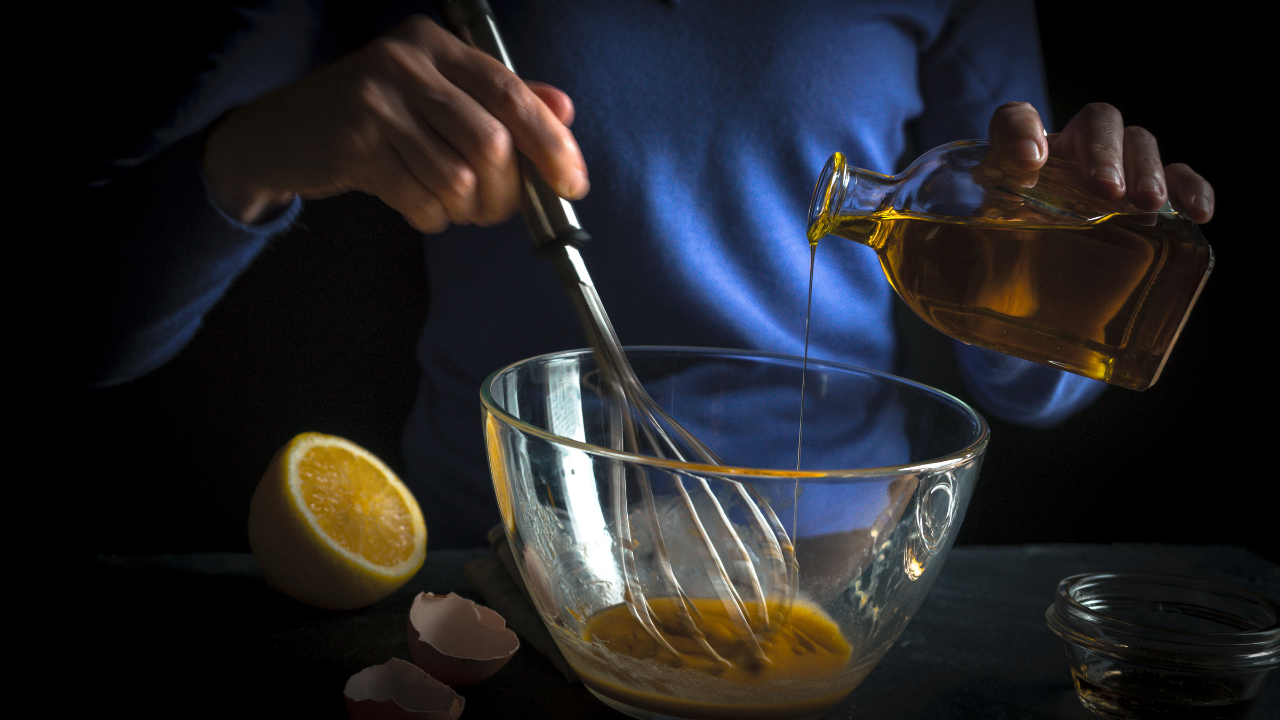
Emulsification Explained
Vinaigrettes may separate during storage. Mayonnaise can turn thin and greasy. Butter sauces may lose their gloss and divide into distinct layers.
Emulsification brings ingredients such as oil and water into a single, smooth mixture. It allows vinaigrettes to cling to greens, mayonnaise to hold its shape, and pan sauces to coat food rather than collect on the plate.
A sauce is not defined by flavor alone. Its structure affects how it moves, how evenly it distributes seasoning, and how it feels in the mouth.
When an emulsion forms properly, fat, acidity, salt, and aroma are evenly distributed throughout the food. When the structure weakens, one bite may taste oily, while another may taste overly sharp or watery.
Some emulsions need to remain combined only long enough for serving. Others must hold through resting, storage, or gentle heating. Understanding that difference helps you determine what a dressing or sauce needs, rather than relying solely on mixing time.
What an Emulsion Is and What Holds It Together
An emulsion is a mixture of two liquids that do not naturally remain combined, such as oil and water. When the liquids are mixed with sufficient force, one liquid is broken into small droplets and dispersed throughout the other.
The liquid divided into droplets is called the dispersed phase. The liquid surrounding those droplets is called the continuous phase.
In mayonnaise, oil forms the dispersed phase. The water contained in the egg yolk, vinegar, lemon juice, and other ingredients forms the continuous phase.
The size and distribution of the droplets determine how the mixture behaves. Small droplets spread evenly, creating a smooth, uniform texture. When those droplets begin joining together, they grow larger and eventually separate from the surrounding liquid.
An emulsifier helps keep the droplets apart. Egg yolk, mustard, garlic, dairy proteins, and finely suspended ingredients can interact with both fat and water, forming a protective layer around the droplets.
An emulsifier supports the structure, but it does not build the emulsion by itself. Whisking, blending, or shaking supplies the movement needed to divide the dispersed liquid into droplets.
This is why briefly stirring oil and vinegar together does not create a reliably stable mixture. The liquids may appear combined for a moment, but the large droplets reconnect quickly.
The foundational principle is straightforward. Smaller, evenly distributed droplets create a smoother and generally more stable emulsion.
How Emulsification Changes Texture, Flavor, and Stability
Emulsification changes how a dressing or sauce moves, coats food, carries flavor, and feels in the mouth.
As more droplets become suspended in the continuous phase, the mixture becomes more resistant to movement. This creates body and thickness without requiring starch or another traditional thickener.
Mayonnaise demonstrates this clearly. Its thickness is largely due to the high concentration of oil droplets packed closely within the surrounding water-based phase.
Droplet size also affects smoothness. Large droplets can feel oily and uneven on the palate. Smaller droplets are less noticeable and create a more unified mouthfeel.
A properly formed emulsion also distributes flavor more consistently. Fat carries many aromatic compounds, while the water-based phase may contain acidity, salt, sweetness, and other seasonings.
When both phases remain evenly dispersed, each bite receives a more balanced combination.
This is especially noticeable in vinaigrettes. A separated dressing may deliver mostly oil to one part of a salad and concentrated acid to another. An emulsified vinaigrette brings oil, acid, and seasoning together.
The same principle applies to sauces. An emulsified pan sauce clings to food. A broken sauce leaves a thin liquid underneath and a greasy layer on the surface.
A greasy, watery, or unevenly seasoned sauce often has a structural problem rather than only a seasoning problem. Texture, flavor distribution, and stability are closely connected.
Where Emulsions Appear Across Dressings, Sauces, and Condiments
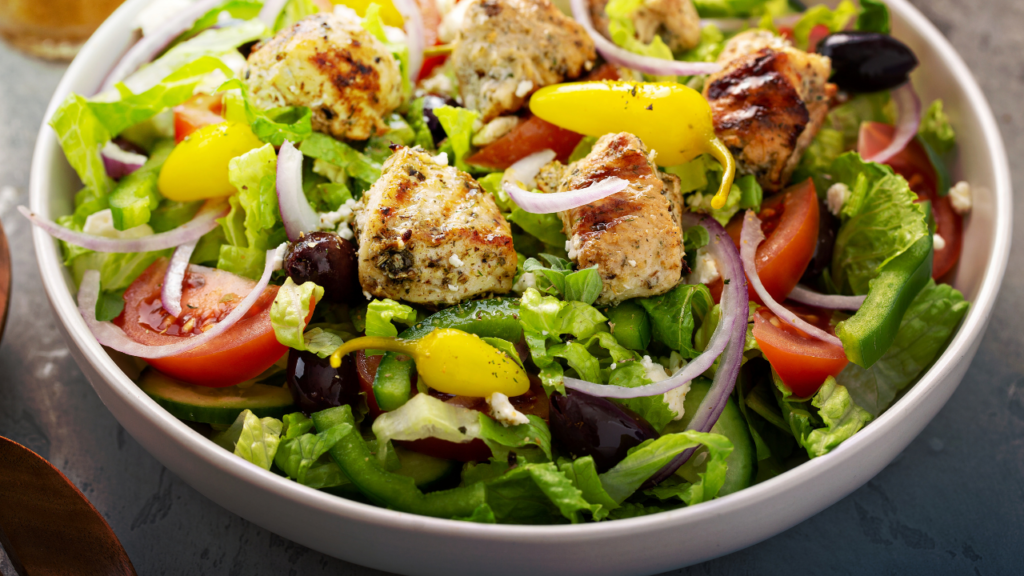
Recognizing where emulsions appear helps you understand the type of structure a preparation needs.
Cold Emulsions
- A basic vinaigrette is usually a temporary emulsion. Whisking or shaking distributes oil through vinegar or citrus juice long enough to coat and season the food.
- Mustard vinaigrettes and creamy dressings contain more structural support, which allows them to remain unified longer.
- Mayonnaise and aioli are thicker, more stable cold emulsions. Their texture comes from a high concentration of fine oil droplets supported by egg yolk, garlic, or both.
Warm Emulsions
- Hollandaise combines butter with a warm egg yolk and water-based phase.
- Beurre blanc suspends butterfat in a reduced, flavorful liquid.
- Butter-finished pan sauces use gradual incorporation to build gloss, light body, and a cohesive texture.
These sauces require closer temperature control because their structure can weaken as water evaporates, butterfat separates, or proteins tighten.
Ingredient-Based Emulsions
- Egg yolk supports mayonnaise, hollandaise, and creamy dressings.
- Mustard adds emulsifying support and body to vinaigrettes and pan sauces.
- Crushed garlic helps stabilize traditional aioli and related Mediterranean sauces.
- Tahini combines sesame fat and finely ground solids with water and acid.
- Yogurt, cream, and cultured dairy contribute fat, water, protein, and body.
These patterns appear across French, Mediterranean, Middle Eastern, and modern sauce traditions.
The ingredients change, but the purpose remains consistent. Fat and water must behave as one mixture long enough to coat food and distribute flavor evenly.
How to Read an Emulsion as You Build It
An emulsion gives visual and tactile signals as it develops. Learning to recognize those signals helps you adjust before the mixture fully separates.
Watch for sheen first. Separate streaks of oil begin to disappear, and the surface becomes more uniform and glossy.
Next, notice the body of the mixture. It should begin moving more slowly and offer greater resistance to a whisk, spoon, or blender.
Do not judge success by maximum thickness. A vinaigrette should remain looser than mayonnaise. The useful cue is a steady and controlled change in texture.
Coating ability provides another useful test. A well-formed dressing or sauce should spread evenly over food. It should cling long enough to deliver flavor without running away or leaving isolated oily patches.
Signs the Emulsion Is Developing Well
- Separate oil streaks disappear.
- The surface looks even and lightly glossy.
- The mixture gains controlled resistance.
- The texture remains consistent around the edges.
- The sauce coats food in an even layer.
Uniformity matters more than thickness alone. A properly formed emulsion should look consistent from the center of the bowl to the edges.
Signs the Emulsion Is Weakening
- Oil beads collect on the surface.
- Watery liquid appears around the edges.
- The mixture suddenly becomes thinner.
- The surface loses its uniform sheen.
- The sauce runs, pools, or leaves greasy patches.
When these warning signs appear, pause before adding more ingredients. Slow the addition, increase the agitation, check the temperature, or restore the balance between fat and continuous liquid.
Early instability is easier to correct than complete separation.
Why Emulsions Break and How to Correct Them
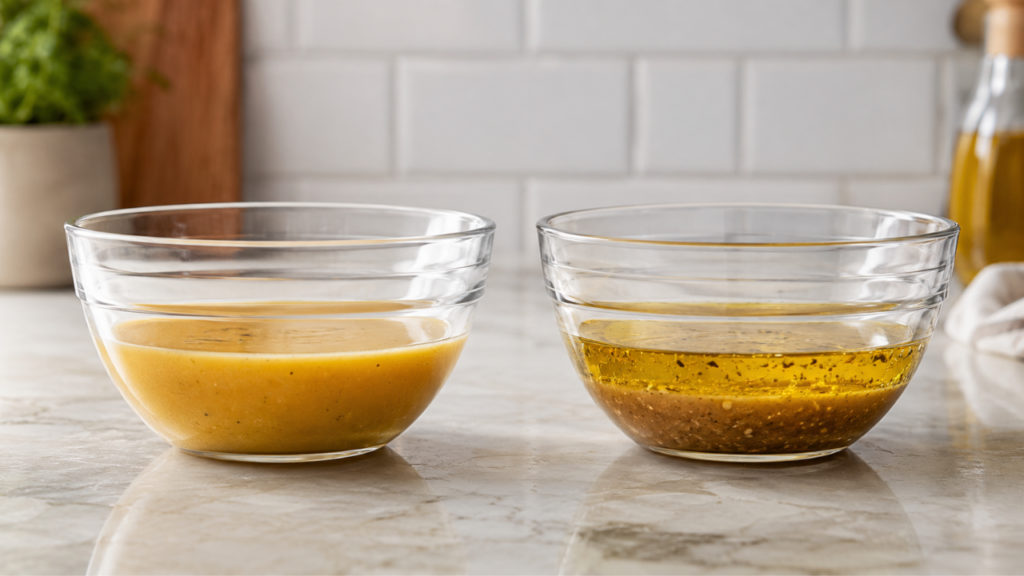
An emulsion breaks when the dispersed droplets begin joining together faster than the continuous phase can keep them apart.
The sauce may first lose its sheen or become unusually loose. As the droplets continue merging, the mixture can separate into distinct fat- and water-based layers.
The Fat Enters Too Quickly
An emulsion can accept only as much fat as its existing structure can divide and hold.
When oil or melted butter enters too quickly, large droplets reach the mixture before they can be broken apart. The sauce may stop thickening, develop oily streaks, or suddenly loosen.
Slow the addition and allow each portion to become fully incorporated before adding more.
The Mixture Receives Too Little Agitation
Whisking, shaking, and blending provide the force needed to divide fat into droplets.
Without enough movement, the droplets remain large and reconnect easily. The mixture may appear combined during mixing, then separate shortly after resting.
Match the level of agitation to the intended result. A temporary vinaigrette needs less structural development than mayonnaise.
The Temperature Moves Out of Range
- Temperature affects fat thickness, protein behavior, and the amount of water available to support the emulsion.
- Excessive heat can tighten egg or dairy proteins, evaporate water, and encourage butterfat to separate.
- Temperatures that are too low can solidify fat or create incompatibility between ingredients.
- Keep the ingredients fluid and compatible enough to combine without damaging the structure that supports them.
The Emulsion Reaches Its Structural Limit
Every emulsion needs enough continuous phase to surround its dispersed droplets.
As more fat enters, the droplets become increasingly crowded. The mixture may become very thick just before it breaks because the continuous phase can no longer support additional fat.
A small amount of compatible water-based liquid may restore sufficient continuous phase to maintain emulsion stability.
Thickness Is Mistaken for Stability
A sauce can be thick without being stable.
Chilled fat, starch, dairy solids, vegetable purée, and suspended particles can all contribute to thickness, while oil begins to collect around the edges.
Judge the sauce by uniformity, coating ability, and how it behaves after resting rather than by thickness alone.
Rebuilding a Broken Emulsion
Continuing to whisk a fully separated sauce rarely restores its original structure.
A more reliable correction is to begin with a fresh continuous phase. Depending on the sauce, this may be water, egg yolk, mustard, or another compatible ingredient.
Gradually incorporate the broken mixture into the fresh base. This allows the separated fat to be divided into droplets and suspended again.
Correct the temperature before rebuilding. Allow an overheated sauce to return to a suitable range. Gently warm partially solidified fat until it becomes fluid enough to disperse.
Troubleshooting Emulsions
| What you notice | Likely cause | What to do |
| Oil streaks appear while mixing | The fat is entering too quickly | Slow the addition and maintain steady agitation |
| The mixture separates after resting | The droplets are too large or poorly supported | Increase agitation or add emulsifying support |
| The sauce becomes grainy while heating | Egg or dairy proteins are overheating | Reduce the temperature before continuing |
| The sauce becomes greasy and thin | Fat is separating from the continuous phase | Restore water balance and correct the temperature |
| The mixture becomes unusually tight | There is too much fat or too little continuous liquid | Add a compatible water-based liquid gradually |
| A thick sauce develops oily edges | Thickness is masking instability | Check uniformity and ingredient balance |
The central correction is to restore control over the continuous phase and rebuild the emulsion gradually.
Temporary, Stable, and Heat-Sensitive Emulsions Compared
Judge an emulsion according to how it will be served, held, and heated.
A vinaigrette may need to remain combined only long enough to dress a salad. Mayonnaise must hold through resting and storage. A warm butter sauce needs to remain smooth within its serving range.
| Emulsion type | Structure | Examples | Expected stability | Warning signs |
| Temporary | Droplets briefly dispersed with limited structural support | Basic vinaigrette, oil and citrus dressing | Holds through mixing and immediate serving | Oil rising, liquid settling, larger droplets forming |
| More stable | Fine droplets supported by an emulsifier or suspended solids | Mayonnaise, aioli, creamy dressing, mustard vinaigrette | Holds through serving, resting, and refrigeration | Oil beads, watery edges, uneven texture, sudden thinning |
| Heat sensitive | Fat dispersed through a warm water-based phase | Hollandaise, beurre blanc, butter finished pan sauce | Holds while heat and moisture remain controlled | Greasiness, curdling, dullness, loss of body, fat pooling |
Greater stability does not automatically produce a better result. The correct structure is the one that performs the required job.
Adjusting for Ingredients and Temperature

- Thickened silicone protective cover, stop scratching your cookware : Walfos whisk is made of 1.65 mm reliable stainless …
- Ergonomically plastic handle, provides you with a comfortable grip : Walfos Silicone whisk set has a 5 inch long handle,…
- High performance,sturdy andsafe : Plastic whisks allows to withstand high heat resistant up to 480℉. Our non-stick whisk…
Different fats and supporting ingredients affect how an emulsion forms. Their thickness, water content, proteins, and suspended solids influence how they should be handled.
Thicker Oils
Some oils are naturally more viscous, while others thicken when chilled.
A thicker oil moves and disperses more slowly. It may require stronger agitation or more controlled incorporation to form fine droplets.
Cold oil can also make a mixture gain body before the droplet structure is fully developed. The sauce may appear stable while still containing poorly dispersed fat.
Keep the oil fluid enough to mix efficiently.
Melted Butter
Butter contains fat, water, and milk solids, so it behaves differently from pure oil.
Keep melted butter warm enough to incorporate, but not so hot that it overwhelms a delicate egg yolk or water-based phase.
Butter finished pan sauces often benefit from cooler butter and gentler heat. This allows the butter to melt gradually into the surrounding liquid rather than separating immediately into free fat.
Dairy
Dairy ingredients contain varying proportions of water, fat, proteins, and milk solids.
- Yogurt and cultured dairy add body and acidity to cold dressings.
- Cream is generally more heat-tolerant than lower-fat dairy because its higher fat content provides greater structural protection.
- Lower-fat dairy contains more water and less fat protection. It often requires gentler handling, especially when combined with acidic ingredients.
Choose the dairy according to the desired richness, body, and serving temperature of the sauce.
Nut and Seed Pastes
Tahini and nut butters contain fat and finely ground solids with limited available water.
When a small amount of water is first added, the paste may become noticeably thicker. This is often a normal structural change rather than a sign of failure.
As more water is incorporated, the mixture can loosen and become smooth.
The amount of liquid depends on the intended result. A dipping sauce needs more body than a sauce intended for drizzling or coating.
When Similar Temperatures Help
Ingredients often combine more predictably when their temperatures are reasonably close.
Very cold oil may be difficult to disperse. Hot butter can raise the temperature of egg yolk or dairy too quickly.
Room temperature ingredients are often useful for mayonnaise and creamy dressings because the fat remains fluid and the emulsifier is not exposed to a sudden temperature change.
This is not a universal requirement. Cooler butter is useful when finishing certain pan sauces because it controls how quickly the fat melts.
The practical goal is temperature compatibility rather than one fixed temperature.
Adjusting for the Intended Consistency
A successful emulsion is not defined by maximum thickness.
A vinaigrette should remain fluid enough to coat greens lightly. Mayonnaise needs enough body to hold its shape. Tahini sauce may need to be drizzled, spooned, or spread depending on how it will be served.
- If an emulsion is too thick, gradually add more continuous liquid.
- If it is too loose, increase agitation to create finer droplets or add more emulsifying support when appropriate.
The final judgment is functional. The sauce should remain unified and move, coat, and cling in a way that suits the food.
Emulsification: What to Remember
- An emulsion keeps liquids such as fat and water evenly dispersed even though they would normally separate.
- Smaller, evenly distributed droplets create a smoother texture, better coating, and more consistent flavor.
- Agitation creates the droplets. Controlled addition gives the continuous phase time to hold them.
- Temperature, available water, ingredient balance, and emulsifiers influence stability.
- A glossy, uniform surface usually signals good distribution. Oil beads, watery edges, or sudden thinning suggest instability.
- A broken emulsion can often be corrected by restoring the continuous phase and gradually rebuilding the structure.
Frequently Asked Questions About Emulsifying
Emulsification often raises practical questions because different sauces behave differently. These answers clarify the most common points of confusion and help you understand what happens when a dressing or sauce thickens, separates, or loses stability.
Why Do Oil and Vinegar Separate?
Vinegar is mostly water, and oil does not dissolve in water. Mixing divides one liquid into droplets, but those droplets reconnect without enough emulsifying support. This is normal in a basic vinaigrette. Shaking or whisking restores the temporary emulsion before serving.
What Makes Mustard an Effective Emulsifier?
Mustard contains compounds and fine particles that help surround oil droplets and slow their movement toward one another. It also adds body to the continuous phase, helping a dressing or sauce remain unified longer.
Why Does Mayonnaise Become Thick?
Mayonnaise contains a high concentration of small oil droplets packed closely within a water-based phase. As those droplets become crowded, they restrict one another’s movement and create a thick texture. Egg yolk helps prevent them from merging again.
Can an Immersion Blender Repair a Broken Emulsion?
An immersion blender can help because it creates strong, concentrated agitation and divides separated fat into smaller droplets. It works most reliably after the temperature and ingredient balance have been corrected and the broken sauce is gradually incorporated into a fresh continuous phase.
Why Does Hollandaise Separate When It Becomes Too Hot?
Excessive heat can tighten egg proteins until they curdle, rather than supporting the butterfat. Heat may also evaporate too much water. The sauce can become grainy, greasy, or visibly separated as the continuous phase weakens.
Does Every Vinaigrette Need to Remain Emulsified?
No. Many vinaigrettes need to remain combined only long enough to coat and season the food. A more stable vinaigrette is useful when the dressing must rest longer or cling more firmly, but permanent stability is not always necessary.
Can an Emulsion Look Smooth but Still Be Unstable?
Yes. A mixture may look smooth immediately after blending but still contain droplets that are too large or poorly supported. Its stability becomes clearer after it has rested, warmed, or been applied to food.
Kitchen Tools That Support This Concept


Emulsification depends more on technique than on specialized equipment. The right tool helps create smaller droplets, maintain steady movement, and make changes in texture easier to observe.
Whisk
A whisk provides direct control over agitation and the speed of addition. Its wires repeatedly move through the mixture, dividing the dispersed liquid into droplets while allowing you to observe changes in sheen, thickness, and resistance.
Match the whisk to the amount being prepared. A whisk that is too large may move a small mixture around the bowl without working through it efficiently.
Whisking is especially useful when temperature and gradual incorporation require close attention.
Immersion Blender
An immersion blender creates fast, concentrated agitation. It can produce smooth mayonnaise, creamy dressings, and blended vinaigrettes.
Keep the blender head fully submerged so the blade remains in contact with the mixture rather than drawing in excess air. Check the consistency frequently because the mixture can thicken quickly.
An immersion blender can help repair a broken emulsion, but it cannot correct excessive heat or poor ingredient balance on its own.
Narrow Mixing Container
A narrow container keeps the ingredients concentrated around the whisk or blender.
For an immersion blender, choose a container only slightly wider than the blender head. This allows the blade to circulate the mixture through a compact area.
A rounded bowl is often more suitable for hand whisking because it allows continuous movement without trapping ingredients in corners.
The container should support the method. Narrow vessels concentrate blending force. Rounded bowls support whisk movement. A stable base helps maintain control.
Building Confidence With Emulsified Sauces
The most useful habit is to observe the sauce as it develops.
Notice when separate streaks disappear, when the surface becomes even, and when the mixture begins coating food consistently. These changes show that the liquids are forming a unified structure.
When oil beads, watery edges appear, or the coating is uneven, pause and respond. Slow the addition, adjust the agitation, check the temperature, or restore the liquid’s balance.
Emulsification becomes more reliable when you learn to recognize these signals early. Watch the surface, feel the resistance, and let the intended consistency guide your next decision.
Explore more Kitchen Know How articles to continue building your understanding of fat, acidity, heat, and sauce structure.