
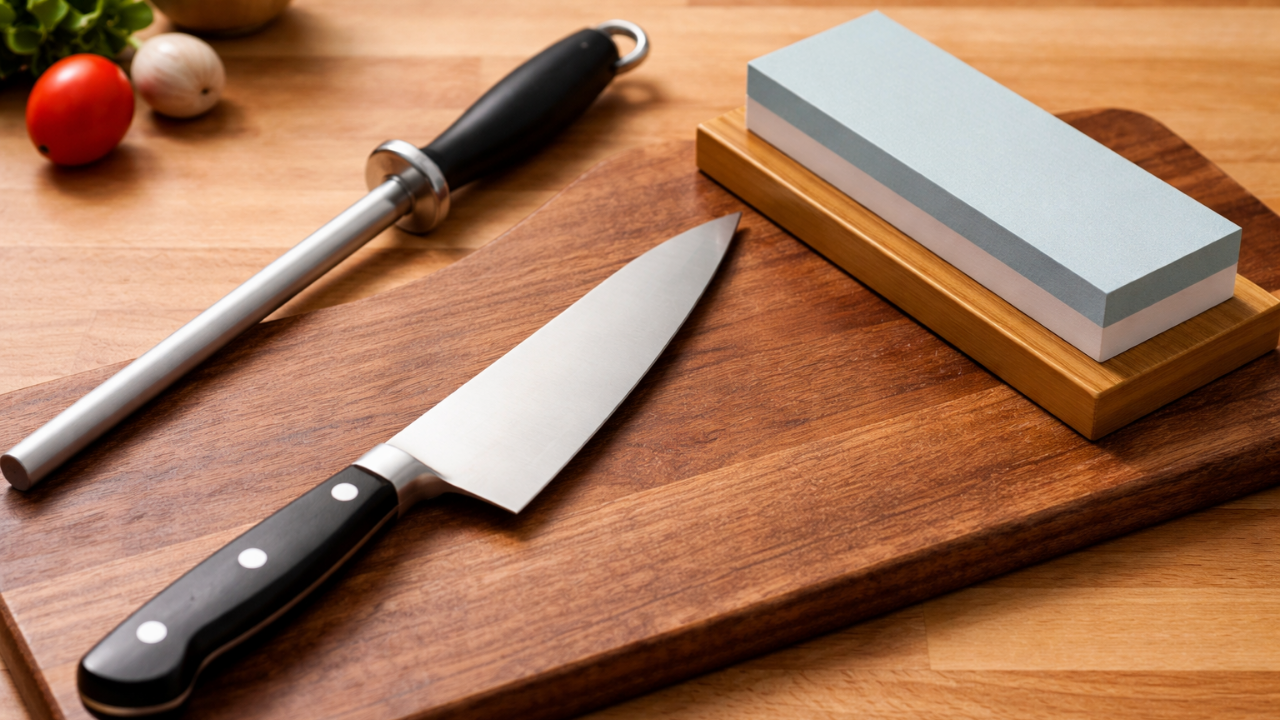
A knife that cuts cleanly changes the entire feel of prep. It gives you better control, cleaner slices, and a steadier rhythm at the board. When the edge is not in good condition, even simple cutting becomes awkward. You use more force, ingredients tear rather than slice, and the work becomes less precise.
This is why sharpening and honing matter. Although these terms are often treated as if they mean the same thing, they serve distinct purposes. One restores the edge, while the other maintains it between sharpenings. Understanding the difference helps home cooks take better care of their knives and make informed decisions about each blade’s needs.
You encounter this every time a knife struggles to pass through an onion, slips on tomato skin, or crushes herbs instead of slicing them cleanly. These are not just signs of inconvenience, but indications that the knife is no longer functioning properly.
Understanding how sharpening and honing work makes knife care easier to judge. This knowledge allows you to stop guessing and start responding to the knife’s behavior during prep.
Sharpening and Honing Are Not the Same Thing
Sharpening and honing are often grouped together, but they have different roles. Recognizing this distinction makes knife care easier to manage.
Sharpening removes a small amount of metal from the blade to recreate the cutting edge. Over time, regular use wears that edge down. As it becomes rounded and less effective, the knife starts to drag, slip, or crush food instead of cutting cleanly. Sharpening corrects that by rebuilding the edge itself.
Honing does something different. It does not rebuild the edge by removing significant metal. Instead, it helps realign the fine edge of the blade after it has shifted slightly during normal use. Even a knife that is not fully dull can begin to feel less precise if that edge has moved out of alignment. Honing helps bring it back into line, so the knife cuts more cleanly again.
This is why honing is a form of maintenance, not a substitute for sharpening. While honing can improve a knife when the edge is still in good condition, once the edge has worn down too far, honing will no longer be effective. At that point, the knife needs sharpening.
It helps to understand that these two tasks happen on different timelines: honing, a routine upkeep, is done more regularly, while sharpening, a more corrective process, occurs less often. When home cooks confuse the two, they often continue sharpening a knife that is too dull, leading to frustration.
A simple way to separate these terms is to look at what each actually does. This approach helps clarify when to use either sharpening or honing.
| Honing | Realigns the edge during regular use | When the knife feels slightly less precise but still cuts | It does not rebuild a worn edge |
| Sharpening | Removes metal to rebuild the edge | When the knife stays dull even after honing | It does not need to happen as often |
A Well Kept Edge Improves Precision, Speed, and Control
A well-maintained knife changes prep almost immediately: cuts are cleaner, movement is more controlled, and the work requires less effort. This matters beyond convenience, as knife performance influences accuracy, consistency, and ingredient condition.
When the edge is in good shape, the blade moves through food with less resistance. That makes it easier to slice herbs cleanly, cut onions evenly, and portion vegetables with better control. You do not need to force the knife through the ingredient, which helps the hand stay steady, and the motion stay deliberate. In practical terms, that often means faster prep and more reliable results.
A neglected edge has the opposite effect. Rather than cutting cleanly, the knife drags, slips, or crushes. Soft items can collapse under pressure, herbs may bruise, and onion layers can tear rather than separate cleanly. Even if the knife seems usable, extra force often reduces precision and increases fatigue.
This is also where confidence begins to change. A sharp, properly maintained knife gives clearer feedback. It responds more predictably, allowing the cook to focus on the task rather than fighting the tool. A dull or poorly maintained knife creates hesitation. It makes the cook work harder to stay accurate, and that usually leads to slower, less consistent prep.
Recognizing this practical impact moves knife care beyond routine maintenance. It becomes not just about preserving the tool, but about improving your work every time the knife touches the board.
Where Edge Maintenance Shows Up Across Everyday Prep
Edge maintenance is not something that only matters in professional kitchens or specialty knife work. It shows up in everyday prep tasks, often in ways home cooks notice without immediately knowing why. The condition of the edge affects how the knife moves, how the ingredient responds, and how much control the cook has from one cut to the next.
You see this clearly when working with ingredients that need a clean, controlled cut. Herbs are a simple example. A well-maintained edge slices through them neatly, while a neglected edge tends to crush or bruise them. The same is true with onions: a clean edge helps the knife pass through the layers more smoothly, preventing it from slipping on the surface or tearing the structure apart. Tomatoes, citrus, soft fruit, and delicate greens all make edge conditions easier to notice because they respond quickly to pressure and resistance.
This also becomes more visible when prep involves repetition. Cutting several vegetables for a soup, slicing cabbage for slaw, trimming raw meat, or portioning ingredients for a stir fry all place repeated demands on the knife. When the edge is aligned and properly maintained, the work stays steadier and more efficient. When it is not, the decline becomes obvious. The cuts become less clean, the pace slows down, and more effort is required to do the same job.
Different cooking contexts also make edge maintenance easier to recognize. Fine knife work, such as thin slicing, small dice, or precise garnish cuts, depends on a blade that responds accurately. But even less delicate prep, such as chopping root vegetables or breaking down larger produce, still benefits from a knife that cuts predictably. In both cases, the cook is relying on the same basic thing: an edge that can enter the ingredient cleanly without excessive force.
This is why edge care matters across cuisines and cooking styles. It is not tied to a specific dish or skill level. Whether you are preparing aromatics for a sauce, slicing vegetables for a salad, or cutting proteins for a weeknight meal, the knife’s edge is part of what makes that work unfold smoothly. Once you begin to notice where clean cutting matters, it becomes easier to see that sharpening and honing are not separate from cooking. They support the quality of prep that underlies cooking.
How to Read the Knife While You Work
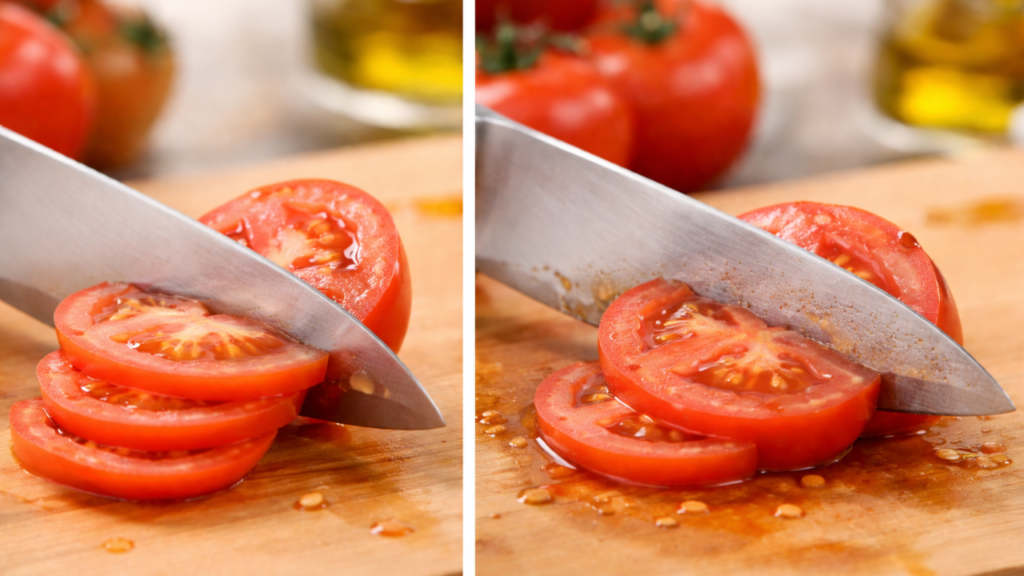
One of the most useful parts of understanding sharpening and honing is learning to notice what the knife is telling you during prep. A knife does not need to look obviously damaged to perform poorly. In most home kitchens, the first signs appear in the way the blade feels and how the food responds.
A knife that is working well should move through ingredients with a sense of control and predictability. The blade should enter the food without excessive pressure, and the cut should follow the path you intend. When that starts to change, it is usually a sign that the edge needs attention.
Common signs your knife needs attention:
- The blade drags through food.
- The knife slips on onion skin or tomato skin.
- Herbs bruise instead of slicing cleanly.
- Soft produce crushes under pressure.
- You need more force than usual to finish the cut.
One common signal is drag. If the knife begins to feel as though it is resisting the cut more than usual, the edge may no longer be aligned cleanly. You may also notice slipping, especially on smooth or tight surfaces such as onion, tomato, or pepper skin. Instead of biting into the ingredient, the blade skates slightly before cutting. That is often one of the first signs that performance has started to decline.
Tearing and crushing are also important cues. Fresh herbs may bruise rather than slice cleanly. Soft produce may collapse under the blade. Onion layers may split unevenly rather than cleanly separating. These signs matter because they show that the knife is no longer working with the ingredient cleanly. The blade is creating pressure before it creates a proper cut.
It also helps to notice how much force you are using. If you find yourself pressing harder than usual, adjusting your grip to compensate, or feeling the need to saw back and forth through foods that should cut more smoothly, the knife is no longer performing as it should. In many cases, this is where home cooks adapt to the problem instead of correcting it. They push harder, slow down, or accept messy cuts as normal. That habit makes the issue harder to recognize over time.
The next step is choosing the right response. If the knife has simply started to feel less crisp but still cuts reasonably well, honing may help restore better alignment. If honing no longer improves the feel of the cut, or if the blade continues to drag, slip, or crush after honing, the knife likely needs sharpening. The key is not to guess based solely on routine. It is to respond to the actual behavior of the knife.
This kind of awareness makes knife care much more practical. Instead of waiting until the blade feels completely dull, you begin to read smaller changes in performance and act earlier. That leads to better cutting, less frustration, and a clearer sense of when your knife needs maintenance.
The Most Common Problems Home Cooks Run Into with Knife Care
Many knife-care problems begin with a simple misunderstanding: home cooks often treat sharpening and honing as if they were the same thing. Once that confusion sets in, it becomes harder to tell what the knife actually needs. A dull blade may be honed repeatedly without improving. A knife that only needs minor edge maintenance may be overcorrected with the wrong tool. In both cases, the result is frustration and inconsistent performance.
Common knife care mistakes include:
- Using a honing rod as if it were sharpening the knife.
- Waiting too long to address a worn edge.
- Depending too heavily on pull-through sharpeners.
- Sharpening with poor angle control.
- Overlooking the effect of cutting boards and storage.
One of the most common misconceptions is that a honing rod sharpens the knife. It can improve the feel of the edge when the knife has started to drift slightly out of alignment, but it does not rebuild a worn edge as sharpening does. This is why some cooks keep reaching for the honing rod even when the knife still drags, slips, or crushes food. The knife feels better for only a moment, or not at all, because the actual problem is edge wear, not alignment.
Another frequent issue is waiting too long to do anything. Many home cooks do not think about knife maintenance until the blade feels obviously dull. By that point, the signs have usually been present for a while. The knife may already be tearing herbs, slipping on tomato skin, or requiring extra force during basic prep. When edge care is delayed too long, the correction becomes more noticeable, and the knife becomes harder to trust in the meantime.
Tool choice also causes problems. Pull-through sharpeners are popular because they feel quick and convenient, but they often encourage a rougher approach to edge maintenance. In many cases, they remove metal aggressively and with less control than a whetstone or a well-handled professional sharpening service. That does not mean every home cook must sharpen on stones, but it does mean convenience tools should be understood for what they are. They are not always the best path to a well-maintained edge.
Technique matters too. Poor angle control, inconsistent pressure, and rushed sharpening habits can all lead to uneven results. Even when the right tool is used, careless handling can leave the knife performing worse rather than better. This is especially common when someone tries to sharpen without understanding whether the goal is light maintenance or actual edge repair. Knife care works best when the correction matches the blade’s condition.
There is also a tendency to blame the knife too quickly without looking at the full setup. A good knife can lose its edge faster when it is used on hard cutting surfaces, stored loosely, or left wet after washing. In that case, the issue is not only sharpening frequency. It is the overall treatment of the knife between uses. Edge maintenance is easier and more effective when the rest of the handling habits support it.
The useful correction in all of this is not complexity. It is clarity. Know whether the knife needs alignment or edge rebuilding. Notice the signs earlier. Use tools that match the task. Treat knife care as part of cooking, not as a separate problem you only address once the blade becomes frustrating to use. That shift makes maintenance easier to judge and much easier to keep up with.
A Clear Comparison Between Honing Rods, Whetstones, and Pull-Through Tools
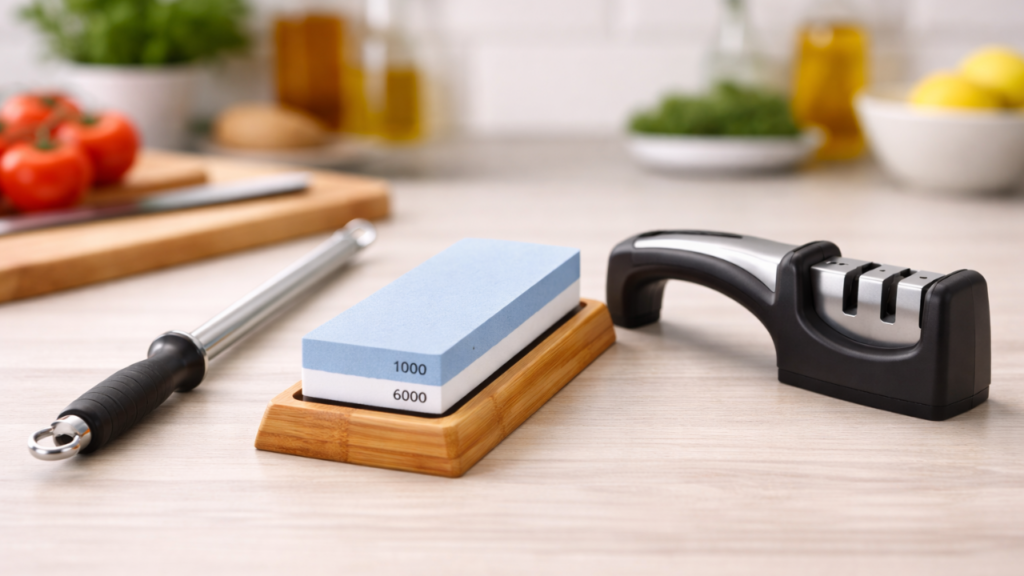
Not every knife tool does the same job, and much of the confusion around knife care comes from using one tool while expecting the result of another. Honing rods, whetstones, and pull-through sharpeners are often grouped together because they all relate to edge maintenance, but they serve different purposes and offer different levels of control.
These tools support knife care in different ways, so it helps to compare their roles directly.
| Honing rod | Edge maintenance | Routine upkeep between sharpenings | Cannot fix a truly dull knife |
| Whetstone | True sharpening | Rebuilding and refining the edge | Requires practice and control |
| Pull through sharpener | Convenience sharpening | Quick improvement for home use | Less precise and can remove metal aggressively |
A honing rod is meant for edge maintenance, not true sharpening in the full corrective sense. Its main job is to help realign the fine edge of the blade after regular use. When a knife has started to feel slightly less clean in the cut, but the edge itself is not yet badly worn down, honing can help restore better performance. This is why a honing rod is useful as a regular upkeep tool. It supports a knife that is still in reasonably good condition, but it will not fully restore a blade whose edge has already worn away.
A whetstone does more than maintain alignment. It sharpens by removing metal in a controlled way so the edge can be rebuilt and refined. This is what makes it the most complete of the three sharpening tools. It can correct a knife that has become truly dull, and it allows more control over the edge than most convenience tools. It also requires more user attention. Angle, pressure, and consistency all matter. For that reason, a whetstone is often the best option for long-term edge quality, but it requires practice and patience to use well.
Pull-through sharpeners sit in a more convenient category. They are designed to simplify sharpening by guiding the blade through a fixed slot. That makes them appealing to home cooks who want a quick solution, but the tradeoff is reduced control. Because the angle and abrasive action are built into the tool, the process is faster but often less precise. Some pull-through sharpeners can restore a very dull knife to a more usable condition, but they do not usually offer the same refinement or edge quality that a whetstone can provide. They can also remove metal more aggressively than expected, especially when used too often.
This distinction matters because each tool fits a different need. A honing rod helps maintain an edge that still has life. A whetstone rebuilds and improves an edge with greater control. A pull-through sharpener prioritizes convenience, often at the expense of precision. When home cooks understand these roles clearly, they can stop expecting one tool to solve every problem.
It also helps to think in terms of maintenance, correction, and convenience. Honing rods belong to maintenance. Whetstones belong to correction and refinement. Pull-through tools belong to convenience. None of these categories is inherently wrong, but they do produce different results. The important thing is to match the tool to the knife’s condition and the level of control you want over the result.
When the Usual Rule Changes Slightly
The core idea behind knife maintenance stays the same across most kitchens. Honing helps maintain an edge in workable condition, and sharpening restores an edge that has worn down. What changes slightly is how often each step is useful and how the knife responds, depending on the blade and its use.
One reason for this is that not all knives are made from the same type of steel. Some knives, especially many Western-style kitchen knives, are made from softer steel. These blades tend to lose their ideal edge alignment a little more easily during regular use, which means honing can play a more frequent role in keeping them cutting well between sharpenings.
Many Japanese-style knives, by contrast, are made from harder steel and are often sharpened to a finer angle. These knives can hold their edge longer in some situations, but they may not respond to frequent rod honing in the same way. In those cases, sharpening method and edge care need to be approached with a little more restraint and awareness.
Use patterns also matter. A knife used every day on dense vegetables, herbs, proteins, and repetitive prep tasks will need attention sooner than a knife used occasionally for lighter work. The cutting surface matters as well. A knife used on wood or softer synthetic boards will generally hold its edge better than one used on harder, less forgiving surfaces.
Storage habits also influence how long the edge stays in good condition. A well-sharpened knife can lose performance more quickly if it is knocked against other tools in a drawer or handled carelessly between uses.
This is why maintenance frequency cannot be reduced to a single fixed rule. Some home cooks ask how often they should hone or sharpen, as though there is a single timeline that applies to every knife. In practice, the better question is how the knife is behaving. A heavily used knife may need more regular upkeep. A lightly used knife may go much longer between sharpenings. A softer blade may benefit from more routine honing, while a harder blade may require a different approach, depending on its construction and edge style.
Even with these variations, the principle remains simple. The knife still needs to be observed, not managed by habit alone. If the edge has drifted but is still fundamentally sound, honing may help. If the edge has worn down and cutting quality does not improve, sharpening is the real correction. The material, style, and use of the knife may change the pace of maintenance, but they do not change the basic logic behind it.
That is a useful judgment call. Adjust the knife’s frequency and the work, but keep the distinction between honing and sharpening clear. Once that stays in place, the exceptions become manageable rather than confusing.
A Simple Way to Decide What the Knife Needs
A simple decision guide can make knife maintenance easier to judge during everyday prep.
| What you notice | What it likely means | What to do |
|---|---|---|
| The knife feels slightly less clean in the cut but still works reasonably well | The edge may be slightly out of alignment | Try honing first |
| The knife continues to drag, slip, or crush food after honing | The edge has likely worn down | Sharpen the knife |
| The knife seems to lose performance quickly | The issue may involve more than the edge alone | The knife feels slightly less clean in the cut, but still works reasonably well |
Quick Takeaways
- Honing helps maintain an edge in good condition.
- Sharpening rebuilds an edge that has worn down.
- A knife that drags, slips, or crushes food needs attention.
- Honing cannot fix a truly dull knife.
- Better edge maintenance improves control, safety, and cut quality.
FAQs About Sharpening and Honing Knives
Even after the main distinction is clear, a few practical questions usually remain. These quick answers help make sharpening and honing easier to judge in everyday kitchen use.
How often should I hone my kitchen knife?
That depends on the knife, the steel, and how often you use it. In a home kitchen, honing is usually done as needed when the knife starts to feel slightly less clean or responsive in the cut. It is not something that must follow a fixed schedule. The better guide is how the blade behaves during prep.
How often should I sharpen my kitchen knife?
Sharpening happens less often than honing because it rebuilds the edge rather than simply maintaining it. A heavily used knife may need sharpening more regularly than a lightly used one. What matters most is whether the knife continues to drag, slip, or crush food even after honing. That is usually the clearer sign that sharpening is needed.
Can a honing rod sharpen a dull knife?
Not in the full sense. A honing rod helps realign an edge that has drifted during use, but it does not rebuild an edge that has worn down. If the knife is truly dull, honing may improve the feel only slightly or not at all. In that case, the knife needs sharpening.
Are whetstones better than pull-through sharpeners?
A whetstone usually offers more control and can produce a better edge, but it also requires more skill and patience. A pull-through sharpener is more convenient, though often less precise. The difference is not only about quality. It is also about how much control you want over the result and how willing you are to learn the tool.
How do I know when my knife needs sharpening instead of honing?
If the knife feels slightly off but still cuts reasonably well, honing may help. If it continues to drag, slip, tear, or crush food after honing, the edge has likely worn down too far and needs sharpening. The knife’s behavior during prep is usually the best guide.
Does knife steel change how I should maintain the edge?
Yes, to a degree. Softer knives often respond well to more regular honing, while harder knives may hold their edge longer but require a more careful sharpening approach. The maintenance rhythm may change, but the core principle stays the same. Honing maintains an edge that is still workable, and sharpening restores one that is worn down.
Related Kitchen Know How Articles
This topic connects naturally to a few other areas of kitchen judgment and prep technique. Good follow-up articles for this post could include:
- Choosing the Right Knife: Chef’s vs Paring vs Serrated
- Cutting Boards Explained: Wood vs Plastic vs Bamboo
- Onion Julienne and Brunoise Demonstration
Kitchen Tools That Support Better Knife Maintenance
The right tools make knife maintenance easier to understand and easier to do well. For this topic, the goal is not to list every available sharpening product. It is to focus on the few tools that directly support better edge care, better judgment, and better long-term knife performance.
Honing Rod

- KEEP YOUR KNIVES SHARP – The Cutluxe Artisan Series 10-Inch honing rod is used to hone and realign your knife edge quick…
- EXCEPTIONAL QUALITY – Constructed with a non-slip PakkaWood ergonomic handle that fits right-handed or left-handed users…
- LONGER LENGTH – With 10” of length, this honing rod ensures that whatever the size or type of your knife, honing it will…
A honing rod supports routine edge maintenance between sharpenings. Its role is to help realign the fine edge of the blade after regular use so the knife continues to cut more cleanly. This makes it useful for everyday upkeep, especially when the knife has started to feel slightly less precise but is not yet truly dull.
What matters here is understanding its purpose clearly. A honing rod helps maintain an edge that remains workable. It does not replace sharpening. Used correctly, it helps extend the time between sharpenings and makes daily prep feel more controlled.
Whetstone
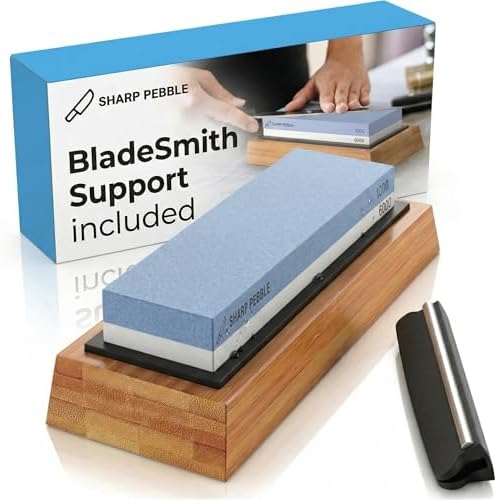
- WHETSTONE KNIFE SHARPENER — NO SKILL, NO GUESSWORK Most people avoid whetstones because holding the correct angle is int…
- SHARP PEBBLE TECH — STAYS FLAT 3X LONGER THAN CHEAP STONES Bargain whetstones dish, crack, and leave rough inconsistent …
- COMPLETE KNIFE SHARPENING KIT — Dual-grit whetstone, bamboo base, angle guide, instruction manual, tips & tricks ebook a…
A whetstone is the tool that supports actual sharpening. It removes metal in a controlled way so the edge can be rebuilt and refined when the knife has worn down. This makes it one of the most useful tools for long-term knife care because it addresses the edge’s true geometry rather than just its alignment.
It also supports understanding. Using a whetstone makes the distinction between maintenance and correction clearer than most convenience tools. Even if a home cook eventually chooses professional sharpening instead, knowing what the whetstone does helps make knife care less mysterious.
Proper Cutting Board

- Exceptional Non-Slip Design and Superior Craftsmanship:Our FSC-certificated teak wood cutting board set comes with a non…
- Multi-Sized for Versatile Use:This set includes three different sizes (10inch, 13inch, 17inch) of teak wood cutting boar…
- Durable Teak Wood Construction:These teak wood boards are highly durable. Teak, a tropical wood, has superior moisture e…
A cutting board may not seem like a knife maintenance tool at first, but it has a direct effect on how long the edge stays in good condition. A board that is too hard is harder on the knife, which can wear the edge down more quickly. A more forgiving board helps protect the edge during daily prep and supports more consistent performance over time.
This is why knife maintenance is not only about sharpening tools. It is also about the surfaces the knife comes into contact with every day. A good cutting board helps preserve the results of sharpening and honing, which makes it an important part of the overall setup.
Better Knife Care Leads to Better Prep
Sharpening and honing become much easier to manage once their roles are clear. Honing helps maintain an edge that remains workable. Sharpening restores an edge that has worn down and no longer responds well to maintenance alone. That distinction is what gives knife care its logic.
This matters because edge maintenance is not separate from cooking. It affects how the knife moves through ingredients, how much control you have during prep, and how reliably your cuts hold their shape. A well-maintained edge makes the work cleaner, steadier, and easier to trust.
The most useful next step is simple. Start paying closer attention to how your knife behaves while you work. Notice when it begins to drag, slip, or require more force than it should. Those small signals will usually tell you more than habit or guesswork.
Explore related Kitchen Know How articles to keep building confidence at the board, or join the Kitchen Know How mailing list for more practical kitchen guidance.