
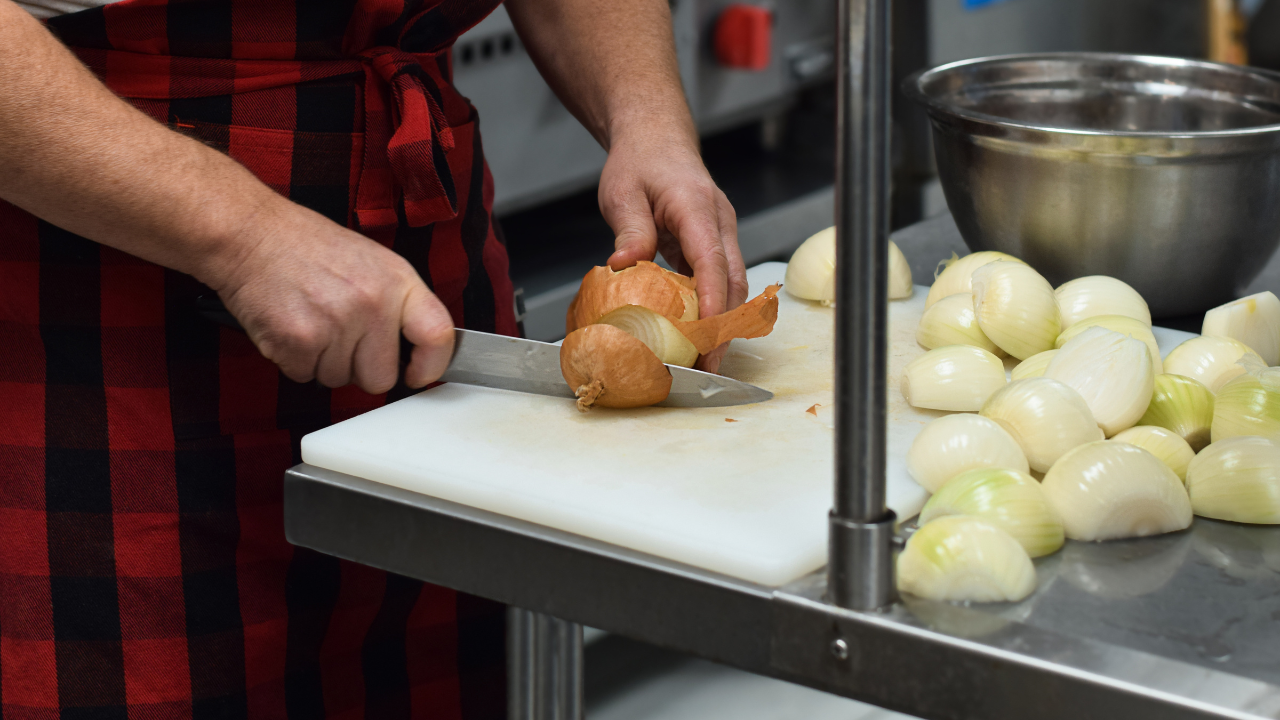
Rough chopping onions is often treated as a shortcut — something done quickly before cooking begins. In professional kitchens, it serves a different purpose. This technique involves preparing onions with intention, choosing a size range that supports how they will behave when heated.
The focus here is refinement—understanding when precision helps and when restraint yields better results. A controlled rough chop allows onions to soften gradually, release moisture at the right pace, and develop flavor without collapsing too early in the pan.
When onions are cut too small or handled too aggressively, they begin to break down before browning can occur. Excess moisture builds, heat drops, and texture is lost before flavor has time to develop. These issues often arise during cooking, but they begin much earlier—at the cutting board.
Professional cooks make prep decisions based on outcome, not appearance. Rough-chopping onions with intention preserves their structure long enough to support sautéing, braising, and long-cooked preparations. The goal is not uniformity but control, ensuring the ingredient performs correctly when heated.
Watch: Chef Mark Sandoval Demonstrates Rough Chopping Onions
In this video, Chef Mark walks through the rough chop, emphasizing control over speed. The demonstration highlights how small choices at the cutting board influence moisture release, structure, and overall behavior once the onions hit the pan.
Pay attention to the size range of the pieces, the knife’s rhythm, and how pressure is applied throughout the cut. These details determine whether onions soften gradually or begin to break down before browning has a chance to develop.
The goal is not uniform shape, but consistent performance, preparing the onions so they respond predictably to heat during cooking.
What You’ll Learn
- How rough chop differs from careless cutting
- What size tolerance actually means for onions
- Visual cues that indicate proper prep before cooking
- How the onion structure affects moisture release and browning
Ingredient Overview
This technique relies on firm and structurally sound onions. A fresh onion should feel dense in the hand, with tight layers and no soft spots. Firmness matters because it determines how well the onion holds its shape during prep and how gradually it releases moisture once heat is applied.
Overly soft or aging onions behave differently in the pan. Their cell structure breaks down more readily, causing excess moisture to be released early in the cook. This lowers the surface temperature, slows browning, and can result in steaming rather than sautéing.
Starting with a firm onion gives you a wider margin of control. It allows the rough chop to do its job — preserving structure long enough for flavor development to begin before breakdown occurs.
Tools You’ll Need
- Chef’s knife
A sharp chef’s knife allows controlled forward motion without excessive downward force. Proper sharpness reduces crushing, helps maintain clean edges on the onion, and supports consistent size tolerance throughout the rough chop. - Cutting board
Use a stable board with enough surface area to allow natural rhythm. Movement or crowding interrupts flow and often leads to uneven pressure or overworked pieces.
Optional
- Bench scraper
Useful for keeping the board organized and transferring onions without dragging the blade edge across the surface. Board management matters — a clear workspace helps maintain consistency from the first cut to the last.
Technique Breakdown
Establishing Stability
Before cutting begins, stability determines how much pressure the knife requires and how well the onion holds together through prep. The goal is to create security without removing the structure that protects the layers.
- Remove only what’s necessary from the top and root.
- Create a flat base that prevents rolling.
- Avoid excessive trimming that loosens layers early.
- Let stability reduce grip tension and knife force.
That reads as awareness, not steps.
Size Tolerance for Onions
Rough chop operates within a range rather than a fixed measurement. Understanding that range allows onions to cook evenly without requiring uniform shapes.
- Pieces should fall within a similar weight range.
- Slight variation is acceptable and often beneficial.
- Avoid fragments that cook too fast.
- Avoid oversized pieces that delay softening.
Again, judgment cues, not choreography.
Knife Pressure and Motion
Knife motion affects onion behavior before heat is ever applied. Pressure determines how quickly moisture is released.
- Favor forward motion over downward force.
- Keep the blade connected to the board.
- Avoid striking or chopping through the onion.
- Maintain rhythm rather than chasing speed.
Reading the Onion Before the Pan
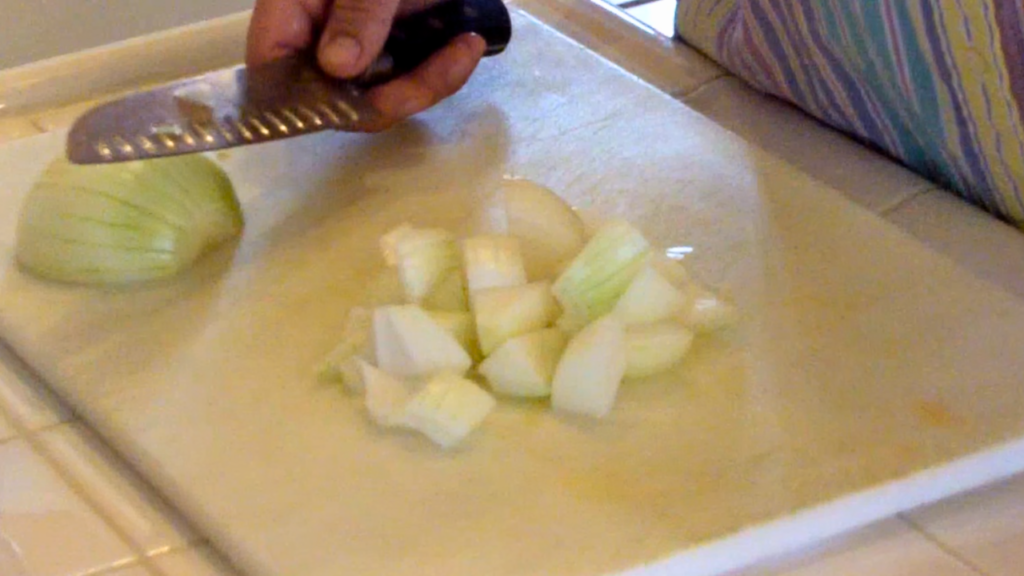
The board tells you whether prep was successful. This final check prevents problems later in the cooking process.
- Surface should appear mostly dry.
- Minimal juice on the board.
- Edges should look clean, not crushed.
- The pile should feel balanced when lifted.
Key Chef Tips & Common Mistakes to Avoid
The goal of this technique is not speed or appearance, but control. The table below highlights the mindset professional cooks use when rough-chopping onions—and the habits that often work against it.
| Chef Awareness | Common Mistake | Why It Matters |
| Rough chop is chosen based on cook time, not convenience | Cutting too fine out of habit | Smaller pieces release moisture too early, lowering the pan temperature before browning begins |
| Onions should hold their structure long enough to release flavor gradually | Overworking the onion during prep | Excess handling damages cell walls and accelerates breakdown |
| A mostly dry board signals proper knife pressure | Ignoring excess juice on the board | Visible moisture before cooking often leads to steaming instead of sautéing |
| Prep decisions influence pan behavior before heat is applied | Treating prep and cooking as separate steps | Problems in the pan usually begin at the cutting board |
| Efficiency comes from control and rhythm | Confusing speed with efficiency | Fast cutting without control creates inconsistency and loss of structure |
When to Use This Technique
Rough chopping onions with intention is most effective in preparations where time and heat are used to develop flavor gradually. The size tolerance created during prep allows the onion to soften in stages, releasing moisture and sweetness without collapsing too early.
This technique works especially well for:
- Sauté bases
When onions form the foundation of a dish, controlled rough chop helps them soften evenly while maintaining enough structure to support browning and aroma development. - Braises and stews
Slight variation in size allows onions to break down at different rates, contributing both body and depth over long cooking times without disappearing all at once. - Long-cooked sauces
Onions benefit from a gradual transition from structure to softness. Rough chop provides enough integrity early on, then dissolves naturally as the sauce develops. - Roasted preparations
Larger, irregular pieces promote caramelization at the edges while preserving interior texture, adding complexity rather than uniform softness.
This technique is less appropriate when precision, appearance, or cooking speed is the priority.
Avoid using rough chop for:
- Raw applications
Irregular size and exposed edges create uneven bite and inconsistent sharpness when onions are not cooked. - Garnishes
Visual uniformity and clean structure matter more than size tolerance in finishing elements. - Quick, high-heat cooking
Small variations in size can lead to uneven results when cook times are extremely short, and the heat is aggressive.
Choosing when not to use a technique is as important as knowing when to use it. Rough chop earns its value when time and heat are allowed to do their work.


Final Thoughts
Rough chopping onions is not about cutting faster or doing less work. It’s about preparing an ingredient so it behaves as intended when heat is applied. When size, pressure, and structure are chosen intentionally, onions release flavor gradually instead of breaking down too early.
This kind of control begins at the cutting board. Paying attention to moisture, edge integrity, and overall balance before cooking allows you to guide the outcome in the pan with far greater confidence.
Practice this technique with repetition and observation. Small adjustments in prep lead to noticeable improvements in flavor development, texture, and consistency across a wide range of dishes.
Watch another Chef Mark Sandoval technique video to continue building your control and confidence in the kitchen.