
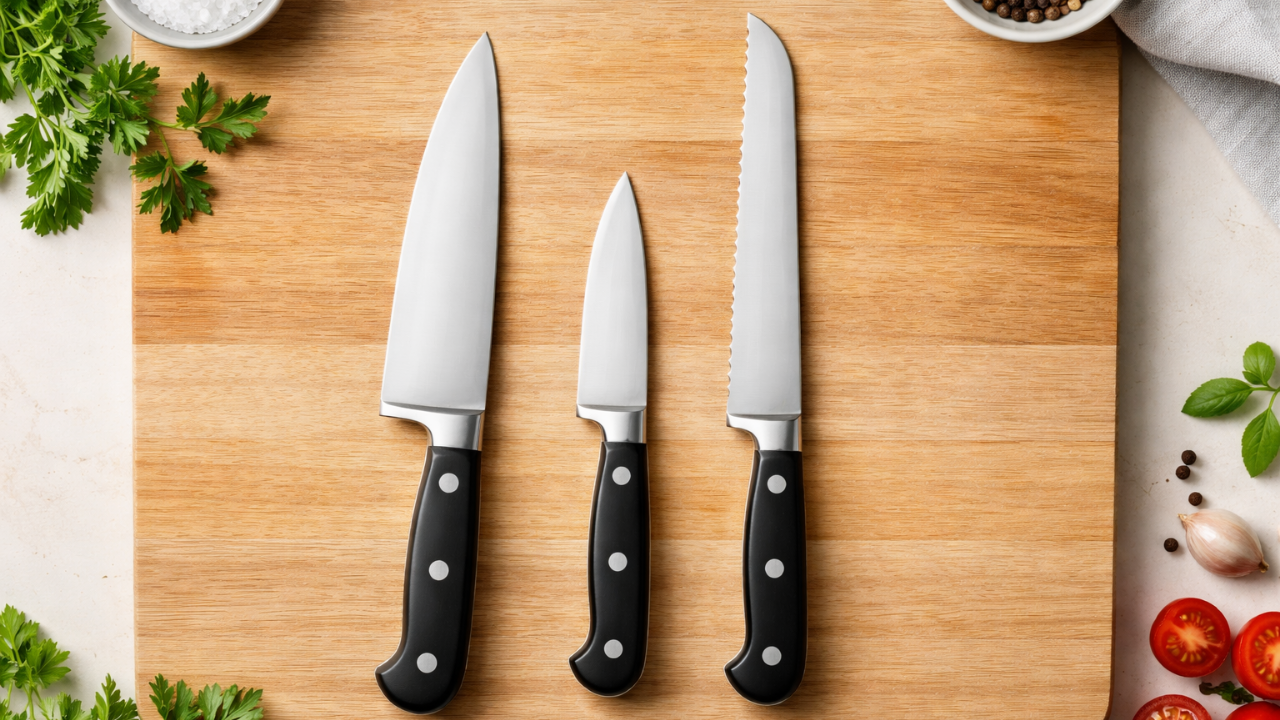
Every knife in your kitchen is designed to solve a different cutting problem. A chef’s knife, a paring knife, and a serrated knife are not interchangeable tools. Each one changes how you control ingredients, manage texture, and work safely.
When the wrong knife is used, ingredients tear rather than slice cleanly. Soft foods crush. Dense foods require excessive force. Cuts become uneven, which affects cooking time and final texture.
Home cooks often reach for one knife for everything. That habit limits precision and increases effort. Choosing the right knife improves consistency, speed, and confidence before heat is ever applied.
You encounter this decision daily when slicing vegetables, trimming fruit, portioning protein, or cutting bread; understanding which knife is best for each task helps you cook with intention rather than improvisation.
In the video below, I demonstrate the physical differences between these three essential blades and how they handle common kitchen tasks.
Blade Design Determines Function
Choosing the right knife means matching the blade’s design to the ingredient’s size, structure, and surface. Knife choice is not about preference. It is about mechanics.
- Blade length affects leverage.
- Blade shape affects motion.
- Edge type affects how the ingredient separates.
When you understand what each blade is designed to do, the decision becomes practical rather than habitual.
Chef’s Knife
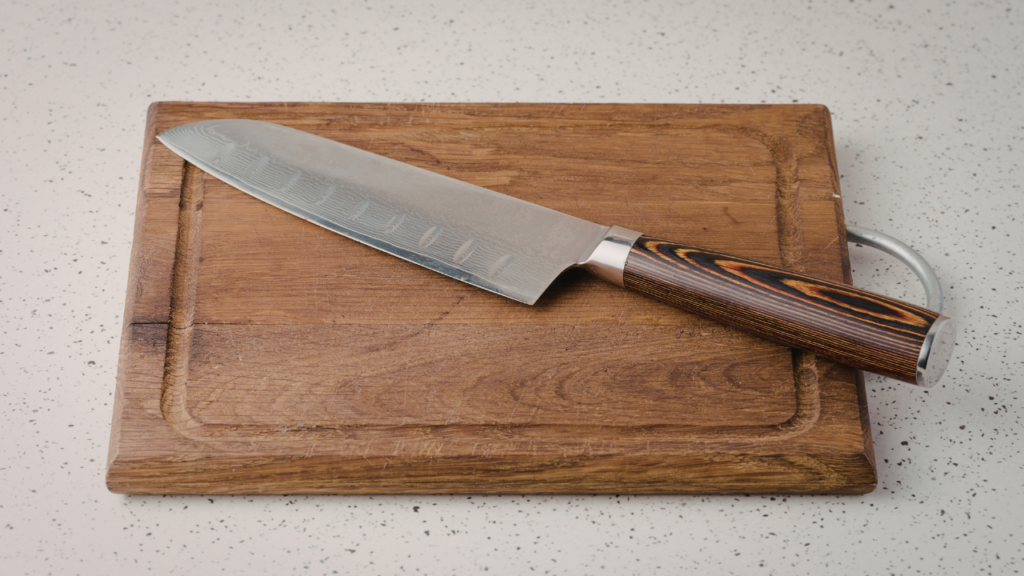
A chef’s knife is broad-bladed, typically 8 to 10 inches long, with a curved cutting edge and a pointed tip. The curved edge allows a rocking motion on the board. The length provides leverage and stability.
This knife is designed for:
- Slicing large vegetables
- Chopping herbs
- Dicing onions
- Portioning proteins
- Breaking down bulk ingredients
Its weight and length do most of the work. The motion is board-based, not hand-held.
It is not built for:
- Peeling in the hand
- Turning small vegetables
- Cutting through crusty bread
- Tasks that require tight, fingertip-level precision
Using it for small, delicate work often reduces control rather than increasing it.
Paring Knife
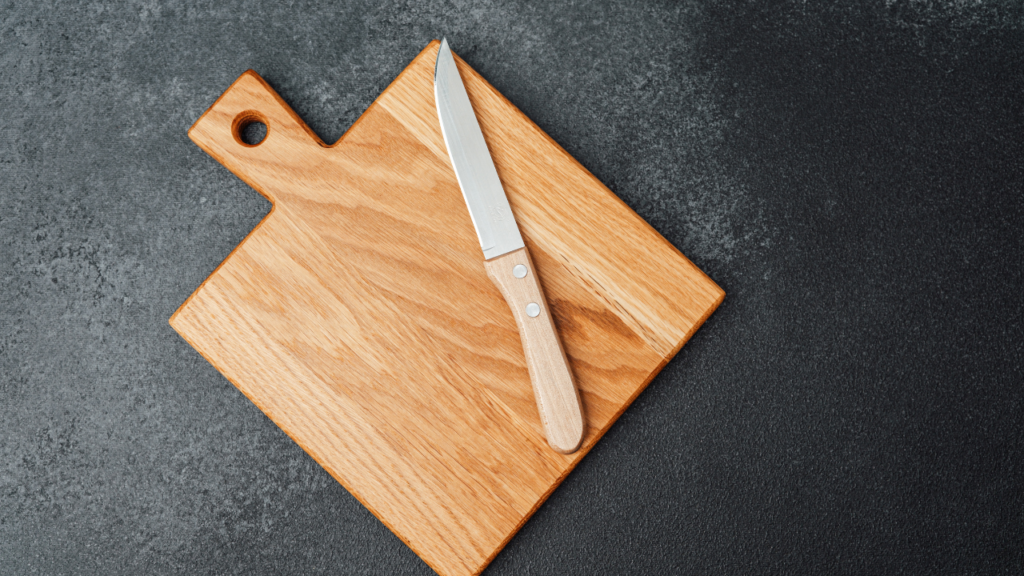
A paring knife is a short blade, usually 3 to 4 inches long, with a narrow profile. It is designed for control close to the fingers.
Unlike a chef’s knife, it is often used off the board, held in the hand while the ingredient is being used.
It is built for:
- Peeling fruits and vegetables
- Trimming fat or blemishes
- Segmenting citrus
- Detailed garnish work
- Small, controlled cuts
Its strength is precision, not power.
It is not designed for:
- Large volume chopping
- Heavy downward force
- Cutting dense squash or root vegetables
- Extended board work
Because it lacks length and weight, forcing it into heavy tasks reduces efficiency and increases instability.
Serrated Knife
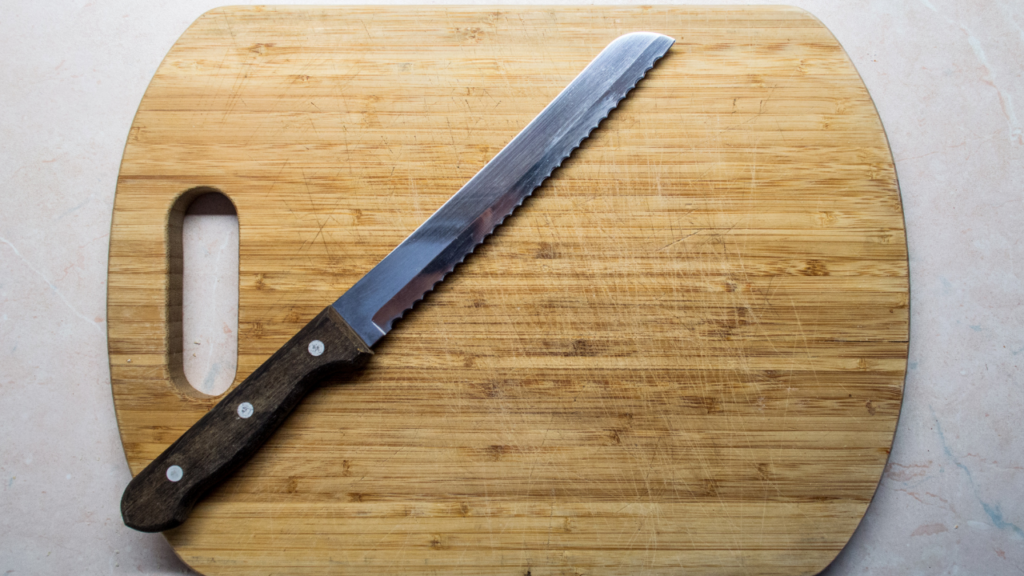
A serrated knife has a toothed edge rather than a smooth blade. Those teeth grip the surface before cutting through it.
This design allows it to:
- Slice crusty bread without compressing the crumb.
- Cut tomatoes without crushing the interior.
- Handle delicate cakes or baked goods.
- Penetrate firm skin with minimal pressure.
Instead of pushing straight down, the saw’s serrations gently cut through resistant surfaces.
It is not ideal for:
- Clean, straight cuts in firm vegetables
- Fine dicing
- Peeling
- Precision trimming
Serration trades smoothness for grip. That tradeoff is useful when the surface resists a straight edge.
How Knife Choice Affects Texture, Timing, and Control
Knife selection is not only about cutting. It shapes how ingredients behave in the pan, in the oven, and on the plate.
The way an ingredient is cut determines how it cooks, how it feels in the mouth, and how evenly it absorbs heat.
Texture and Structure
A chef’s knife produces clean, straight cuts when used properly on stable ingredients. Clean cuts preserve cell structure. Preserved structure means:
- Vegetables hold their shape during sautéing.
- Proteins sear evenly instead of fraying at the edges.
- Herbs bruise less and retain aroma.
When cuts are uneven, some pieces overcook while others remain underdone. Texture becomes inconsistent, even if the seasoning is correct.
A paring knife protects the delicate structure during fine work. When trimming strawberries, segmenting citrus, or removing blemishes, precision prevents tearing. That preserves visual clarity and reduces excess moisture release.
A serrated knife protects soft interiors by gripping before cutting. Instead of compressing bread or tomatoes under pressure, the blade moves through the surface gradually. The interior stays intact. Structure is preserved.
Heat and Timing
Uniform size controls cooking speed.
Even cuts:
- Brown at the same rate
- Soften evenly
- Reduce the need for mid-cook adjustments.
If pieces vary significantly in size, you are forced to compensate by adjusting the heat, stirring, or removing pieces individually. That interrupts the flow and increases the risk of overcooking.
Knife choice is part of heat management. It begins before the stove is turned on.
Moisture Control
| Cut Quality | What Happens to the Ingredient | What Happens in the Pan |
|---|---|---|
| Clean, smooth cut | Cell structure stays intact | Browning happens more evenly |
| Crushed or torn cut | Cells rupture and release moisture early | Ingredients steam instead of caramelize |
Clean cuts preserve structure. Preserved structure controls moisture release. Controlled moisture supports proper browning and better texture.
Efficiency and Confidence
Using the right knife reduces effort.
- Less downward force is required.
- Fewer corrective cuts are needed.
- Movements become smoother and more controlled.
When you stop fighting the ingredient, prep becomes steady rather than reactive.
Confidence at the stove often begins with confidence at the cutting board. The right knife creates predictable results. Predictable results make decision-making easier throughout the rest of the cooking process.
Where Each Knife Shows Up in Everyday Cooking
Knife roles become clearer when you see how they repeatedly appear across dishes and cuisines. The goal is not to memorize rules, but to recognize patterns.
When you recognize the pattern, you reach for the correct tool before prep begins.
Chef’s Knife in Savory Prep
In vegetable-based dishes such as stir-fries, soups, stews, sheet-pan roasts, and sautés, the chef’s knife handles most of the boardwork.
You see it used for:
- Slicing onions, peppers, zucchini, and cabbage
- Dicing carrots, celery, and potatoes
- Chopping herbs in quantity
- Portioning boneless proteins
These dishes depend on uniformity. Even slices brown at the same rate. Even dice soften evenly in liquid. Consistency at the board leads to a predictable texture in the final dish.
In cuisines ranging from French mirepoix-based soups to Asian stir fries, the chef’s knife provides speed and structural control during bulk prep.
Paring Knife in Precision Tasks
The paring knife is used for smaller, softer, or more delicate ingredients.
You see it in:
- Peeling apples for tarts
- Segmenting citrus for salads
- Trimming strawberries for pastry
- Removing blemishes from produce
- Detailing garnishes
These tasks require fingertip-level control rather than leverage. The ingredient is often held in the hand rather than stabilized on the board.
In pastry kitchens, fruit preparation depends heavily on this type of blade. In savory kitchens, it appears during finishing stages and fine trimming.
The paring knife supports precision where visual presentation and minimal waste matter.
Serrated Knife in Surface-Resistant Foods
The serrated knife is most useful when an ingredient has a resistant exterior and a soft interior.
Common examples include:
- Crusty artisan loaves
- Baguettes and sandwich breads
- Layer cakes
- Ripe tomatoes
- Soft rolls
In these cases, a straight edge tends to compress before cutting. Serration grips the surface and moves through it with less downward pressure.
Bread service in restaurants universally relies on serrated blades. The same principle applies at home whenever crushing would compromise texture.
Recognizing the Pattern
Across cuisines and recipe categories, the logic stays consistent:
- Large volume and board stability call for a chef’s knife.
- Small size and fine detail call for a paring knife.
- A tough surface with a soft interior calls for serration.
When you begin to see these roles clearly, knife choice becomes automatic rather than reactive. That anticipation improves efficiency before cooking even begins.
How to Choose the Right Knife in Your Own Kitchen
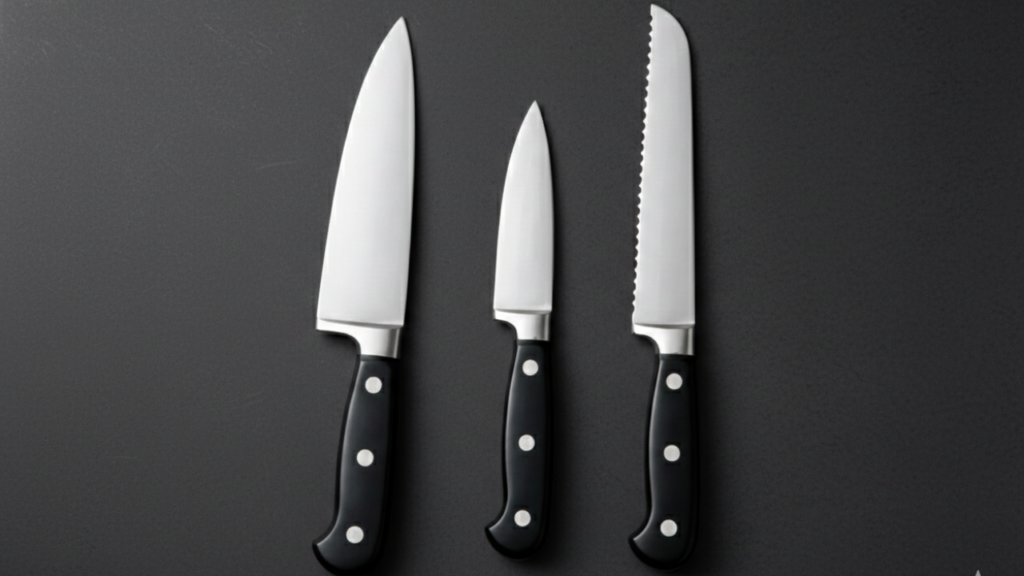
Application is not about memorizing rules. It is about reading the ingredients and adjusting before you begin cutting.
Start by observing three things: size, stability, and surface resistance.
Match the Knife to Size and Stability
- If the ingredient is large and stable on the board, use a chef’s knife.
- If it is small, curved, or easier to handle, use a paring knife.
- If it has a firm or crusted exterior with a soft interior, use a serrated knife.
Board stability matters. When an ingredient sits flat and steady, a longer blade provides efficiency and control. When it shifts easily or must be rotated in your fingers, a smaller blade offers safer precision.
Read the Surface Before You Cut
The ingredient’s surface gives you clues.
- Smooth, firm vegetables usually respond well to a straight edge.
- Tough skin over a soft center signals serration.
- Delicate flesh that bruises easily requires minimal pressure and precise control.
If you must push hard to break the surface, reassess the blade rather than increasing force.
Pay Attention to Resistance
During prep, notice how the ingredient responds.
- If the knife glides cleanly with minimal pressure, the match is correct.
- If the ingredient compresses before cutting, the blade choice may be wrong.
- If you find yourself sawing aggressively with a smooth blade, a serrated blade may be more appropriate.
- If the ingredient feels unstable or awkward to manage, the blade may be too large.
The right knife reduces friction. The wrong knife increases effort.
Adjust Early, Not After Frustration
One of the most common habits is forcing the tool already in your hand. Instead, pause and reassess.
Excessive pressure, slipping, or uneven cuts are signals. Changing knives early prevents:
- Cell damage that releases excess moisture
- Uneven sizes that affect cooking time
- Fatigue from unnecessary force
Efficiency in cooking begins at the cutting board. When the knife matches the ingredient, movement becomes steady, controlled, and predictable.
Common Mistakes & Misconceptions
Misunderstanding knife roles leads to poor cuts, extra effort, and safety risks. Most problems at the board come from habit rather than knowledge.
Frequent Misconceptions Clarified
| Misconception | Why It Happens | What to Understand Instead |
| One good knife can do everything. | The chef’s knife feels versatile and powerful, so it becomes the default tool. | Versatile does not mean optimal. A chef’s knife handles bulk prep well, but it cannot replace serration for crusty surfaces or a paring knife for fine control. |
| Serrated knives are only for bread. | Bread is the most obvious example of a tough exterior. | Serration is useful anytime the surface resists a smooth blade. Tomatoes, citrus with firm skin, and delicate cakes benefit from reduced compression. |
| Paring knives are safer because they are smaller. | Smaller size feels less intimidating. | Safety comes from stability and control. A small blade on a large, unstable ingredient can increase risk. Match blade size to ingredient size. |
| If I push harder, it will cut. | When resistance is felt, force feels like the solution. | Excess pressure signals the wrong tool or a dull edge. More force reduces control and increases the risk of slipping. Change the knife or sharpen it. |
Why These Misconceptions Matter
Each of these habits leads to:
- Crushed or torn ingredients
- Uneven cooking
- Fatigue from unnecessary force
- Increased chance of slipping
Correcting these misunderstandings improves both efficiency and confidence.
Visual or Technical Breakdown
Side-by-Side Comparison
| Knife Type | Best For | Control Level | Cut Quality Outcome |
| Chef’s Knife | Bulk prep, slicing, chopping | Board-based control | Clean, uniform cuts |
| Paring Knife | Peeling, trimming, and detail work | Hand-held precision | Minimal waste, delicate control |
| Serrated Knife | Bread, tomatoes, soft interiors | Surface grip control | Reduced crushing, preserved structure |
This comparison clarifies how blade design affects the outcome.
Controlled Exceptions and Skill-Based Adjustments
Knife guidelines are built on typical ingredient behavior. With experience, you may occasionally adjust.
If you do not have a serrated knife, a very sharp chef’s knife can slice tomatoes cleanly. The key is sharpness and minimal downward pressure. If the blade compresses the tomato before cutting, the tool is not appropriate for that task.
When working with very small produce, some cooks prefer a shorter chef’s knife instead of a paring knife for added board stability. In this case, stability may outweigh fingertip precision.
In both examples, the adjustment depends on:
- Blade sharpness
- Ingredient firmness
- Your level of control
These are refinements based on awareness, not shortcuts that replace proper tools.
Skill improves when you observe how ingredients respond. If the texture suffers or the force increases, return to the core principle: match the blade design to the ingredient structure.
Quick Takeaways
- Blade design determines control and texture outcome.
- Chef’s knives handle volume and uniformity.
- Paring knives handle precision and detail.
- Serrated knives protect soft interiors from crushing.
- If you are using excessive force, reassess the knife choice.
FAQs
Do I need all three knives?
For efficient home cooking, yes. A chef’s knife handles most bulk prep, a paring knife supports precision work, and a serrated knife protects soft interiors from crushing. Together, they cover the majority of daily cutting tasks without forcing compromises.
What size chef’s knife is most practical?
An 8-inch blade offers the best balance between control and versatility for most home kitchens. It is long enough for efficient slicing and chopping, but short enough to feel stable and manageable on a standard cutting board.
Can I sharpen a serrated knife the same way I sharpen a smooth-blade knife?
No. Serrated knives require different sharpening tools and techniques because each tooth must be maintained individually. Many home cooks choose professional sharpening services for serrated blades.
Is a paring knife meant to be used on the cutting board?
It can be used on the board for small items, but it is primarily designed for hand-held tasks such as peeling or trimming. For larger ingredients on the board, a chef’s knife usually offers better stability and control.


Final Thoughts
Knife choice is not about owning more tools. It is about understanding how blade design affects control, texture, and efficiency.
When you match the knife to the ingredient, prep becomes cleaner, safer, and more consistent. Even cuts cook evenly. Soft ingredients hold their structure. You use less force and make fewer corrective adjustments.
That clarity at the cutting board carries into every stage of cooking. Strong fundamentals simplify decisions at the stove later.
Explore more Kitchen Know How articles to continue building practical skill and confidence in your kitchen.
3 thoughts on “Choosing the Right Knife: Chef’s vs Paring vs Serrated”
Comments are closed.