
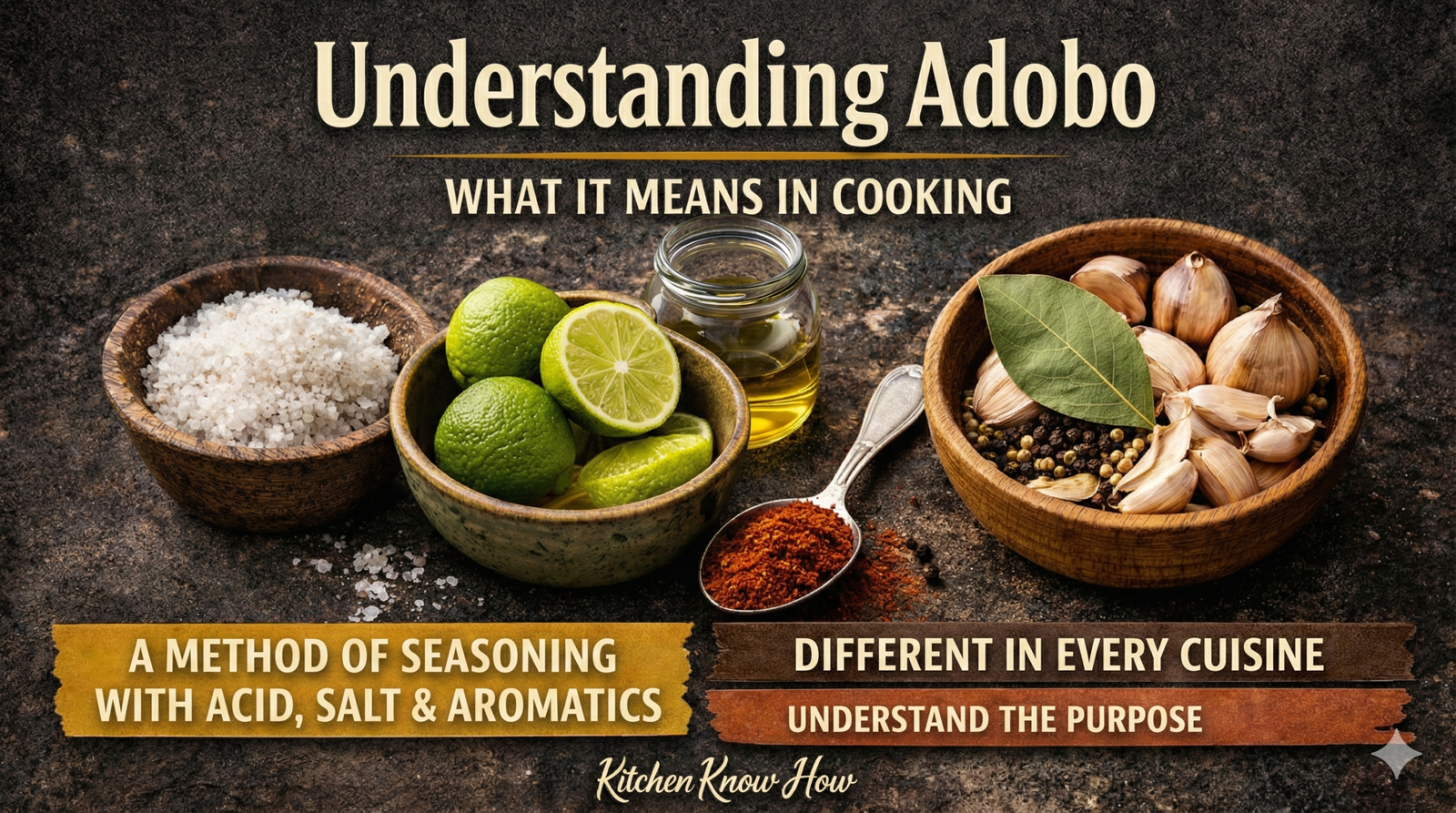
Adobo is a term used across multiple cuisines, but it does not mean the same thing everywhere. The term describes different cooking approaches based on region, ingredients, and historical influences.
Home cooks encounter “adobo” in sauces, marinades, spice blends, and finished dishes, often without clarity on what connects them or why they taste so different.
Understanding how adobo evolved globally helps cooks interpret recipes more accurately, choose appropriate ingredients, and avoid assuming that all adobo-style dishes function the same way.
This knowledge improves decision-making when adapting recipes, substituting ingredients, or cooking across cuisines.
What “Adobo” Means at Its Core
At its foundation, adobo refers to a seasoning system built around control, not a fixed dish or flavor profile.
The core idea is simple:
Combine the acid, salt, and aromatics so the flavors move into the food over time while maintaining structure.
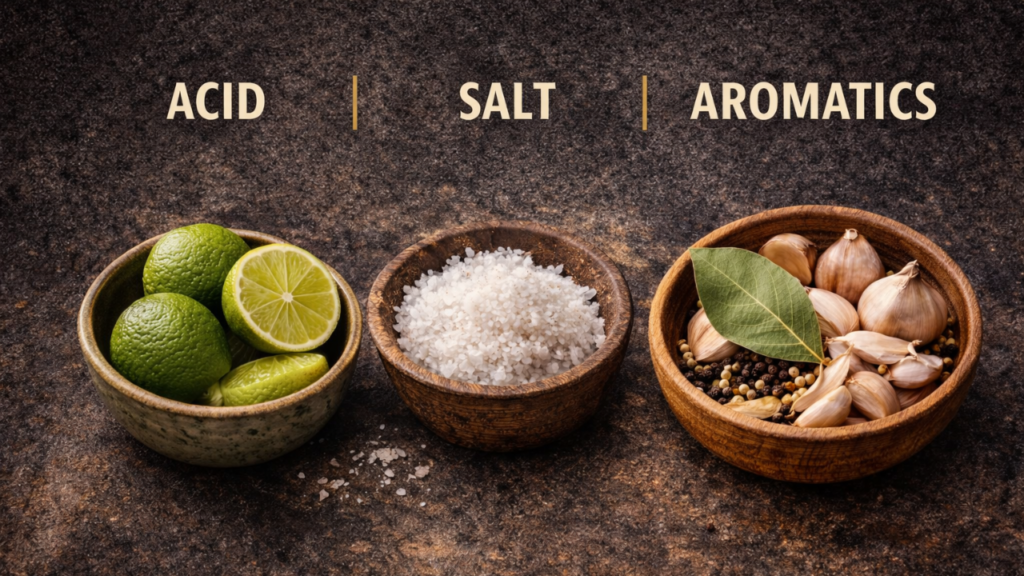
Across cultures, adobo-style preparations almost always include:
- An acidic element
Used to sharpen flavor, slow spoilage, and influence how proteins behave. - Salt or salinity
Essential for seasoning, moisture control, and flavor penetration. - Aromatic components
Such as garlic, spices, herbs, or chilies, depending on the region. - Time
Allowing these elements to interact with the ingredient rather than sit only on the surface.
This combination creates more than flavor alone. It shapes how food holds moisture, how deeply seasoning penetrates, and how stable the dish remains during cooking or storage.
In other words, adobo is about structure and balance, not decoration.
Why the Meaning Changes by Region
While the concept of adobo remained consistent, the ingredients used to express it did not.
As the term spread through colonization and trade, cooks adapted the method using what was locally available. Vinegars differed. Salts changed form. Aromatics reflected regional agriculture and taste.
Because of this:
- The purpose of adobo stayed largely the same.
- The flavor expression changed significantly.
Some versions are sharply acidic.
Others emphasize savory depth.
Some function primarily as marinades, while others become the cooking medium itself.
This explains why adobo can refer to a marinade, a sauce, or a finished dish, while still following the same internal logic.
For the cook, this distinction matters.
The word “adobo” signals how the seasoning system works, not what it must taste like.
Understanding that difference prevents misinterpretation when reading recipes across cuisines and allows better judgment when adjusting or substituting ingredients.
Why This Matters in Cooking
Flavor
Adobo is built on the deliberate use of acidity and salt, two elements that shape flavor more than any spice or herb.
When cooks understand this foundation, they stop evaluating adobo dishes by intensity alone and start thinking in terms of balance. Acidity provides lift and clarity. Salt provides depth and continuity. Aromatics fill in character.
Without this understanding, it’s easy to overcorrect by adding sweetness, extra fat, or heat, thereby masking the imbalance rather than fixing it.
Recognizing adobo’s structure allows cooks to ask better questions:
- Is the dish sharp or flat?
- Is the savoriness fully developed or thin?
- Does the acidity feel integrated or disconnected?
These questions lead to clearer adjustments and more controlled flavor outcomes.
Texture
Acid and salt don’t only affect taste; they actively change how food behaves.
In adobo-style preparations, proteins may tighten, relax, or retain moisture depending on exposure, concentration, and time. This directly influences tenderness, firmness, and mouthfeel.
Without understanding this interaction, cooks may assume a texture problem is due to overcooking when it is actually caused earlier in the seasoning process.
Knowing that adobo alters structure helps cooks interpret texture issues more accurately:
- Firmness that feels dry rather than juicy
- Meat that breaks apart too quickly
- Surfaces that tighten before interior flavor develops
This awareness prevents misdiagnosing the problem and repeating the same mistake.
Timing
Time plays a different role in adobo depending on its purpose.
Some adobo traditions allow time for the seasoning to penetrate before cooking. Others rely on cooking time to reduce acidity and enhance flavor. In some cases, resting improves balance more than additional heat.
When cooks don’t understand this distinction, timing becomes guesswork:
- Resting too long when penetration is already complete
- Rushing dishes that require mellowing
- Extending cooking when flavor, not doneness, is the issue
Understanding why time is being used enables cooks to respond intelligently rather than defaulting to “longer must be better.”
Confidence
Perhaps the most important impact is mental.
When cooks understand the logic behind adobo, it no longer feels like a cultural mystery or a fixed formula. It becomes a recognizable seasoning system with predictable behavior.
That clarity changes how recipes are read:
- Unfamiliar ingredient lists feel interpretable.
- Substitutions become thoughtful rather than risky.
- Variations make sense rather than cause doubt.
Confidence doesn’t come from memorizing versions of adobo.
It comes from understanding what the method is trying to achieve.
Once that logic is clear, cooks shift from following recipes to evaluating them, where real cooking confidence begins.
How It’s Used in Real Recipes
Understanding how adobo appears in recipes helps cooks interpret what the word is signaling before they even look at the ingredient list.
The same term may describe very different approaches, depending on culinary tradition. Recognizing these patterns prevents incorrect assumptions and improves decision-making from the start.
Spanish Influence
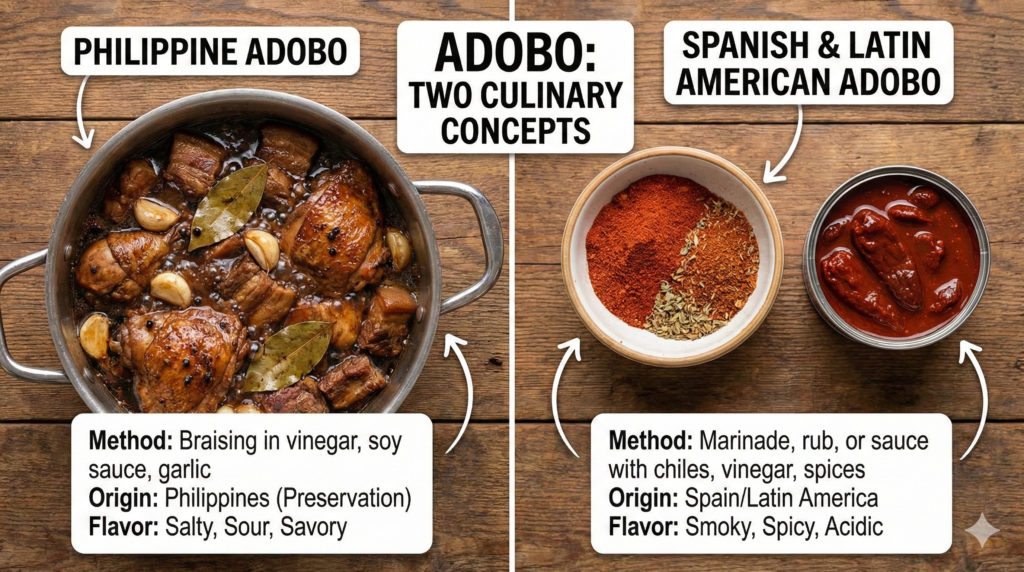
In Spain, adobo developed primarily as a pre-cooking seasoning system.
It was used to coat meats in an acidic, aromatic mixture designed to enhance flavor and provide short-term preservation. The focus was not on producing a finished sauce, but on preparing the ingredients for the next step.
In recipes, Spanish-style adobo often appears as:
- Meats seasoned ahead of cooking.
- Preparations intended to rest briefly before use
- Flavor profiles built around vinegar, garlic, and paprika
When cooks encounter this form of adobo, the key signal is preparation, not completion. The adobo develops its flavor and structure before heat is applied, shaping them early rather than during cooking.
This explains why these dishes often finish crisp, clean, and sharply seasoned rather than saucy.
Filipino Evolution
In the Philippines, adobo evolved into something fundamentally different.
Rather than functioning only as a seasoning step, adobo became the cooking environment itself. The same elements, acid, salt, and aromatics, are present, but they operate throughout the cooking process.
In Filipino recipes, adobo functions simultaneously as:
- A method of cooking
- A flavor-building system
- A finished dish
The defining characteristic is balance developed over time. Acidity softens, savoriness deepens, and fat integrates as the dish cooks.
For the home cook, the word “adobo” signals a process, not preparation. The flavor is not meant to be complete at the beginning; it evolves as the dish progresses.
Understanding this prevents confusion when the mixture tastes aggressive early but settles later.
Latin American Interpretations
In Mexico and surrounding regions, adobo commonly refers to a chili-based sauce or paste rather than a marinade or braise.
Here, the emphasis shifts toward:
- Dried chilies
- Spices
- Aromatics blended into a concentrated flavor base
In recipes, adobo often appears as:
- A coating for proteins
- A flavor base added to stews
- A seasoning component incorporated into larger dishes
This version is less about preservation and more about delivering concentrated flavor. The adobo serves as a building block, adding depth, color, and intensity to the dish.
For cooks, this signals that the adobo is contributing character and complexity rather than structural change.
Modern Usage
In contemporary cooking, the term “adobo” is often used broadly and sometimes loosely.
Modern recipes may apply the word to:
- Wet marinades inspired by traditional systems
- Dry seasoning blends labeled for flavor familiarity
- Slow-cooked dishes borrowing elements from multiple traditions
- Sauces used as bases for stews, rice dishes, or fillings
Because of this, the word alone is no longer enough information.
When cooks see “adobo” in a modern recipe, it should prompt a moment of evaluation:
- Is this functioning as a marinade, a sauce, or a seasoning base?
- Is it acting before cooking, during cooking, or as the dish itself?
The shared name reflects historical lineage, not identical technique.
Recognizing that distinction allows cooks to approach recipes with clarity rather than assumptions, which is exactly where better cooking decisions begin.
How to Apply It at Home
Applying adobo correctly at home begins with understanding its role, not by trying to replicate a specific ingredient list.
When cooks prioritize function, they gain flexibility and avoid forcing one version of adobo to behave like another.
Use the following cues to guide interpretation and decisions.
- Identify the purpose of the acidity
Ask whether the acid is meant to preserve, season, or balance richness. Sharp, forward acidity often signals early-stage seasoning, while softer acidity usually indicates balance developed over time. - Pay attention to how salt is delivered
Salt may appear directly or through ingredients such as soy sauce, seasoned pastes, or blends. This affects how quickly the seasoning penetrates and how pronounced the final flavor will be. - Notice when the adobo is introduced
If it appears before cooking, it is already shaping its structure. If it is added during cooking, it is meant to evolve. If it becomes the cooking medium, it determines the dish’s final balance. - Use aroma as an early warning system
Strong, sharp acidity on the nose often indicates imbalance or incomplete integration. As adobo settles, aromas tend to round out and soften rather than intensify. - Watch how the texture responds over time
Proteins exposed to acid may firm, tighten, or release moisture. Observing these changes helps distinguish seasoning effects from cooking errors. - Adjust expectations of appearance and thickness
Not all adobos are glossy, thick, or sauce-like. Some are intentionally thin, some reduce naturally, and others remain light but intensely seasoned. - Read recipes for intent, not labels
Treat the word “adobo” as a signal to evaluate structure, balance, and timing, not as a promise of a specific flavor or texture.
When cooks approach adobo this way, they stop copying and start interpreting, which leads to better judgment, cleaner adjustments, and more consistent results across cuisines.
Common Mistakes & Misconceptions
All Adobo Tastes the Same
This misunderstanding usually comes from assuming the name defines the flavor.
In reality, adobo refers to a seasoning method, not a standardized flavor. Different regions apply the same concept using entirely different ingredients, balances, and cooking styles.
When cooks treat all adobos as interchangeable, they often misjudge:
- How sharp or mild the dish should be
- Whether sweetness or richness is needed
- How the seasoning is meant to develop
The correction is simple: Use the word “adobo” as a signal to investigate function, not as a flavor guarantee.
Adobo is a Sauce
Many cooks expect adobo to behave like a finished condiment that can be poured, spooned, or added at the end.
In several traditions, however, adobo is not something applied after cooking. It is a process that shapes the dish as it develops.
This confusion can lead to:
- Adding adobo too late to integrate properly
- Expecting thickness where none is intended
- Misunderstanding why flavor feels incomplete early on
Reframing adobo as a seasoning rather than a topping brings clarity.
Stronger Acid Means More Flavor
Acidity is one of adobo’s core tools, but more is not better.
Excessive acid can dominate aromatics, mute savoriness, and create a sharpness that never fully settles. Instead of tasting bright, the dish may feel hollow or aggressive.
When this happens, cooks often compensate with sweetness or fat, which masks the imbalance rather than resolving it.
The better approach is to recognize acid as a structural element—one that must work in balance with salt and aroma to build depth.
Adobo is Spicy by Default
Because some modern interpretations emphasize chilies, many cooks assume heat is required.
Historically, heat is optional.
Many classic adobo styles rely primarily on:
- Acidity
- Salt
- Garlic and aromatics
Spice may appear, but it is not the defining feature.
Understanding this prevents unnecessary additions that disrupt the dish’s intended balance and helps cooks evaluate whether heat supports or distracts from the core flavor.
Visual or Technical Breakdown
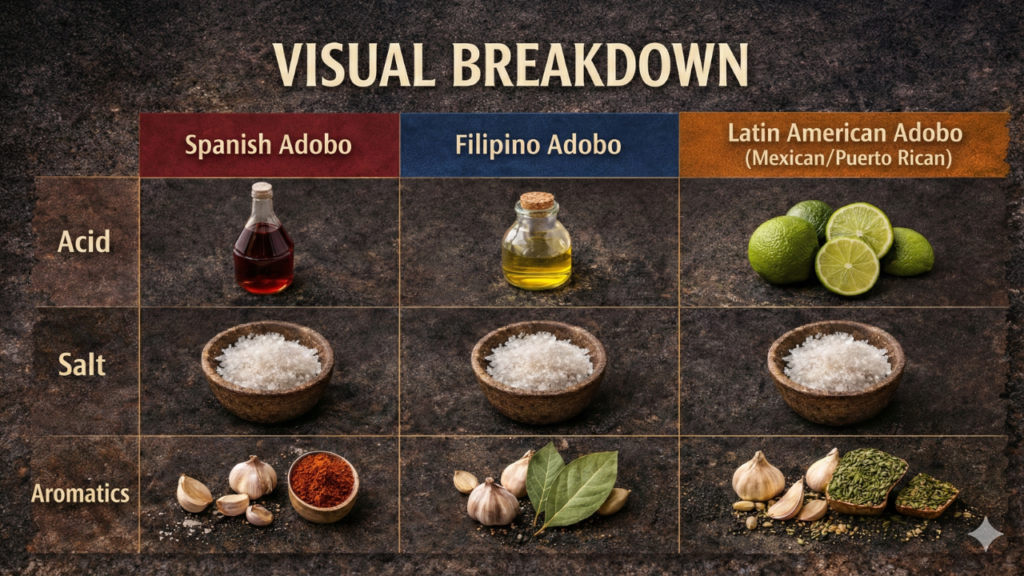
This comparison helps cooks quickly identify the type of adobo a recipe references before making assumptions about flavor, texture, or technique.
| Spain | Seasoning / Preservation | Vinegar – Paprika – Garlic |
| Philippines | Braising method | Vinegar, soy sauce, aromatics |
| Mexico | Sauce base | Dried chilies, spices, and acidity |
Quick Takeaways
- Adobo is a method, not a universal recipe
The word describes how seasoning is structured and applied, not a fixed list of ingredients. - The shared name reflects function, not identical flavor
Different cuisines use the same term to express the same purpose, but with different components. - Acid and salt form the backbone
These elements shape flavor, influence texture, and determine how seasoning develops over time. - Regional context determines behavior
Whether adobo serves as a marinade, a sauce, or a cooking medium depends on the recipe. - Understanding intent improves judgment
When cooks understand what adobo is meant to do, substitutions become thoughtful and adjustments controlled.
FAQs
Is adobo a marinade or a dish?
It can be either. In some cuisines, adobo functions as a seasoning applied before cooking. In other cases, it refers to a complete dish in which the seasoning system develops during cooking.
Why do Filipino and Mexican adobos taste so different?
They evolved independently using local ingredients. The shared term reflects a common seasoning concept, not a shared flavor profile.
Can I substitute one adobo for another?
Only with caution. While the name may be the same, the role it plays, marinade, sauce, or cooking medium, may not match.
Is adobo always acidic?
Yes. Acidity is central to its structure, though it may come from vinegar, fermented ingredients, or chilies rather than a single source.
Does adobo always contain soy sauce or chilies?
No. Those ingredients are regional expressions, not requirements. Many traditional adobos rely solely on acid, salt, and aromatics.
Why does adobo sometimes taste harsh at first?
Early sharpness is common when acid has not yet integrated. In many adobo styles, balance develops over time rather than immediately.
Is adobo meant to be thick or saucy?
Not necessarily. Some adobos are thin by design, emphasizing seasoning and balance over texture or body.


Final Thoughts
Adobo becomes far more useful once you understand what it is designed to do in cooking, not just what ingredients appear on the page.
When you view it as a seasoning system rather than a single recipe, the confusion disappears. Acidity, salt, aromatics, and time begin to make sense as tools working together, each serving a specific purpose.
With that understanding, recipes become easier to interpret. Variations feel logical instead of contradictory. Adjustments can be made intentionally rather than hesitantly.
This is the shift that builds real confidence in the kitchen: knowing why something works before deciding how to use it.
Explore related Kitchen Know How articles to deepen your understanding of how seasoning systems function — and how to apply that understanding across many styles of cooking.