
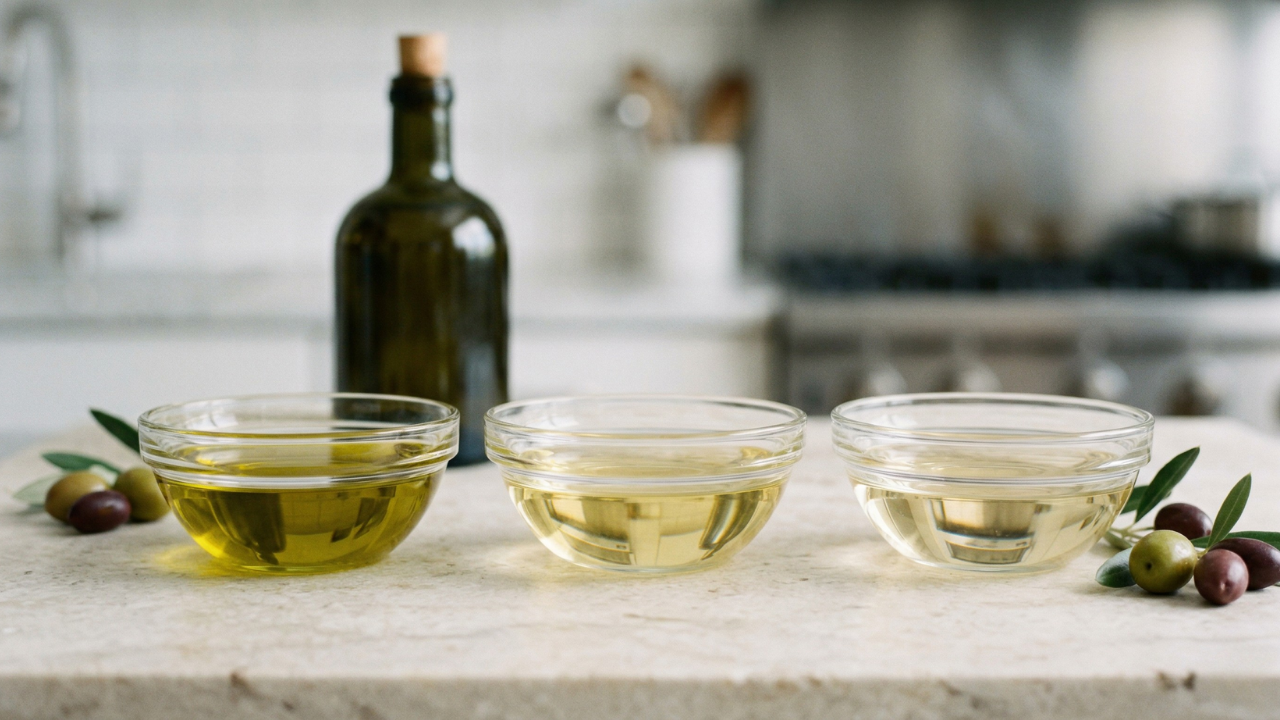
Olive oil labels can be more confusing than helpful. Terms like extra virgin, light, and pomace seem straightforward, but they rarely tell home cooks what matters most in the kitchen.
These grades affect flavor, refinement, and how the oil fits different cooking tasks. That matters whether you are making a vinaigrette, roasting vegetables, sautéing aromatics, or finishing a dish at the table.
Understanding the difference helps you choose oil with more intention. Instead of assuming one type is always better, you can match the oil to the job and cook with better judgment.
What These Grades Actually Mean on the Bottle
Olive oil grades describe how the oil was produced and how much of the olive’s original character remains. They are not just marketing terms. They point to real differences in flavor, refinement, and use.
| Extra virgin olive oil | Least refined | Fruity, bitter, peppery, more aromatic | The most expressive grade when flavor matters |
| Light olive oil | More refined | Milder, lighter in flavor and aroma | A softer olive oil for cooking where the fat should stay in the background |
| Pomace oil | Further processed after initial extraction | Neutral to very mild | A more functional oil chosen more for utility than flavor |
Extra virgin olive oil is the least processed of the three, which is why it keeps more of its natural aroma and character. Light olive oil is more refined, so its flavor is milder. Pomace oil is made differently and is usually valued more for its practicality than for sensory quality.
The main principle is simple. These oils all come from olives, but they do not offer the same flavor, quality, or cooking role.
How Oil Grade Changes Flavor and Cooking Result
Olive oil does more than carry heat. Its grade changes how much flavor it contributes and how clearly that flavor shows up in the finished dish.
Extra virgin olive oil has the strongest personality. It often brings a fruity aroma, gentle bitterness, and a peppery finish that can add depth and structure. In the right setting, that is an advantage. It can make a vinaigrette taste fuller, give a finished soup more definition, or add dimension to vegetables, beans, or grilled bread.
More refined olive oils have much less of that character. Their aroma is softer, their bitterness is lower, and their finish is less assertive. That makes them useful when the goal is not to highlight the oil itself. If the main ingredients should stay in front, a milder oil can support the dish without competing.
When the right oil is matched to the job, the food feels balanced. A flavorful oil adds character where the oil will be noticed. A milder oil keeps the background clean when the dish needs restraint.
Problems usually begin when all olive oils are treated as interchangeable. A strong extra virgin can dominate delicate ingredients or make a dish taste heavier, more bitter, or more peppery than intended. A very neutral oil can leave a dressing, drizzle, or finishing step tasting flat when that final layer should have added character.
Where You Will See These Oils Used Most Often
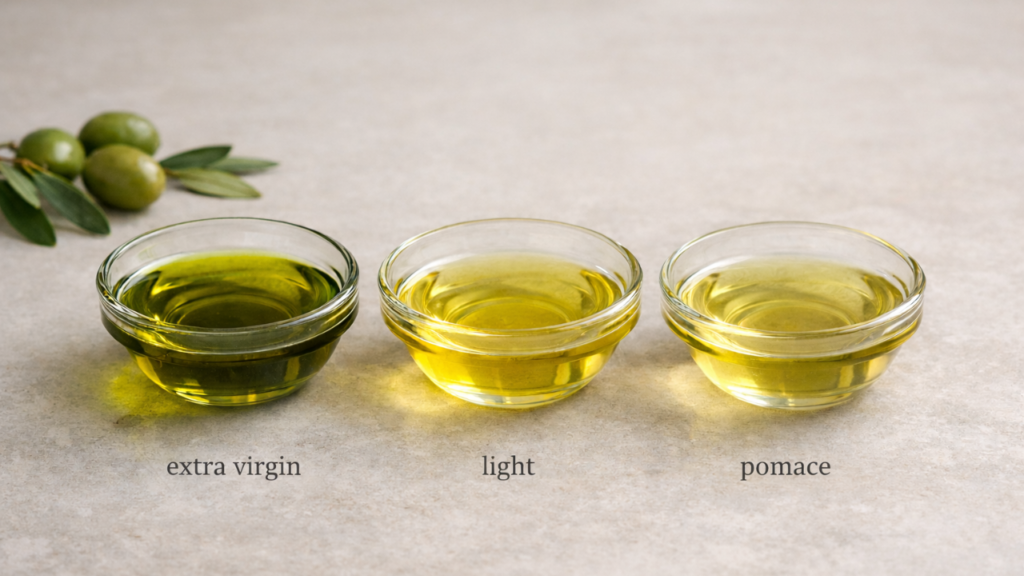
The easiest way to understand olive oil grades is to connect them to how they are used in real cooking.
Extra virgin olive oil appears most often where its flavor remains exposed. This includes vinaigrettes, finishing drizzles, bread dipping, cold sauces, and simple preparations where the oil is meant to be tasted directly. In these settings, its fruitiness, bitterness, and peppery finish are part of the final result.
Light olive oil is more often used for general cooking when a milder olive presence is preferred. It fits comfortably into sautéing, roasting, and everyday pan-cooking, where the oil supports the process without becoming a major flavor contributor.
Pomace oil is usually found in more utilitarian cooking contexts. It is often chosen in higher volume kitchens or in situations where cost, neutrality, and practicality matter more than aroma or character. Its role is less about adding flavor than about serving as a cooking medium.
Recognizing these patterns removes much of the confusion. Instead of asking which olive oil is best in general, it becomes easier to ask which one makes sense for the kind of cooking you are doing.
How to Choose the Right Olive Oil in Your Kitchen
Choosing olive oil well starts with the bottle. The most important detail is the grade itself. Extra virgin, light, and pomace tell you more about likely flavor and refinement than most front-label language ever will.
A few details are worth checking:
- Grade language.
- Origin information.
- Harvest date or best by date.
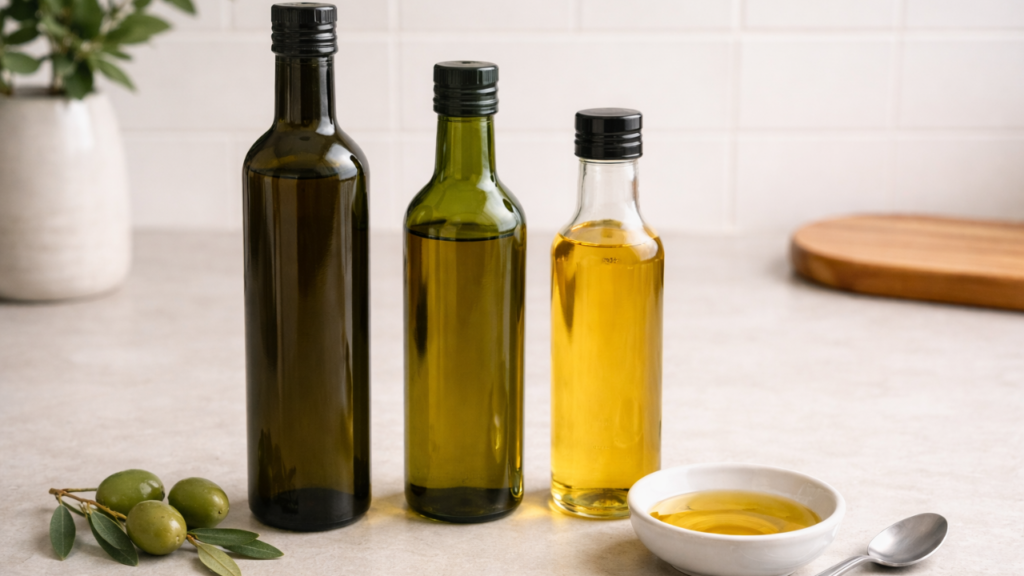
- Bottle type, especially dark glass over clear packaging.
Origin can help when the bottle clearly states where the olives were grown or where the oil was produced. This does not guarantee quality, but it usually gives you more useful information than a vague label. Freshness matters too. A harvest date or clear best-by date gives you a better sense of how lively the oil may still taste.
After the label, the next guide is sensory. A good extra virgin usually smells fresh and tastes alive. You may notice fruitiness, slight bitterness, or a peppery finish. Those are not flaws when they feel clean and balanced. What you want to avoid is oil that seems flat, waxy, harsh, or stale.
If an oil tastes too aggressive, save it for heartier dishes or use it more lightly where the flavor stays exposed. If it tastes too dull, it may still work for general cooking, but it will not do much as a finishing oil or in a simple dressing. When an oil feels wrong for the dish, the goal is not to force it. It is to better match the oil’s character to the job.
Label Confusion That Leads to Poor Choices
A lot of olive oil confusion starts with the idea that ‘premium’ always means ‘correct’. Extra virgin is often treated as the best choice in every situation, but that is too simple. It is the highest grade in terms of flavor and minimal processing, yet that does not make it the right oil for every task. In some dishes, its character is exactly what you want. In others, it can pull the balance away from the main ingredients.
Light olive oil creates a different misunderstanding. Many home cooks assume the word light means fewer calories or less fat, but that is not what the label describes. The term refers to a lighter flavor, aroma, and color due to further refining. From a cooking standpoint, this matters because someone may buy it for the wrong reason and never realize it was meant to signal a milder sensory profile rather than a nutritional advantage.
Pomace oil is often misunderstood because it still carries the olive name. That leads some people to assume it stands on equal ground with extra virgin oil in terms of quality, only at a different price point. In reality, the difference is not just cost. It is also about how the oil is obtained, how much refinement is involved, and how much of the olive’s original flavor remains.
The useful correction is this: olive oil labels do not describe the same product at different price levels. They describe different products with different strengths, limits, and kitchen uses.
A Clear Side-by-Side Look at EVOO, Light, and Pomace
A side-by-side comparison makes these grades easier to judge in practical terms.
| Extra virgin | Strongest and most expressive | Least refined | Finishing, vinaigrettes, dipping, simple dishes where the oil is tasted clearly | Flavor, aroma, character |
| Light olive oil | Mild and less assertive | More refined | General cooking, sautéing, roasting, everyday use when a softer olive presence is preferred | Versatility, restraint |
| Pomace oil | Neutral to very mild | Most processed of the three | High volume cooking, utilitarian kitchen use, situations where cost matters more than flavor | Economy, function |
This comparison helps separate culinary quality from cooking convenience. Extra virgin oil offers the most character, but that does not mean it is automatically the best choice for every use. Light olive oil may be less expressive, yet that can be an advantage when the oil should stay in the background. Pomace oil does not offer the same flavor value, but it may still serve a practical purpose where neutrality and cost matter most.
The main lesson is that label language should not be read as status alone. It should be read as a signal of how the oil will perform in food.
When a Less Flavorful Oil Can Be the Better Choice
A milder olive oil can be the smarter choice when the dish does not need the oil to speak loudly. Not every preparation benefits from the grassy, bitter, or peppery notes of extra virgin olive oil. In some cases, those qualities add depth. In others, they compete with what you are actually trying to highlight.
This matters most in dishes where the oil is present but not meant to define the final flavor. A more neutral olive oil can make more sense for everyday sautéing, larger batches, or preparations where seasoning, stock, dairy, spices, or the main ingredient should stay in the foreground.
Cost also plays a practical role. If you are cooking in volume, using oil more heavily, or saving your more flavorful bottle for finishing and cold applications, a milder grade can be a reasonable working choice. That does not mean it is equal in quality to extra virgin. It means it may be better suited to the task.
Flavor neutrality can also be useful when a dish already carries a strong identity from other ingredients. In that case, less expression from the oil is not a loss. It is part of better control.
The best olive oil is not always the one with the highest status. It is the one that gives the dish the result it needs.
What to Remember When Reaching for Olive Oil
- Extra virgin brings the most character and works best where the oil will be tasted clearly.
- Light olive oil is more refined and milder, making it useful when a strong olive flavor is not desired.
- Pomace oil is more functional than expressive and is usually chosen for economy or neutral performance.
- Light does not mean fewer calories or less fat.
- The right grade depends on what the dish needs, not what sounds premium.
Common Olive Oil Questions Home Cooks Still Ask
These are some of the most common questions home cooks still have about olive oil grades.
Can I cook with extra virgin olive oil?
Yes. Extra virgin olive oil works well in many everyday cooking situations, especially when its flavor supports the dish.
It can work well for sautéing vegetables, cooking beans, building a sauce base, or roasting foods that benefit from fuller olive character. But it is not always the best fit. If the dish is delicate, if you do not want the oil’s flavor to stand out, or if you are cooking in larger volumes and want to be more economical, a milder olive oil may make more sense.
Is light olive oil healthier than extra virgin?
No. Light olive oil is not called light because it has fewer calories or less fat. The word refers to a lighter flavor, aroma, and color due to greater refinement.
This is one of the most misleading label terms in the oil aisle. From a kitchen standpoint, the useful distinction is sensory, not nutritional.
Why does one olive oil taste peppery and another taste flat?
That difference usually comes down to grade, processing, and freshness. Extra virgin keeps more of the olive’s natural character, which is why it can taste fruity, bitter, or peppery.
A flatter oil has usually been more refined, or it may simply be older and less expressive. Refining removes much of the character that gives olive oil its identity. Age softens aroma and dulls flavor.
Is pomace oil bad, or just different?
Pomace oil is better understood as different. It is not valued for the same reasons as extra virgin. It comes from the remaining olive material after the initial extraction and undergoes further processing, giving it a more neutral and functional profile.
That places it lower in culinary quality when flavor and aroma are the priority. But practical use is a separate question. In some kitchens, pomace oil may still be chosen for economy, volume cooking, or situations where expressive olive flavor is not needed.
Do I need more than one olive oil at home?
Not necessarily, but it often helps. The more useful question is not how many oils you need. It is whether the oil you have can do the jobs you ask of it.
If you use olive oil both for cooking and finishing, having one more-flavored bottle and one milder everyday bottle makes your choices easier. But a small kitchen does not need a collection. It needs clarity.
Kitchen Tools That Support This Concept
A few simple tools can help you store olive oil better and judge it more accurately.


- Dark glass oil bottle: for protecting oil from light and slowing the quality loss
- Small tasting cup or spoon: for checking aroma and flavor before cooking
These are small tools, but they support better storage, better tasting habits, and better ingredient judgment.
Cook With Better Oil Judgment
Olive oil grade is not just a label detail. It is a cooking decision that affects flavor, balance, and the oil’s role in the dish. Once you understand what extra virgin, light, and pomace actually mean, the bottle becomes easier to read, and the choice becomes more intentional.
The most useful next step is comparison. Taste different oils side by side, then notice how each one behaves in real dishes. Pay attention to aroma, bitterness, pepperiness, and how strongly the oil shows up once the food is finished. That kind of direct observation builds better judgment than label language alone.
The goal is not to memorize which bottle is best in general. It is to understand which oil makes the most sense for the result you want. Explore related Kitchen Know How articles to strengthen that ingredient judgment even further.