
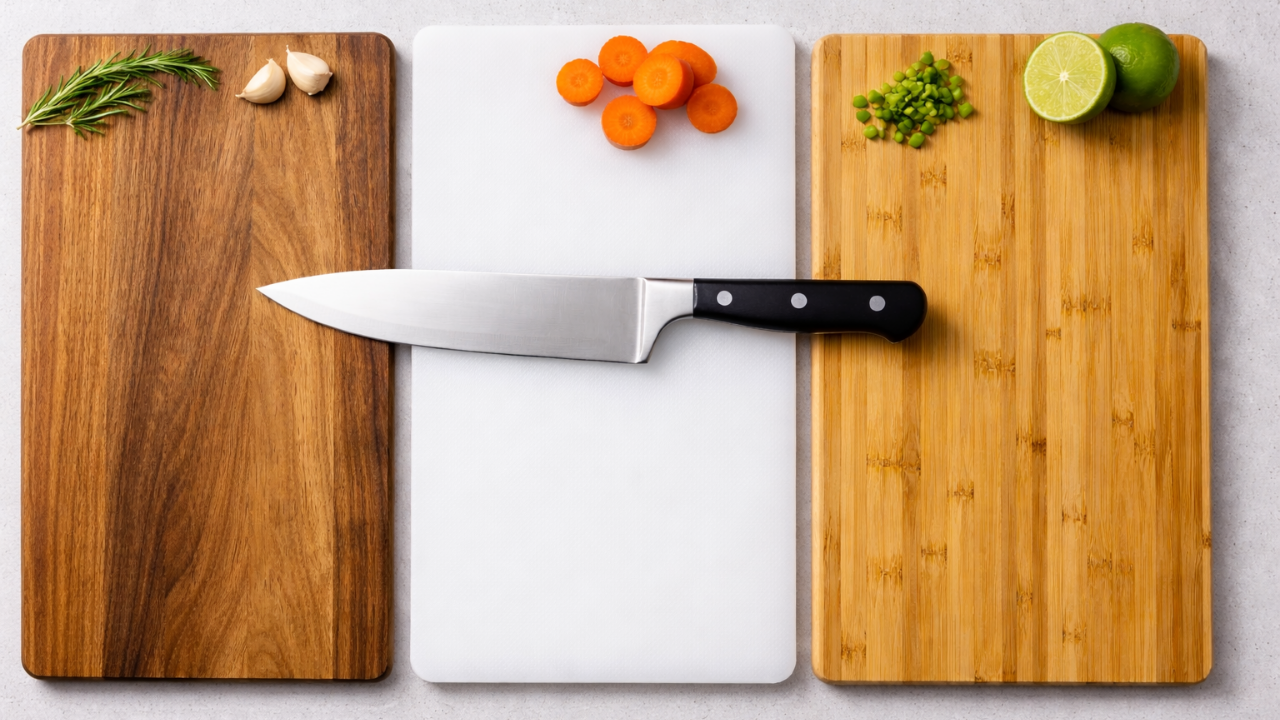
Cutting boards are one of the most used tools in any kitchen. Every ingredient preparation step begins on a stable surface where ingredients are trimmed, sliced, chopped, or portioned before heat is applied.
The material of that surface matters more than many home cooks realize. A cutting board affects knife control, edge longevity, sanitation practices, and how ingredients behave during prep. The wrong board can dull knives quickly, cause ingredients to slip, or make cleaning difficult.
Home cooks regularly encounter three common board materials: wood, plastic, and bamboo. Each behaves differently under a knife and requires slightly different care. Understanding these differences helps cooks choose a surface that supports safe preparation, protects knives, and improves consistency at the cutting board.
What Different Cutting Board Materials Actually Mean
Cutting boards are typically made from three common materials: wood, plastic, and bamboo. While all three provide a surface for ingredient preparation, they behave very differently under a knife. These differences stem from how the materials are structured, manufactured, and respond to repeated cutting.
Wood Cutting Boards
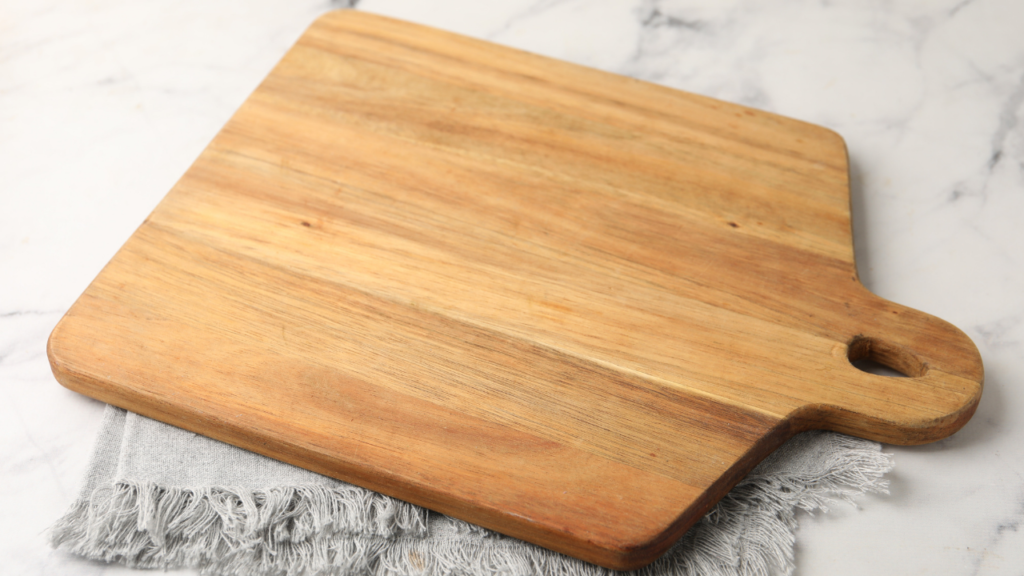
Wood boards are usually made from hardwoods such as maple, walnut, or cherry. These woods contain tightly packed fibers that create a dense but slightly forgiving cutting surface.
Wood boards are commonly manufactured in two primary styles.
Edge-grain boards
- Constructed by aligning long wood fibers horizontally
- Durable and widely used in home kitchens.
- Moderately gentle on knife edges
End-grain boards
- Built with wood fibers facing upward toward the knife
- Knife blades pass between fibers rather than cutting across them.
- Often considered the most knife-friendly surface.
The natural fiber structure allows the surface to absorb minor knife contact while maintaining stability during prep.
Plastic Cutting Boards
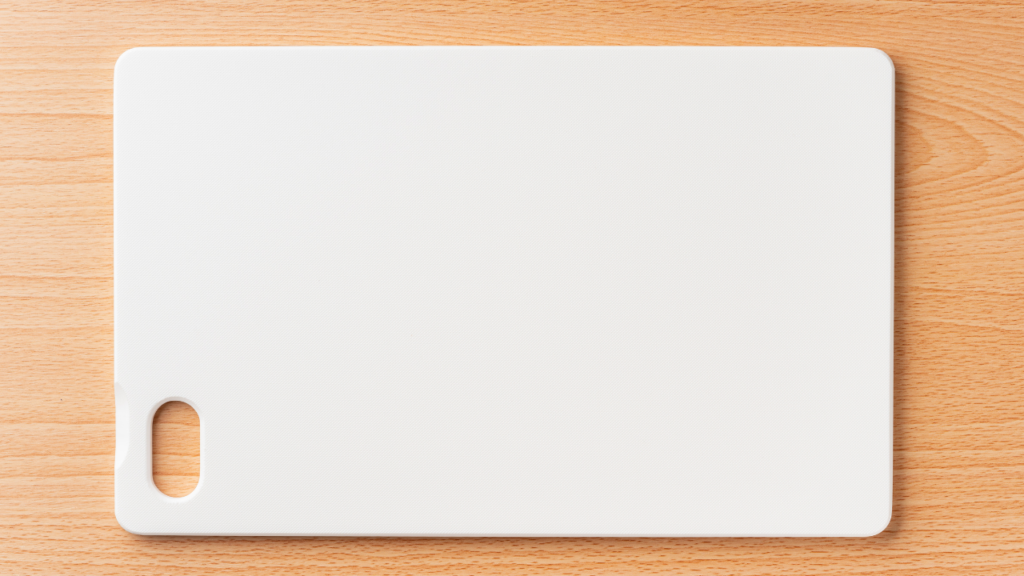
Plastic boards are typically made from polyethylene or similar food-safe polymers. These boards are manufactured by molding or compression, resulting in a uniform, nonporous surface.
Plastic boards behave differently from wood in several ways.
- The surface does not contain natural fibers.
- Knife marks remain visible as shallow grooves.
- Boards can be cleaned aggressively with hot water or a dishwasher.
Because plastic boards are easier to sanitize, they are commonly used in professional kitchens when handling raw proteins.
Bamboo Cutting Boards
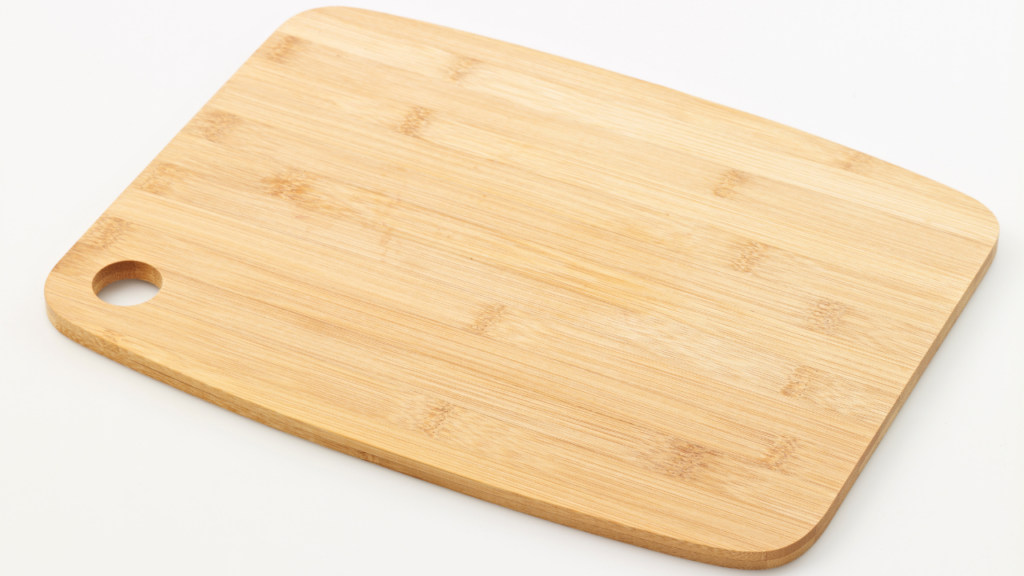
Bamboo boards are often mistaken for wood boards, but bamboo is technically a grass rather than a hardwood. To create a cutting board, bamboo strips are laminated together with adhesives and compressed into a rigid surface. This manufacturing process produces a board that is usually harder than many wooden boards.
Key characteristics include:
- Dense laminated construction
- High surface hardness
- Lower flexibility under knife pressure
While bamboo boards are durable and moisture-resistant, their harder surface can be slightly tougher on knife edges than most hardwood boards.
The Foundational Principle
Regardless of material, the purpose of a cutting board is to provide a stable preparation surface that protects both the cook and the tools being used.
A good cutting board should support three essential goals.
- Maintain safe food preparation practices.
- Provide enough surface grip for ingredient control.
- Protect knife edges from unnecessary wear.
When the board supports these functions, cutting becomes more controlled, sanitation becomes easier to manage, and knives maintain their sharpness longer.
How Board Material Influences Knife Control, Sanitation, and Ingredient Handling
A cutting board is not simply a surface to protect the countertop. Its material directly affects how the knife behaves, how ingredients move during prep, and how safely the surface can be cleaned after use. Surface hardness, texture, and moisture behavior all influence how comfortably and safely a cook can work.
Surface Hardness and Knife Control
When a knife contacts the board, the blade edge meets resistance from the surface beneath it. The board’s hardness determines how that contact behaves.
A board that is too hard causes the knife edge to stop abruptly with each cut. Over time, this repeated impact dulls the blade faster and reduces cutting precision.
A slightly forgiving board allows the blade to complete its downward movement without harsh resistance. This protects the edge and helps maintain smoother, more controlled cuts.
Texture also plays a role. A board with a subtle surface grip keeps ingredients stable while the knife moves through them. If the surface is overly slick or heavily scarred with deep grooves, ingredients can slide unexpectedly.
Good cutting control depends on a surface that balances firmness with slight give.
Sanitation, Moisture, and Cleaning
Cutting board materials also behave differently when exposed to moisture, food residue, and bacteria.
- Plastic boards are nonporous, allowing them to be cleaned aggressively with hot water or in the dishwasher. However, repeated knife cuts can create shallow grooves where food particles may collect if the board is not cleaned thoroughly.
- Wood boards absorb small amounts of moisture and contain natural fibers that close slightly after cutting. When properly maintained and cleaned promptly, this structure helps limit the depth of surface damage and reduces long-term buildup.
- Bamboo boards are dense and moisture resistant, but their laminated construction means the surface behaves more like a rigid panel than a flexible fiber surface.
The key factor is not simply the material, but how consistently the board is cleaned, dried, and maintained after use.
Ingredient Stability During Prep
Board texture and friction affect how ingredients behave under the knife. A slightly grippy surface helps keep vegetables, herbs, and proteins stable during slicing and chopping. This stability improves both safety and consistency.
If the board surface is too smooth, wet ingredients may slide across the board while cutting. If the board becomes deeply scarred with grooves, small ingredients can catch in the cuts and disrupt knife movement.
The board should support clean, predictable knife travel without unexpectedly shifting ingredients.
When the Wrong Board Creates Problems
Using the wrong cutting board surface can introduce several common issues in everyday cooking.
- A very hard board can dull knives quickly, making cutting feel harsh or uncontrolled.
- A heavily scored board may trap food particles, creating sanitation concerns if not cleaned properly.
- An unstable or slick surface may cause ingredients to slip during cutting, increasing the risk of uneven cuts or knife accidents.
Choosing a board with the right balance of durability, surface grip, and cleanability helps maintain better knife performance and safer ingredient handling during daily prep.
Where Different Board Types Appear in Real Kitchens
Different cutting board materials appear in kitchens for practical reasons. The choice is rarely about preference alone. It reflects sanitation practices, prep volume, and how the board interacts with knives during daily work. Professional kitchens and home kitchens often approach this differently because their priorities and workloads differ.
Task Separation in Professional Kitchens
In professional kitchens, cutting boards are often separated by task to maintain sanitation and prevent cross-contamination.
Many kitchens follow a color-coded board system that assigns specific boards to specific food categories. This allows cooks to work quickly while maintaining clear food safety boundaries.
Common examples include:
- Red boards are used for raw meats.
- Blue boards are used for raw seafood.
- Green boards are used for fruits and vegetables.
- Yellow boards are used for poultry.
- Whiteboards are used for dairy or bakery work.
Plastic boards are widely used in these environments because they can be cleaned aggressively and sanitized repeatedly throughout the day. This separation system allows multiple cooks to work simultaneously while maintaining clear sanitation control.
Typical Material Choices in Professional Prep
While plastic boards dominate many prep stations, wood boards still appear in certain areas of professional kitchens. Wood boards are commonly used for tasks where knife care and cutting control are especially important.
Examples include:
- Vegetable prep stations where high volumes of slicing and chopping occur
- Bread slicing or pastry work, where a stable surface is needed
- Charcuterie or service boards are used for presentation.
These boards provide a slightly forgiving surface that helps maintain knife sharpness during long prep shifts. However, sanitation requirements often determine where wood boards can be used within a commercial kitchen.
How Home Kitchens Approach Cutting Board Choice
Home kitchens typically operate with fewer boards and less strict separation between tasks. Instead of maintaining multiple color-coded boards, many home cooks balance three practical concerns.
- Durability for everyday use
- Ease of cleaning after different ingredients
- Protection of knife edges over time
For this reason, many home kitchens keep at least two boards available.
- A plastic board is often used when preparing raw proteins because it can be cleaned quickly and thoroughly.
- A wooden board is commonly used for vegetables, herbs, bread, and general prep because it provides a comfortable cutting surface and protects knife edges.
Practical Balance for Everyday Cooking
Unlike professional kitchens, home cooks must balance space, convenience, and maintenance. The goal is not to duplicate a commercial kitchen system. The goal is to create a simple workflow that keeps prep organized while maintaining good sanitation and knife care.
In practice, this often means rotating between two or three boards depending on the ingredients being prepared. This small adjustment helps reduce cross-contamination, protects knives from excessive wear, and keeps ingredient preparation more controlled during everyday cooking.
Choosing the Right Board for Everyday Kitchen Work
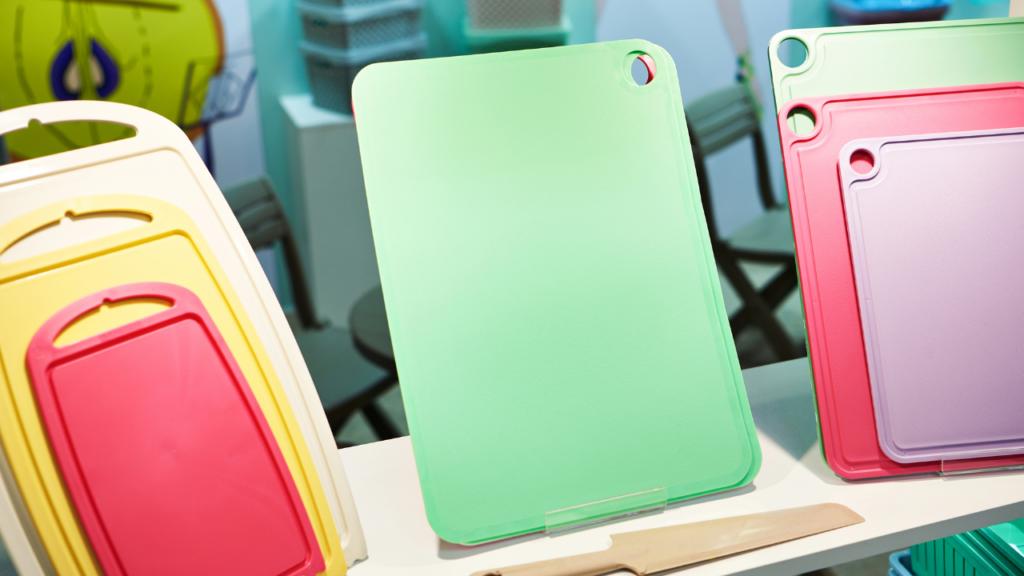
Selecting a cutting board is less about brand or appearance and more about how the board performs during actual preparation. A good board should remain stable, support clean knife movement, and provide enough space to handle ingredients comfortably.
Evaluating a board through these practical factors helps determine whether it will support controlled, efficient prep work.
Evaluating Board Stability
A cutting board should remain firmly in place while you work. Movement during cutting reduces control and increases the chance of uneven cuts or accidents.
Several factors influence stability.
- Board weight: Heavier boards tend to remain more secure during repetitive chopping and slicing
- Surface contact: The board should sit flat against the counter without rocking
- Counter friction: Smooth countertops may require a damp towel or a non-slip mat under the board
If the board shifts when pressure is applied with the knife, stability needs to be improved before continuing prep.
Checking Surface Condition
The cutting surface should allow the knife to move smoothly while maintaining control over the ingredients.
Over time, repeated knife contact leaves visible marks on any cutting board. These marks are normal, but the depth and pattern of the scoring matter.
Look for several signs when evaluating surface condition.
- Shallow, even knife marks are typical and usually harmless.
- Deep grooves can trap food particles and disrupt knife movement.
- Warping or uneven surfaces may cause the board to rock on the counter.
A board that has become heavily scored or uneven may need resurfacing or replacement.
Matching Board Size to Workspace
Board size plays a major role in how comfortably ingredients can be handled.
A board that is too small forces ingredients to crowd together, reducing efficiency and making clean cuts more difficult. It also increases the likelihood that ingredients will fall off the board during prep.
A properly sized board allows room for three working zones.
- A cutting area where the knife is actively used
- A holding area where uncut ingredients wait
- A finished area where chopped ingredients can be moved temporarily
This workspace organization helps maintain a steady rhythm during prep.
Sensory Signals During Cutting
A cutting board provides physical feedback while you work. Paying attention to these signals helps determine whether the board is supporting proper knife movement.
Several cues can indicate how well the board is performing.
- Board movement suggests insufficient stability.
- Knife bounce or harsh impact may indicate a surface that is too hard.
- Excessive resistance may signal a heavily scarred surface.
- Ingredients sliding unexpectedly can indicate a surface that is too slick.
These signals appear quickly during prep and help cooks adjust their setup before problems develop.
Choosing a Board Based on the Task
Different ingredients place different demands on the cutting surface. Matching the board to the prep type improves both safety and efficiency.
Consider several common scenarios.
- Vegetable and herb prep benefits from a knife-friendly surface, such as wood, that supports repeated slicing and chopping
- Raw protein preparation often favors plastic boards that can be cleaned aggressively.
- Bread slicing or pastry work works well on stable boards with enough surface grip to hold the ingredient in place.
The goal is not to find a single perfect board for every task. Instead, the goal is to select a board that supports the specific preparation work being done at that moment.
By evaluating stability, surface condition, and prep needs, cooks can choose a cutting surface that improves control and keeps the preparation process efficient and predictable.
Misunderstandings About Cutting Board Safety and Performance
Cutting boards are often discussed in terms of safety and durability, but many common assumptions about them are oversimplified. Material choice does influence performance, but sanitation and longevity depend more on how the board is used and maintained than on the material alone.
Understanding these misconceptions helps cooks make better decisions about board care and replacement.
The Idea That Plastic Boards Are Always More Sanitary
Plastic cutting boards are frequently described as the most sanitary option because they are nonporous and can be washed in dishwashers or cleaned with strong sanitizers.
This advantage is real, but it does not automatically make plastic boards safer in every situation.
Repeated knife use creates shallow grooves in plastic surfaces. These grooves can hold food particles and moisture if the board is not cleaned carefully. When cleaning is rushed or inconsistent, residue may remain inside those knife marks.
Wood boards behave differently. The natural fiber structure can absorb small amounts of moisture, helping limit deep surface scoring. When wood boards are cleaned promptly and allowed to dry fully, the surface remains stable and usable for long periods.
In practice, sanitation depends less on the material and more on consistent cleaning and drying after each use.
The Assumption That Harder Boards Perform Better
Another common belief is that a harder cutting board must be more durable or longer lasting. While hardness can improve resistance to visible wear, it also affects how the board interacts with knife edges.
Very hard surfaces stop the knife abruptly at the end of each cut. This repeated impact gradually dulls the blade faster than a slightly forgiving surface would.
Boards made from dense bamboo or certain composite materials often feel extremely durable, but their rigidity can increase long-term knife wear. A good cutting board balances durability with enough surface forgiveness to protect knife edges during repeated use.
The Real Risk Comes From Poor Maintenance
Many cutting board safety problems arise not from the material itself but from inconsistent cleaning or poor maintenance. Leaving boards wet for long periods can allow residue to build on the surface.
Failing to scrub knife grooves thoroughly may allow food particles to remain after washing. Using the same board repeatedly without cleaning between tasks can increase the risk of cross-contamination.
Proper board care is straightforward.
- Wash the board promptly after use.
- Use hot water and appropriate cleaning tools.
- Allow the board to dry completely before storing.
- Replace boards that develop deep grooves or unstable surfaces.
When these habits are consistently followed, both wood and plastic boards can be safely maintained for everyday cooking.
The Practical Takeaway
No cutting board material automatically guarantees safety or durability. Plastic boards offer easy sanitation. Wood boards protect knife edges and provide a stable prep surface. Bamboo boards provide durability but require attention to knife wear.
The safest board is the one that is cleaned regularly, maintained properly, and replaced when wear begins to affect performance.
Comparing Wood, Plastic, and Bamboo Boards
Wood, plastic, and bamboo cutting boards all support everyday food preparation, but they behave differently under a knife and require different care. The main differences appear in surface hardness, knife friendliness, sanitation management, and long-term durability.
Understanding these distinctions helps cooks choose the board that best supports the type of prep they perform most often.
Cutting Board Material Comparison
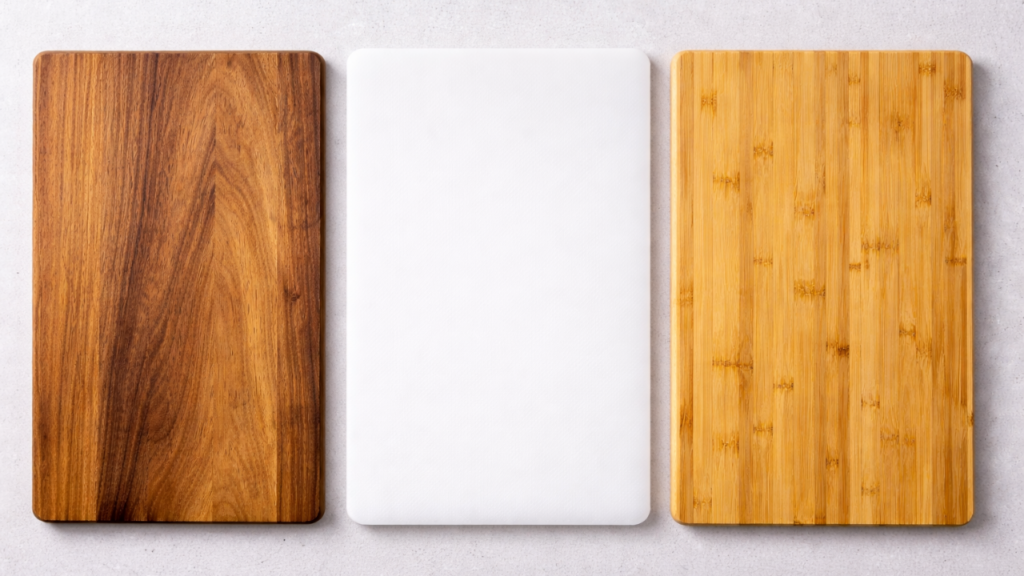
| Surface Hardness | Moderately firm with slight natural give | Firm synthetic surface | A harder surface may dull knives faster |
| Knife Friendliness | Very gentle on knife edges | Resists visible wear, but surface remains rigid | Often, the hardest surface is due to compressed fibers |
| Sanitation Management | Hand wash and dry thoroughly | Can be cleaned aggressively and often dishwasher safe | Hand wash and dry thoroughly |
| Surface Wear Over Time | Shows knife marks gradually but remains stable | Develops visible grooves from repeated cutting | Minimal oiling, but should be dried carefully |
| Maintenance Requirements | Occasional oiling recommended | Minimal maintenance required | Resists visible wear, but the surface remains rigid |
| Typical Kitchen Uses | Vegetables, herbs, bread, general prep | Raw proteins, quick sanitation tasks | Durable general prep boards |
How to Think About These Differences
Wood boards
- Best for protecting knife edges during frequent prep work.
- Provide good ingredient stability and cutting control.
- Require hand washing and occasional oiling.
Plastic boards
- Easiest to sanitize and commonly used for raw protein prep.
- Require minimal maintenance.
- May develop deep grooves over time and need replacement.
Bamboo boards
- Durable and resistant to moisture.
- A harder surface may increase knife wear.
- Require similar care to wood boards, but usually less oiling.
Practical Kitchen Strategy
Most kitchens benefit from using multiple cutting boards rather than relying on a single surface.
A common and practical setup includes:
- A wooden board for vegetables, herbs, and general knife work
- A plastic board for raw meat, poultry, or seafood
- A secondary board for bread, fruit, or quick prep tasks
This simple rotation keeps knives sharper, supports safer food preparation, and allows each board to be used where it performs best.
Situations Where a Different Board Choice Makes Sense
A single cutting board can handle many kitchen tasks, but different ingredients and prep volumes place different demands on the surface. The most practical approach is to select the board that best supports the work being done at that moment.
Professional kitchens regularly adjust cutting boards based on the type of preparation. Home cooks can benefit from the same awareness, even with a smaller set of boards.
Heavy Vegetable Preparation
Large vegetable prep sessions involve repeated slicing, chopping, and dicing. During this type of work, knife-edge protection and ingredient stability become especially important.
Wood boards often perform well in these situations because they provide a slightly forgiving surface that reduces stress on the knife edge. The natural texture also helps keep vegetables stable during repetitive cuts.
Tasks that benefit from this type of board include:
- Chopping onions, carrots, and celery for soups or sauces
- Slicing large quantities of vegetables for stir-fries or roasting
- Preparing herbs and aromatics that require controlled knife movement
Using a knife-friendly surface helps maintain cutting consistency during extended prep sessions.
Raw Meat and Poultry Preparation
When handling raw proteins, sanitation becomes the primary concern. These ingredients require careful separation from other foods to reduce the risk of cross-contamination.
Plastic boards are commonly used for this work because they can be cleaned aggressively and sanitized easily after use. Typical situations include:
- Trimming raw chicken or portioning poultry
- Cutting raw beef, pork, or seafood
- Preparing ingredients that require immediate cleaning afterward
Once the protein preparation is complete, the board should be thoroughly washed before being used again for other ingredients.
Bread and Delicate Ingredients
Certain ingredients benefit from a stable surface that provides gentle support during cutting. Bread slicing, pastry preparation, and delicate fruit work often require controlled pressure rather than heavy chopping.
Boards used for these tasks should offer:
- Enough surface grip to prevent sliding
- A stable, flat working area
- A surface that supports smooth knife travel
Wood boards frequently perform well here because they provide both stability and control.
Rotating Boards During Prep
In many cooking situations, more than one board may be used during the same meal preparation.
For example, a cook might:
- Chop vegetables on a wooden board.
- Switch to a plastic board when trimming raw chicken.
- Return to a separate board for slicing herbs or garnishes.
This rotation keeps tasks organized while maintaining sanitation boundaries. The goal is not to complicate the workflow but to create a simple structure that prevents cross-contamination and protects knife performance.
The Situational Nature of Board Selection
There is no single cutting board that performs best for every ingredient and every task. Board selection depends on several practical factors:
- The type of ingredient being prepared.
- The volume of prep being done.
- Sanitation requirements between tasks.
- The cook’s preference for knife feel and maintenance.
Understanding these variables allows cooks to adjust their setup as needed rather than relying on one universal solution. When board choice is treated as a situational decision, ingredient preparation is safer, knives stay sharper longer, and kitchen workflow is more organized.
Quick Takeaways
- Cutting board material affects knife longevity, sanitation control, and prep efficiency.
- Wood boards protect knife edges but require more care.
- Plastic boards are easy to sanitize and common for protein prep.
- Bamboo boards are durable but often harder on knife edges.
- Choosing the right board improves control and consistency during prep.
Frequently Asked Questions About Cutting Boards
Several common questions come up when choosing and maintaining cutting boards. These short answers clarify practical concerns many home cooks encounter.
Are wooden cutting boards sanitary for raw food preparation?
Yes, when they are cleaned and dried properly. Hardwood fibers limit deep surface damage and allow the board to remain stable during repeated use. Many cooks still prefer using a plastic board for raw meat because it can be sanitized aggressively, but sanitation ultimately depends on cleaning habits rather than the material itself.
Why do some chefs prefer wood boards over plastic?
Wood boards are gentler on knife edges and provide better cutting control. The natural fiber structure allows the blade to finish each cut with a slight give, reducing edge wear during heavy prep work.
Does bamboo damage knives faster than other boards?
Bamboo boards are usually harder than most hardwood boards because they are made from compressed, laminated fibers. This durability resists visible wear but can cause knives to dull faster than on traditional wood-cutting surfaces.
How often should a cutting board be replaced?
Replace a board when deep grooves trap food, the surface warps, or cracks form that are difficult to clean. Plastic boards usually need replacement sooner, while wood boards can often be resurfaced to restore a smooth cutting surface.
What size cutting board works best for everyday cooking?
A board around 12 × 18 inches or larger works well for most kitchens. This size allows space for active cutting, holding uncut ingredients, and moving finished ingredients without crowding the work surface.
Kitchen Tools That Support This Concept
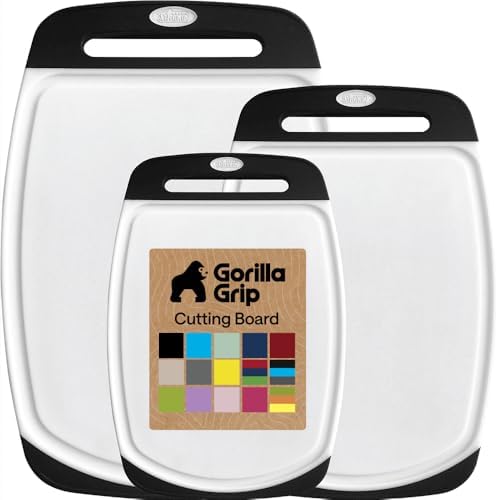


The right tools support safe preparation, protect knife edges, and keep the cutting surface organized during daily prep. These tools help reinforce the cutting board principles explained above.
End Grain Wooden Cutting Board
An end-grain wooden cutting board is one of the most knife-friendly surfaces available. The wood fibers face upward, allowing the blade to move between them rather than cutting across them. This reduces the impact on the knife edge during repeated cutting.
Benefits include:
- Gentle surface that protects knife edges.
- Stable ingredient control during chopping and slicing.
- Long service life when properly maintained.
What to look for
- End-grain construction rather than edge-grain construction.
- At least 1.5 to 2 inches thick for stability.
- Hardwood materials such as maple or walnut.
High-Density Plastic Cutting Board
A high-density plastic cutting board is commonly used when sanitation is the priority. These boards tolerate aggressive cleaning and are widely used for preparing raw protein.
Benefits include:
- Nonporous surface that cleans easily.
- Dishwasher safe in many cases.
- Practical for preparing raw meat, poultry, and seafood.
What to look for
- High-density polyethylene construction.
- Thick board that resists warping.
- Non-slip feet or a textured underside.
Bench Scraper
A bench scraper allows cooks to move chopped ingredients without dragging the knife blade across the board. This helps protect the knife edge and keeps the cutting surface organized during prep.
Benefits include:
- Efficient transfer of chopped ingredients.
- Less wear on knife edges.
- Cleaner and faster prep workflow.
What to look for
- Stainless steel blade.
- Comfortable handle grip.
- Straight edge, wide enough to easily scoop ingredients.
Closing and Next Step
Cutting boards are more than a simple prep surface. The material you choose influences knife performance, sanitation practices, and how comfortably ingredients can be handled during everyday cooking.
Wood, plastic, and bamboo boards each offer different advantages. Wood boards tend to protect knife edges and support controlled cutting. Plastic boards simplify sanitation when handling raw proteins. Bamboo boards provide durability but may feel firmer under the knife.
The most practical approach is to avoid relying on a single board for every task. Instead, choose the surface that supports the ingredient being prepared and maintain it with consistent cleaning and care.
Understanding how cutting boards interact with knives and ingredients helps create a safer, more controlled prep environment in the kitchen.
Continue Building Your Kitchen Know How
If you want to improve control and efficiency during prep work, the next step is to understand how knives and cutting techniques interact with the cutting surface.
Explore these Kitchen Know How lessons to continue building your skills:
- Choosing the Right Knife: Chef’s Knife vs Paring Knife vs Serrated Knife
- How Knife Sharpness Affects Control and Precision
- Small Dice Technique: Why Uniform Cuts Cook More Evenly
Each concept builds on the same foundation: when the tools and surfaces in your kitchen work together properly, cooking becomes more predictable and more confident.