
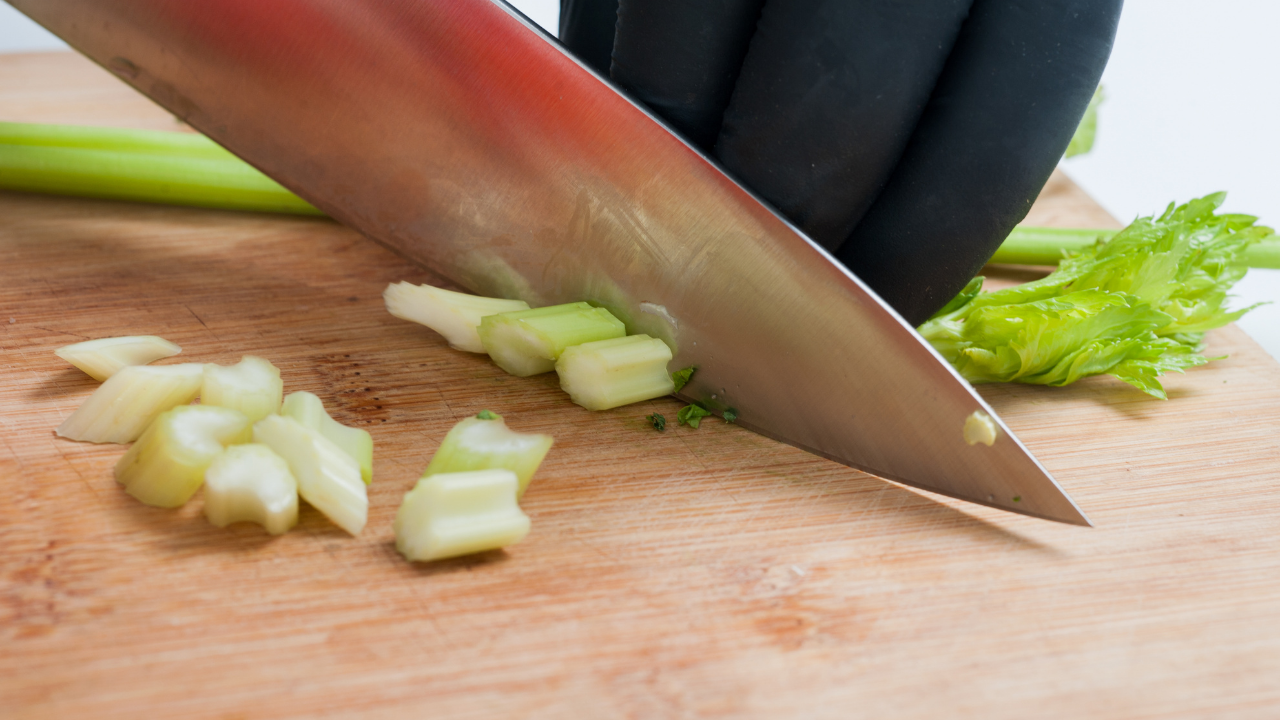
A rough chop is one of the most common knife tasks in professional kitchens — and one of the most misunderstood at home.
In this lesson, Chef Mark Sandoval demonstrates how to rough chop celery with control and intention. This technique is for home cooks who want to move faster while maintaining consistency, safety, and purpose at the cutting board.
A rough chop is not careless cutting. It is controlled, efficient prep designed for soups, stocks, braises, and everyday cooking where uniformity matters — even when precision does not.
Watch: Chef Mark Sandoval Demonstrates Celery Rough Chop
In this video, Chef Mark walks through the technique step by step, focusing on control, consistency, and knife awareness.
What You’ll Learn
- What “rough chop” actually means in professional kitchens
- How to cut celery quickly while maintaining uniform size
- What visual cues signal proper control
- When precision matters, and when it doesn’t
Ingredients Overview
Celery stalks: Choose firm, crisp stalks with tight ribs and no internal hollowness. Fresh celery maintains its structure under the knife, producing cleaner, more controlled cuts.
This lesson focuses on knife execution, not on seasoning or recipe development.
Tools You’ll Need
- Chef’s knife: A sharp, well-balanced knife allows clean cuts and better control. Dull blades require force and reduce precision.
- Cutting board: Use a stable board large enough to give you room to work without crowding the knife path.
- Damp towel: Place it under the board to prevent it from moving. Stability is foundational to safe knife work.
Optional:
- Bench scraper: Useful for transferring chopped celery without dragging the knife edge across the board.
Technique Breakdown
Step 1: Stabilize the Celery
- Trim the root end and, if needed, separate the stalks.
- Lay each stalk flat before cutting. If it rocks, rotate it until it rests securely on the board. Stability always comes before speed.
Chef Mark maintains a relaxed but secure grip. The blade moves with intention, pressure is controlled, never forced. A stable ingredient produces a stable cut.
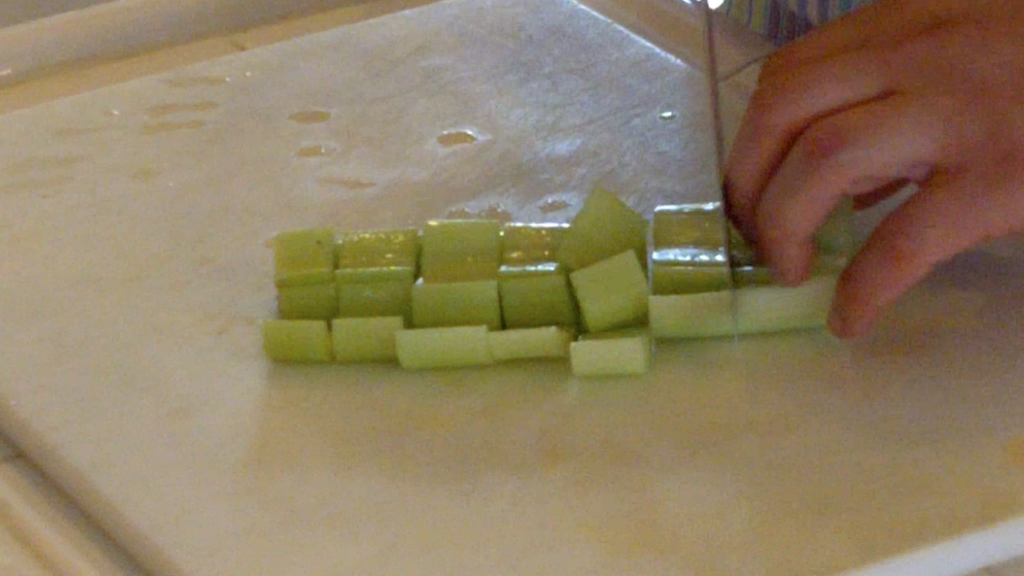
Step 2: Establish the Cut Size
A rough chop is larger and less exact than a dice, but it is still deliberate.
Before cutting, decide the approximate size based on how the celery will be used.
Pieces should be:
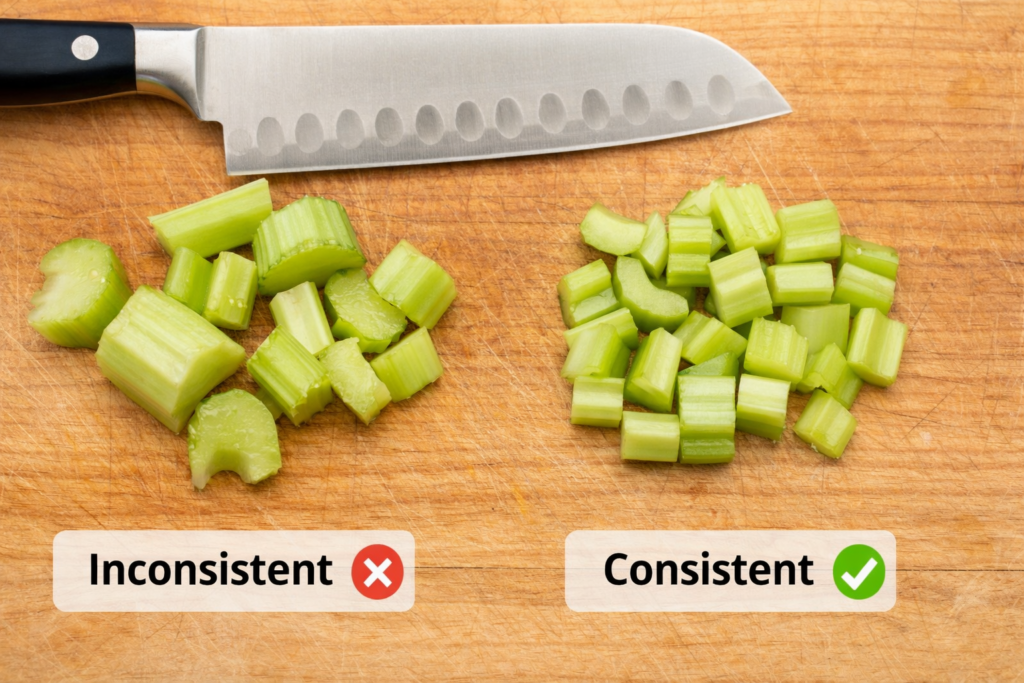
- Relatively even
- Large enough to hold the structure during cooking
- Small enough to cook at a similar rate
The objective is consistent cooking, not visual symmetry.
Step 3: Use a Controlled Rocking Motion
- Keep the knife tip in light contact with the board.
- Use a smooth rocking motion while advancing the celery with your guiding hand in a claw position. Fingers stay tucked; knuckles guide the blade.
- Listen for a steady, rhythmic contact with the board. Clean sound indicates control. Heavy impact often signals excess force.
Speed develops naturally from rhythm. It is never chased.
Step 4: Maintain Awareness of End Use
- For stocks and long-simmered soups, larger, uneven pieces are acceptable. Precision is less critical because extended cooking breaks down the structure.
- For sautéing or braising, slightly more uniform pieces promote even texture and prevent some pieces from softening too quickly.
A rough chop adapts to context. Professional cooking is less about memorizing cuts and more about understanding why you are making them.
Key Chef Tips
- Cut with intention. Decide the final use before you begin, so the size supports the cooking method.
- Keep your guiding hand slightly behind the blade edge, with knuckles forward. The blade should contact your knuckles, not your fingertips.
- If control slips, stop and reset your stance. Speed never compensates for instability.
- Listen to the knife. A steady, rhythmic sound against the board indicates controlled motion. Loud impact usually signals excess force.
Common Mistakes to Avoid
| Mistake | Why It Happens | Correction |
| Cutting pieces too large | Confusing “rough” with unstructured cutting | Maintain relative consistency so pieces cook at a similar rate |
| Inconsistent sizing | Rushing or failing to guide the blade with knuckles | Slow down and reestablish hand positioning before continuing |
| Letting celery roll | Skipping stabilization before the first cut | Rotate the stalk until it rests flat and stable on the board |
| Forcing speed | Trying to work faster than your control allows | Focus on rhythm and control, speed develops naturally |
When to Use This Technique
Roughly chopped celery works best when structure matters more than visual precision.
Use this cut for:
- Mirepoix for soups and stews
The pieces soften over time, so exact symmetry is unnecessary. - Stocks and broths
Larger pieces release flavor gradually and are strained out later. - Braises
Slightly uneven pieces break down naturally during long cooking. - Slow-cooked sauces
Extended heat reduces the need for tight knife precision.
It is not ideal when:
- Precision presentation matters
Plated dishes benefit from more refined cuts. - Quick sautéing requires even caramelization.
Uneven pieces cook at different rates and brown inconsistently. - Short cook times demand a uniform texture.
Smaller, consistent cuts ensure balance in fast applications.
A rough chop is best for dishes where time and moisture do most of the work. When cooking is quick and dry, more precise cuts become essential.
Understanding the difference builds judgment, and judgment improves every recipe.
Tools That Support Proper Integration



Final Thoughts
A rough chop is simple, but not casual. It reflects control, awareness, and efficiency. Practice this slowly at first. Prioritize stability and rhythm. Speed will follow naturally.
When you’re ready, watch the next Chef Mark Sandoval knife skills video and keep building consistency one cut at a time.
1 thought on “How to Rough Chop Celery Like a Chef (Step-by-Step Knife Skills)”
Comments are closed.