
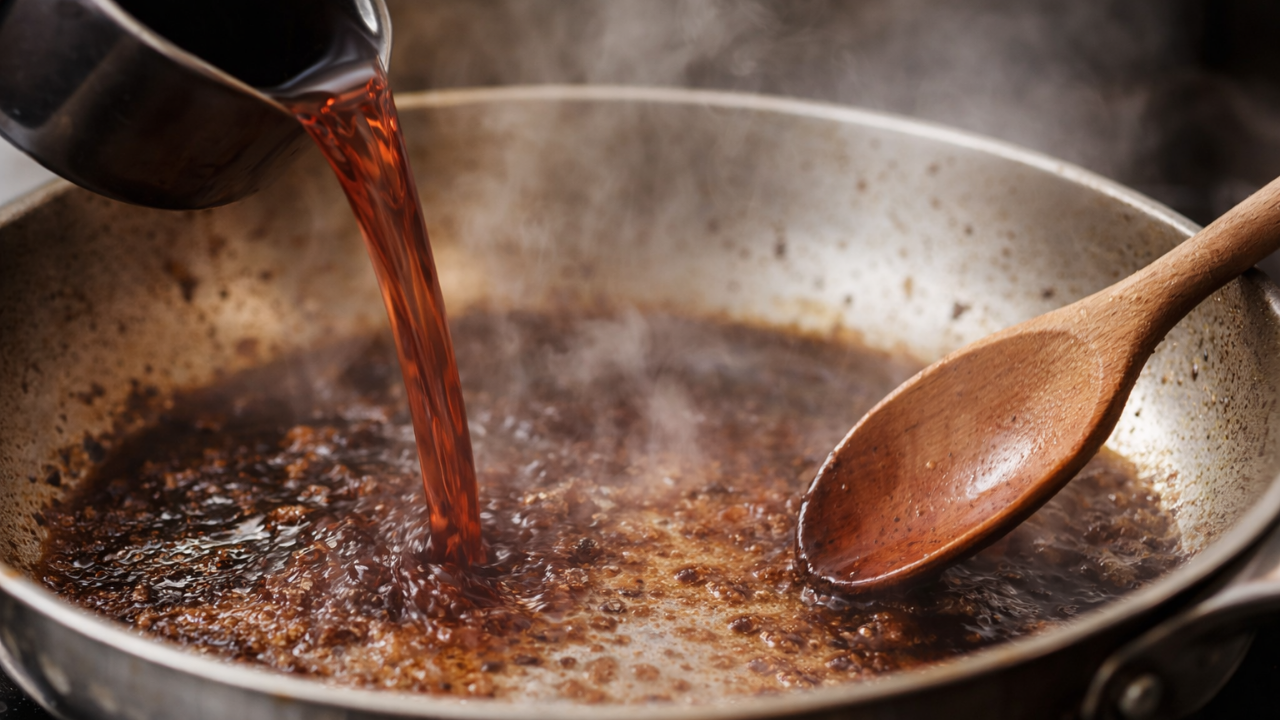
Deglazing is the technique of releasing the browned residue left in a pan after searing or sautéing. That residue holds concentrated flavor created during cooking. When captured properly, it becomes the base of rich, structured sauces.
Most home cooks encounter deglazing without realizing it. After browning meat or vegetables, the pan is left with dark bits stuck to the surface. Many see this as something to scrub away. In reality, it is the most valuable part of the process.
Understanding deglazing shifts how you think at the stove. Instead of separating cooking from sauce making, you begin to see them as connected. The flavor you build during browning does not disappear. It stays in the pan, waiting to be used.
When ignored, that flavor is lost or burned. When understood, it becomes depth, balance, and control in seconds.
What Deglazing Actually Means and Why It Works
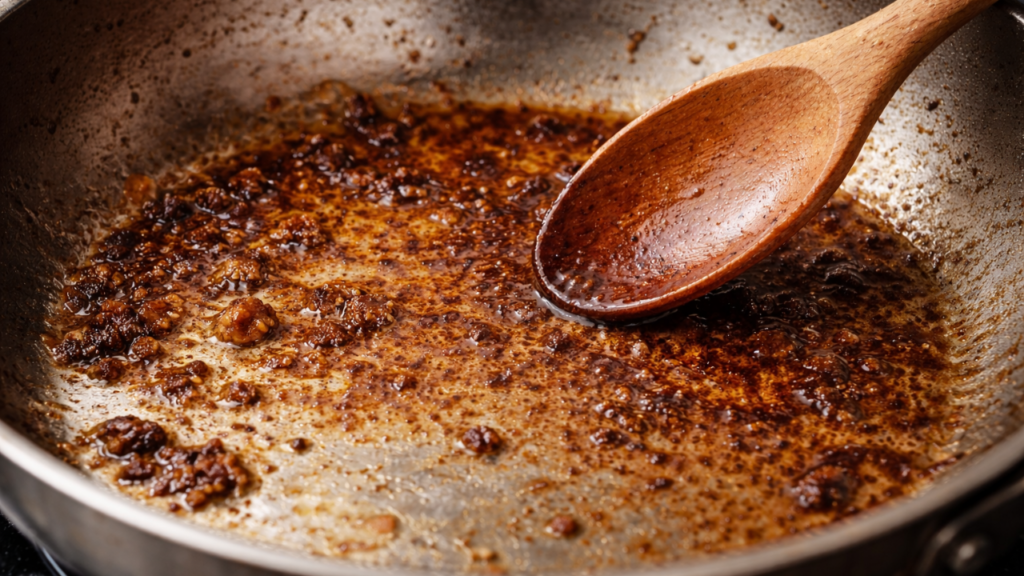
Deglazing is the act of adding a small amount of liquid to a hot pan to dissolve and lift the browned residue left behind after searing or sautéing. The goal is not volume. The goal is to release concentrated flavor from the cooking surface. That browned residue is called fond.
Fond forms when:
• Proteins react to heat
• Natural sugars caramelize
• Compounds bond to the metal surface
This reaction creates deep color and complex flavor. It is not debris. It is a concentrated taste created during browning. Fond develops only when proper browning occurs.
• Stainless steel and cast iron encourage adhesion
• Nonstick surfaces reduce fond formation
• Little browning means little to capture
Deglazing works because:
• Liquid loosens the bonded fond
• Heat accelerates release
• The dissolved flavor integrates into the sauce
What was stuck becomes suspended and usable.
Deglazing is not:
• Simply pouring liquid into a pan
• Boiling down a sauce from scratch
• Adding moisture to fix dryness
It is a targeted extraction of existing flavor.
The principle is direct:
- Browning creates flavor.
- Deglazing transfers that flavor.
Without meaningful browning, there is little depth to capture. Without liquid, that depth remains stuck to the surface.
When both are present, flavor moves from the pan into the dish. Understanding this changes how you evaluate heat, color, and timing. You are no longer just cooking food. You are building and collecting flavor in stages.
How Deglazing Changes Flavor, Structure, and Control
Deglazing directly affects how complete and connected a dish tastes. When understood, flavor becomes layered and intentional. When misunderstood, depth is lost or distorted.
When Deglazing Is Handled Correctly
| What Happens | Why It Improves the Dish |
| Sauces taste fuller | They include concentrated flavor created during browning |
| Pan sauces gain complexity | Depth comes from integrated fond, not extra ingredients |
| Gravies become richer | Flavor connects directly to what was roasted or sautéed |
| Braises start stronger | The base carries a roasted character throughout cooking |
| Cooking feels continuous | Searing and sauce building become one connected process |
When Deglazing Is Misunderstood
| What Happens | Why It Weakens the Dish |
| The sauce tastes thin | Too much liquid dilutes the concentration |
| Burned fond spreads a harsh flavor | Too much liquid dilutes concentration |
| Flavor feels disconnected | Fond was discarded before being captured |
| Little improvement occurs | Browning never developed meaningful depth |
Deglazing is the hinge between heat and liquid. It determines whether the flavor created in the pan becomes part of the dish or is lost. It is not an extra technique. It is how you preserve and transfer flavor with control.
Recognizing Deglazing Across Cuisines and Dishes
Deglazing is not tied to any one cuisine or recipe type. It appears anywhere browning is followed by liquid. Once you recognize the pattern, you begin to see it repeatedly.
| Cuisine or Style | Where Browning Happens | How Deglazing Appears |
| French cooking | Meat seared in a skillet | Fond is lifted to form a pan sauce |
| Italian cooking | Meat browned for ragù | Pan residue is lifted to carry roasting flavor intothe gravy |
| Spanish stews and braises | Aromatics caramelized in a pot | Browned bits are released before adding the main liquid |
| American gravies | Roasted drippings in pans | Pan residue is lifted to carry roasting flavor into gravy |
| Asian stir-fries | High-heat searing in a wok or pan | Small additions of liquid lift flavor quickly from the surface |
You will also see deglazing in:
- Braised short ribs and pot roasts
- Mushroom sauces are built after sautéing.
- Skillet dinners finished with a quick pan reduction.
- Sheet pan meals where drippings are loosened into a finishing sauce
The pattern is consistent:
- Food browns.
- Flavor bonds to the surface.
- Liquid releases it.
- That released flavor becomes part of the final structure.
Recognizing this pattern builds confidence. You stop treating sauce as an afterthought and begin to see it as the continuation of cooking itself.
Deglazing is not an isolated technique. It is a repeated principle that appears wherever browning meets liquid.
Translating Deglazing into Real-Time Judgment
Deglazing is not about memorizing steps. It is about reading the pan and responding with awareness. When you understand what to look for, the decision becomes straightforward. Start by observing the pan’s surface.
Look for these visual signals:
- Visible browned bits adhered to the metal.
- Color that is deep brown rather than pale or black
- A thin layer of residue concentrated in the center or around the edges.
If the pan is clean and smooth with no visible fond, there is little to capture. Deglazing in that moment will add moisture, not depth.
Heat is equally important. The pan should still be hot when liquid is introduced. A hot surface allows the fond to release quickly and integrate into the liquid. If the pan has cooled completely, the liquid will sit without lifting much flavor.
When liquid touches the pan, listen. Sound is one of your clearest indicators of control.
- A controlled sizzle indicates proper heat.
- Silence suggests the pan is too cool.
- Violent smoking suggests excessive heat.
Aroma also guides judgment.
- A rich, roasted smell signals usable fond.
- A sharp, bitter scent signals that the residue may have burned
Color and aroma together determine whether the fond is worth capturing. Decision awareness matters most in borderline situations.
- If the fond is very dark and approaching black, lower the heat before adding liquid. Slowing down prevents bitterness from spreading.
- If the pan is aggressively smoking, reduce the heat first. Deglazing into extreme heat can scorch the liquid and amplify harsh flavors.
- If there is minimal fond, consider whether a sauce is necessary at all. Deglazing is effective because it captures something that already exists.
When something seems off:
- A bitter taste after deglazing usually means the fond was burned. In that case, starting over is more effective than trying to mask it.
- A thin or watery result suggests too much liquid relative to the amount of fond. The issue is balance, not ingredients.
At its core, deglazing trains you to evaluate heat, color, aroma, and sound in real time. You are not following instructions. You are interpreting signals. The pan tells you whether the flavor is ready to be captured. Your job is to notice and respond.
Where Deglazing Goes Wrong and Why
| Misconception | Why It Happens | Burnt fond produces bitterness. It cannot be rescued |
| The browned bits are burnt and should be discarded | Fond looks dark and stuck | True fond is deep brown, not black. Learn to distinguish color and aroma |
| Any liquid works the same way | Focus on quantity, not purpose | Different liquids add different flavors. Choose based on the final dish |
| More liquid equals more sauce | Fear of burning | Small amounts concentrate flavor. Excess liquid dilutes it |
| Deglazing fixes burned food | Confusion between brown and burnt | Burned fond produces bitterness. It cannot be rescued |
These errors usually come from misreading color and heat. The correction is awareness, not complication.
Browning vs Burning: The Critical Distinction
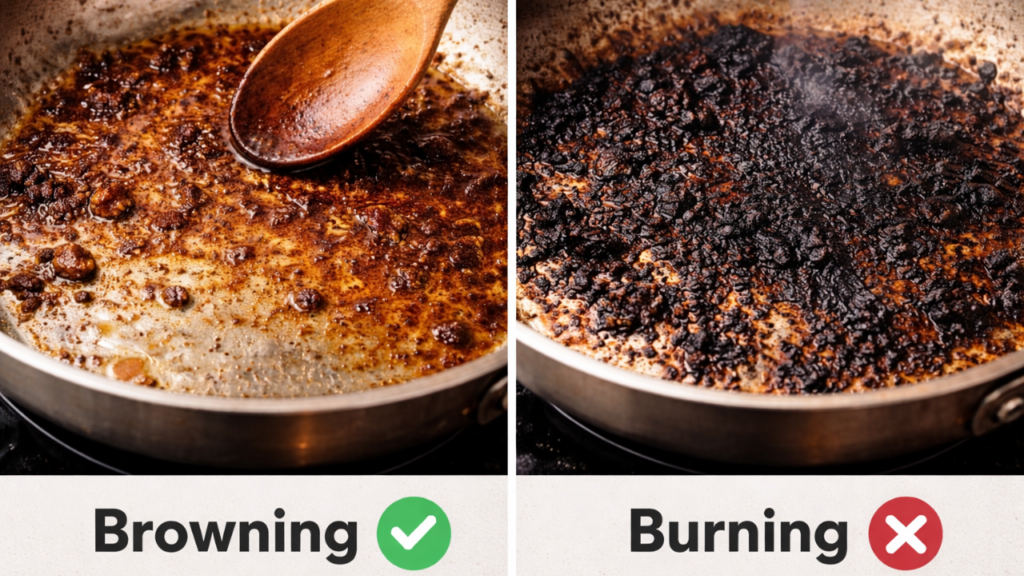
Deglazing only works when the fond is properly browned. If it is burned, releasing it will spread bitterness throughout the sauce.
Browning
- Deep golden to dark brown color
- Even coloration rather than patchy black spots
- Nutty, roasted aroma
- Builds complexity and depth
Browning develops through controlled heat. It signals that proteins and sugars have reacted properly.
Burning
- Blackened or charred surface
- Uneven, overly dark patches
- Sharp, acrid smell
- Creates harsh bitterness
Burning results from excessive heat or inattention. Once bitterness forms, deglazing distributes it rather than fixing it.
Deglazing depends on correct browning. It captures flavor that has developed properly. It cannot correct burned residue.
When Deglazing Is Unnecessary
There are moments when deglazing is unnecessary. If you are cooking delicate foods that do not brown deeply, there may be little fond to capture.
Nonstick pans also reduce fond formation. In these cases, deglazing produces minimal flavor because the surface prevents the flavor from adhering.
In high-heat stir-fry cooking, quick splashes of liquid may lift flavor without forming a traditional fond. The principle still applies, but timing is faster and more controlled.
These are adjustments, not contradictions. The core rule remains: no meaningful browning means no meaningful deglazing.
Quick Takeaways
- Deglazing captures flavor created through browning.
- Fond is concentrated taste, not waste.
- Color and aroma determine whether fond is usable.
- Small amounts of liquid build intensity.
- Burned residue cannot be fixed by deglazing.
FAQs
Do I have to use wine to deglaze?
No. Wine is common because its acidity helps dissolve fond and adds complexity, but it is not required. Stock, broth, water, vinegar, citrus juice, or even tomato-based liquids can work. The liquid should support the dish’s final flavor direction.
Can I deglaze in a nonstick pan?
You can, but the effect will be limited. Nonstick surfaces reduce adhesion, which means fewer fond forms. With minimal fond, there is less concentrated flavor to capture.
Should the pan be hot or cool when deglazing?
The pan should still be hot. Heat allows the liquid to loosen and dissolve the fond quickly. If the pan has cooled too much, the liquid will not lift flavor efficiently.
Why did my sauce taste bitter after deglazing?
The fond likely burned before the liquid was added. Deglazing spreads whatever is in the pan. If the residue is burned, bitterness will carry into the sauce.
How much liquid should I use when deglazing?
Use enough to loosen the fond without flooding the pan. Excess liquid dilutes flavor. The goal is concentration, not volume.
What types of pans produce the best fond?
Stainless steel and cast iron promote adhesion and browning, which encourages fond development. These surfaces typically produce stronger results when deglazing.
Can I deglaze more than once in the same pan?
Yes. If you brown in stages, you can deglaze lightly between rounds or build layers of fond before fully incorporating liquid. The key is managing heat so the residue browns without burning.
Kitchen Tools That Support Proper Deglazing
Stainless Steel Skillet
A stainless steel skillet encourages fond formation because food naturally bonds to the surface during browning. That bonding creates the browned residue needed for proper deglazing.
Unlike nonstick pans, stainless steel makes the development of color and adhesion visible. This helps you evaluate browning in real time and understand whether meaningful flavor has formed.
For learning and practicing deglazing, surface response matters.

Wooden Spoon or Flat-Edge Spatula
Deglazing requires controlled scraping. A wooden spoon or flat-edged spatula allows you to lift browned residue gently without damaging the pan.
The flat edge is especially useful for loosening fond evenly across the surface. It reinforces awareness of heat, texture, and timing.
The goal is not force. It is a controlled release.

Final Thoughts
Deglazing is not complex. It is attention to what the pan is telling you.
When you understand that browning creates flavor and that deglazing transfers it, you begin to cook with continuity rather than treating each step as separate. Searing and sauce building become part of the same process.
You stop washing flavor away. You start collecting it. That awareness alone makes your sauces deeper, more connected, and more intentional.
Explore related Kitchen Know How articles to continue strengthening the way you think at the stove.
3 thoughts on “Deglazing Explained- Build Rich Sauces in Seconds”
Comments are closed.