
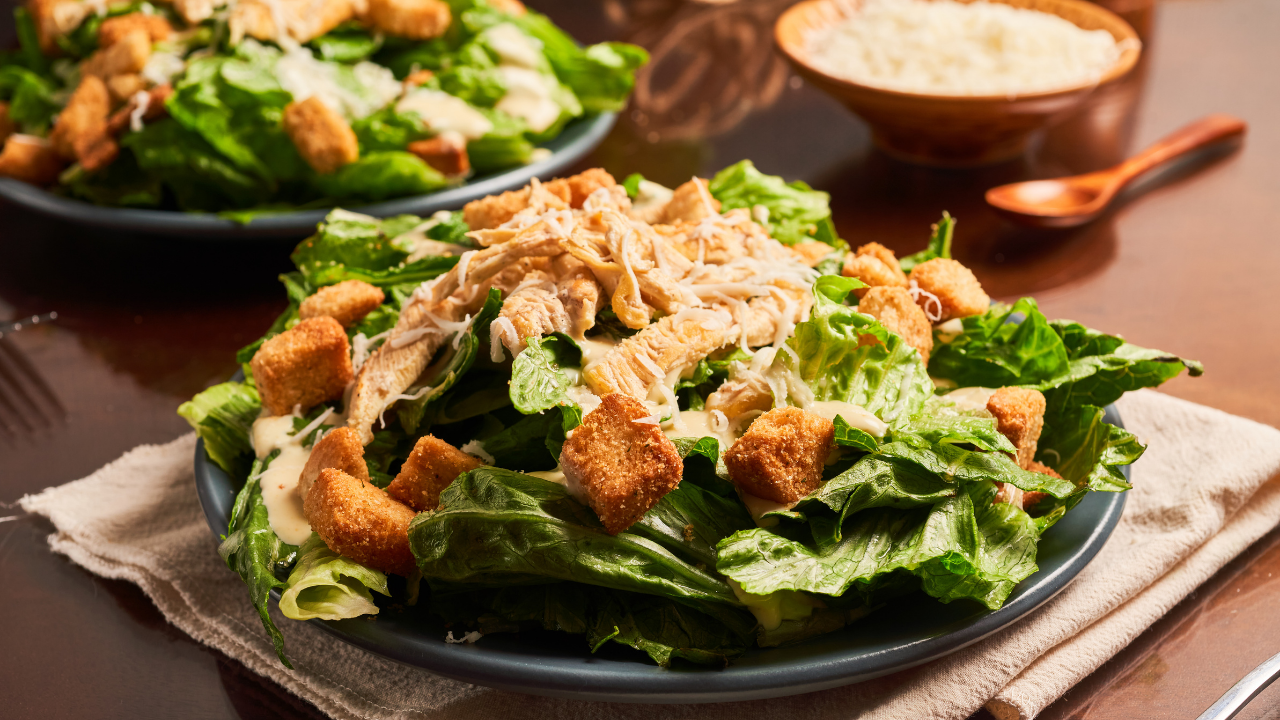
Caesar salad is one of the most recognized salads in modern restaurant culture. It appears simple at first glance: lettuce, cheese, croutons, and a creamy dressing. Because it feels familiar, many cooks assume it is flexible and loosely defined.
That assumption creates confusion. Over time, the dish has been modified, commercialized, and expanded. Bottled dressings, heavy toppings, and sweetened versions have shifted expectations. As a result, many people no longer know what actually makes a Caesar salad a Caesar salad.
Understanding where the salad came from restores structure. It clarifies which elements are foundational and which are later additions. That distinction matters because cooking improves when you understand the framework behind a dish, not just its name.
Home cooks encounter Caesar salad in restaurants, grocery stores, meal kits, and home adaptations. Without context, it becomes a generic base for protein and extras. With context, it becomes a deliberate composition built on balance, texture, and emulsified dressing.
Understanding the origin gives you a reference point. That reference point strengthens your judgment, helps you maintain flavor balance, and prevents small changes from becoming structural mistakes.
The Historical Origin and Foundational Structure of Caesar Salad
Caesar salad was created in the 1920s by Caesar Cardini in Tijuana. It emerged from a professional kitchen serving an international clientele. It was not a rustic family dish passed down through generations in Italy. Despite the name, it is not part of classical Roman cuisine.
This distinction matters because origin shapes intention. The salad was designed for restaurant service. It was built to deliver immediate flavor impact, balanced richness, and clean structure using a limited set of ingredients. It was not designed as a flexible template.
The original version centered on a few specific components:
- Whole romaine leaves
- A dressing built from egg, oil, garlic, lemon juice, Worcestershire sauce, and Parmesan
- Croutons
- Freshly ground black pepper
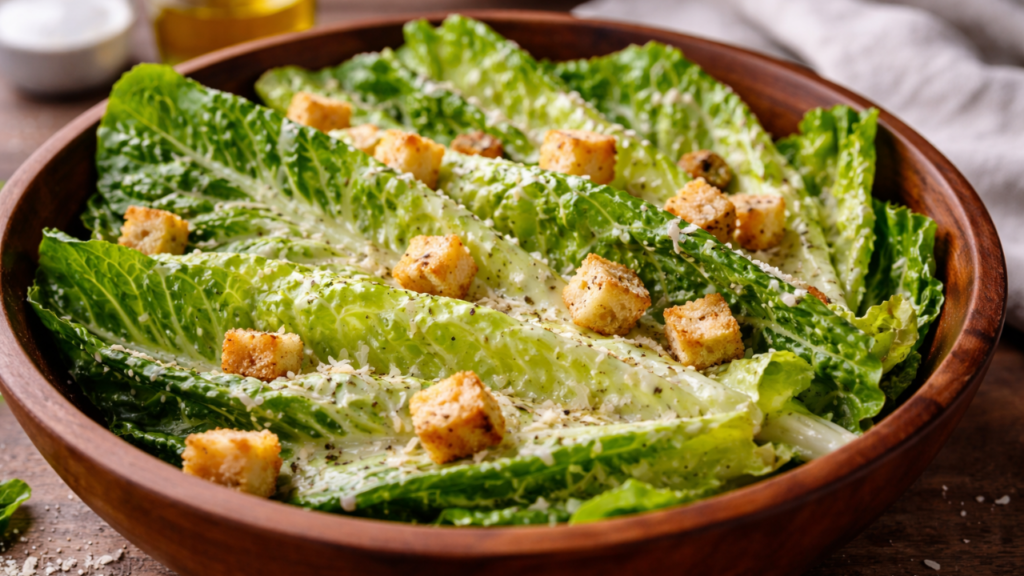
The romaine was served in intact leaves rather than chopped into small pieces. This created structural integrity. Each leaf functioned as a carrier for dressing, cheese, and crunch. The lettuce was not simply a base. It was an active textural element.
The dressing was the defining feature. Egg and oil formed the base of an emulsion. An emulsion is a stable mixture of fat and liquid that would normally separate. When properly formed, it creates a smooth texture that clings evenly rather than pooling at the bottom of the bowl.
Garlic provided sharp aromatic depth. Lemon juice contributed acidity, cutting through the richness. Parmesan delivered salt and umami. Worcestershire sauce added layered savory notes, including anchovy depth, without requiring visible anchovy fillets.
Anchovies were not originally presented as whole fillets on top of the salad. The savory character came indirectly through Worcestershire sauce. Later adaptations emphasized anchovy more directly, but the early structure relied on integrated flavor rather than visible garnish.
The foundational principle is this: Caesar salad is a composed salad defined by an emulsified dressing and a concentrated, savory balance. Every component supports that balance. The lettuce provides crisp freshness. The croutons reinforce contrast. The cheese intensifies umami. The dressing binds everything together.
It is not defined by grilled chicken, bacon, or additional toppings. Those are later additions that shift the salad’s role from composed appetizer to expanded main course.
Understanding what it is not prevents structural confusion. It is not ranch dressing poured over lettuce. It is not a sweet, thick commercial sauce. It is not a neutral base waiting to be customized.
It is a tightly constructed flavor system built on four interacting forces:
- Umami from cheese and Worcestershire
- Acidity from lemon
- Fat from egg and oil
- Crisp texture from romaine and croutons
When you understand this framework, you gain a clear reference point. That reference allows you to evaluate variations, recognize when balance is compromised, and maintain control over flavor structure rather than relying on assumptions.
How Origin Shapes Flavor Balance and Texture
When you understand the original structure, you understand why the salad works and how small shifts affect the outcome.
The dressing is emulsified. That means fat and acid are suspended together in a stable mixture rather than separating. A proper emulsion creates three important results:
- Even coating across each leaf
- Controlled richness without greasiness
- Integrated flavor rather than sharp pockets of acid
If the emulsion breaks or is never properly formed, oil separates. The salad then feels slick instead of creamy. Acid collects at the bottom of the bowl. The result is uneven flavor from one bite to the next.
The flavor profile is deliberate and layered.
- Salt and umami from Parmesan and Worcestershire create depth.
- Bright acidity from lemon sharpens and lifts.
- Richness from egg and oil provides body and mouthfeel.
- Garlic adds aromatic intensity and backbone.
- Romaine contributes crisp texture and mild bitterness to keep richness in check.
These elements are not interchangeable. Each has a structural role.
- If fat dominates, the salad becomes heavy and dull. The palate tires quickly.
- If acidity is low, flavors flatten, and the cheese tastes muted.
- If garlic is excessive, it overwhelms the balance and becomes aggressive rather than supportive.
- If romaine is limp, the salad loses contrast and feels dense.
Texture is just as important as flavor. Caesar salad relies on contrast:
- Crisp lettuce
- Crunch from croutons
- Fine granular texture from grated cheese
- Smooth cling from dressing
When too much dressing is added, crunch disappears and structure collapses. When croutons are soft, the salad lacks contrast. When cheese is thickly shaved rather than finely grated, the distribution of salt becomes uneven.
Misunderstanding the origin often leads to overbuilding. Extra cheese, excessive dressing, grilled chicken, bacon, or sweet elements shift the balance toward heaviness. The dish may still be enjoyable, but it no longer functions as a tightly balanced composition.
Understanding the origin protects proportion. It gives you a reference point for evaluating weight, acidity, salt, and texture before the salad ever reaches the table.
That awareness improves every composed salad you make, not just Caesar.
Recognizing Caesar Salad Across Restaurants and Cuisines
Caesar salad began in Mexico through an Italian American chef and later gained popularity in the United States. It is now considered part of American restaurant cuisine rather than traditional Italian cooking. Understanding that transition helps you recognize why the dish appears in so many different dining contexts.
You will commonly see it in:
- Steakhouse menus
- Italian American restaurants
- Casual chain restaurants
- Hotel dining rooms
- Modern bistros
In steakhouses, it often functions as a bold, savory starter that stands up to rich main courses. In Italian American settings, it may be presented as part of a broader menu that blends tradition with adaptation. In casual chains, it is frequently standardized through bottled dressing and prepped components. In higher-end dining rooms, it may be prepared tableside to emphasize freshness and to control emulsion.
Recognizing these environments helps you anticipate how the salad might be structured before it arrives at the table.
In some settings, the lettuce is left in large pieces to preserve structure. In others, it is finely chopped for convenience. In some kitchens, the dressing is made fresh and emulsified by hand. In others, it is thick, uniform, and slightly sweet, signaling commercial production.
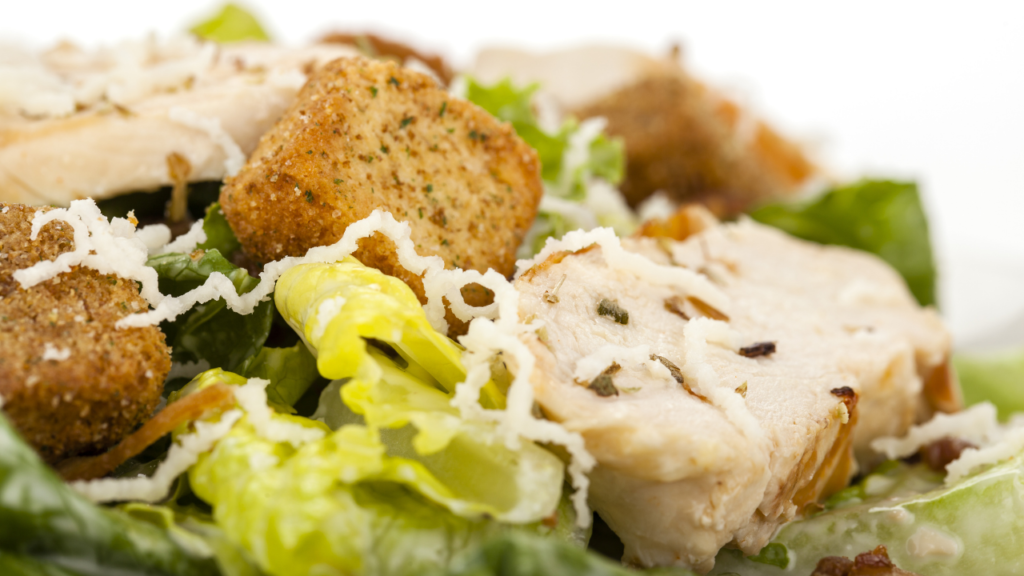
Modern variations introduce grilled chicken, shrimp, salmon, kale, or even alternative cheeses. These versions shift the salad’s role. It moves from composed appetizer to full entrée. The structural balance must then adjust to support heavier components.
When evaluating a Caesar salad, look for structural signals rather than relying on the label:
- Is the dressing light and clingy or dense and creamy?
- Does the lettuce remain crisp and defined or soft and saturated?
- Is salt integrated through grated cheese or concentrated in large shavings?
- Are anchovies integrated into the dressing or presented as a visible garnish?
Visible anchovy fillets reflect later evolution and regional preference. Thick, sweet dressing reflects mass production. Excess protein suggests repositioning of the dish rather than strict adherence to the original structure.
Pattern recognition allows you to separate identity from variation. You learn to see when a dish honors its foundational balance and when it has been adapted for convenience, scale, or modern taste.
This skill improves more than your understanding of Caesar salad. It sharpens your ability to read menus, anticipate flavor, and evaluate structure across cuisines.
Using This Knowledge in Your Own Kitchen
When preparing or evaluating Caesar salad, focus on structural signals rather than trends or additions. The goal is not to replicate history perfectly. The goal is to protect balance.
Watch for these key indicators:
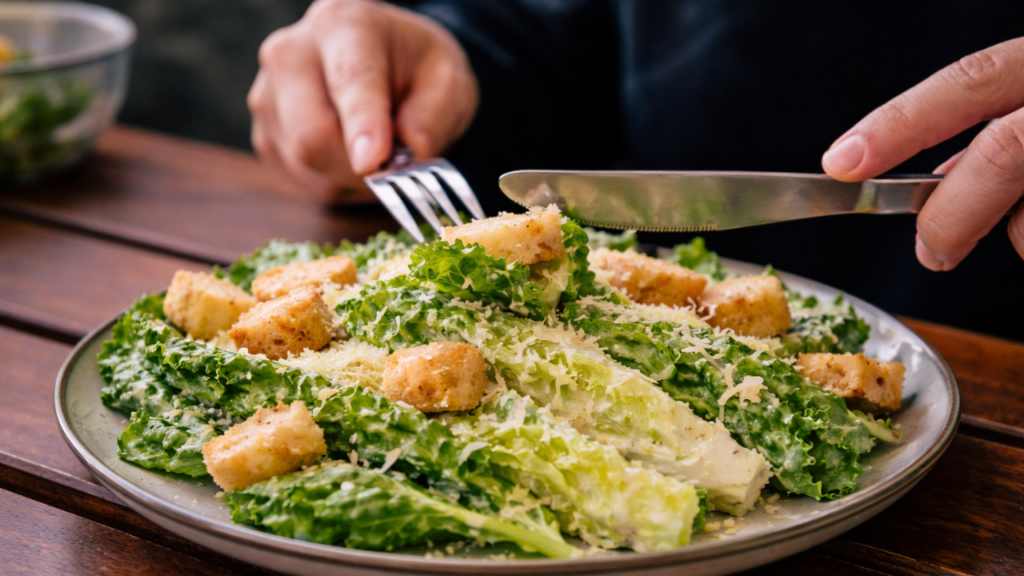
- Coating: Dressing should lightly cling to each leaf without pooling at the bottom of the bowl.
- Texture contrast: Romaine must remain crisp against crunchy croutons and fine-grated cheese.
- Aroma: Garlic should be noticeable but integrated, not sharp or raw.
- Salt balance: Parmesan and Worcestershire contribute salinity. Additional salt may be unnecessary.
- Acid lift: Lemon should brighten the palate and keep richness in check.
When something feels off, diagnose before adjusting. The table below helps translate sensation into correction.
| What You Notice | Likely Structural Cause | Practical Adjustment |
| Salad feels heavy or greasy | Too much fat or weak acid | Increase acidity slightly or reduce dressing quantity |
| Flavor tastes flat | Insufficient acid or umami | Reinforce lemon or savory depth |
| Garlic tastes harsh | Poor integration or excess quantity | Improve emulsification or moderate garlic intensity |
| Leaves feel soggy | Overdressing or weak lettuce structure | Reduce dressing and preserve crisp texture |
| Salt feels uneven | Large cheese shavings or uneven mixing | Use finer cheese distribution and integrate thoroughly |
This approach keeps you inside the framework rather than guessing. Instead of adding sweetness to fix sharpness, you adjust fat. Instead of blindly adding salt, you evaluate the distribution of cheese.
Understanding the origin gives you a stable reference point. You are no longer reacting emotionally to taste. You are diagnosing structure.
That shift builds confidence not only in Caesar salad but in any composed salad built on balance and emulsion.
Frequent Misunderstandings About Caesar Salad
| Misconception | Why It Happens | Correction |
| It is an Italian classic from Rome | The name sounds Italian | It was created in Mexico by an Italian-American chef |
| It requires visible anchovy fillets | Modern interpretations emphasize anchovies | Original flavor often came from Worcestershire sauce |
| Any creamy dressing works | Bottled dressings simplify the concept | Caesar depends on a specific savory emulsion |
| More toppings improve it | Restaurants use it as a base for proteins | The core salad is defined by balance, not additions |
Most mistakes come from assuming the name defines the structure. In reality, the structure defines the dish.
Contextual Variations and When They Make Sense
Over time, Caesar salad has expanded beyond its original structure. Grilled chicken, shrimp, salmon, kale, bacon, and alternative cheeses now appear in many versions. These are adaptations shaped by menu trends, portion expectations, and regional taste.
Adaptations are not inherently wrong. They become problematic only when they fail to maintain structural balance.
When you add grilled chicken or shrimp, the salad shifts from composed starter to main course. Protein introduces weight and moisture. That added weight requires careful control of dressing. Too much dressing creates heaviness. Too little acid makes the plate feel dense.
When kale replaces romaine, bitterness increases, and texture becomes sturdier. Kale holds dressing differently and softens more slowly. The bitterness may require slight adjustments in acid or cheese intensity to maintain harmony. Without awareness, the salad can taste sharp or overly assertive.
When anchovy intensity is increased, the savory depth deepens, but salt concentration rises. If this shift is not controlled, the salad can become aggressively salty rather than balanced.
When bacon is added, smoke and fat enter the system. Smoke competes with garlic. Bacon fat amplifies richness. The salad can quickly lose its clean, bright character.
The critical question is not whether you can adapt the salad. It is whether the adaptation respects the framework:
- Is the emulsion still balanced?
- Does crisp texture remain intact?
- Is acidity sufficient to support added richness?
- Has umami become dominant rather than supportive?
Each modification changes structural forces. Protein increases weight. Bitter greens increase edge. Extra cheese increases salinity. Smoke increases in intensity.
The key is awareness. When you change one element, you must evaluate the ripple effect across fat, acid, salt, and texture. That is how professional kitchens maintain control while evolving dishes.
The core principle does not change. Caesar salad is defined by an emulsified dressing, savory depth, acidity, and crisp contrast. Variations make sense when they operate inside that system rather than replacing it.
Quick Takeaways
- Caesar salad originated in Mexico, not Italy.
- Its identity comes from emulsified dressing and savory balance.
- Worcestershire sauce provided early anchovy depth.
- Texture contrast is essential to its structure.
- Additions are adaptations, not the defining feature.
FAQs
Was Caesar salad originally made with anchovies?
Not as visible fillets. Early versions relied on Worcestershire sauce for layered savory depth, which includes anchovy. The flavor was integrated into the dressing rather than presented as a separate topping. Visible anchovy fillets became more common in later adaptations.
Why is romaine lettuce used instead of other greens?
Romaine provides structural crispness and mild bitterness. Its sturdy ribs hold emulsified dressing without collapsing. Softer greens wilt quickly and lose contrast. The lettuce is not interchangeable without affecting texture and balance.
Is chicken part of traditional Caesar salad?
No. The original version did not include grilled chicken or other proteins. Protein additions developed as restaurants adapted the salad into a main course. Adding protein changes weight and proportion, which requires rebalancing acidity and dressing quantity.
Why does some Caesar dressing taste sweet?
Commercial versions often include sugar to broaden appeal and mask sharp acidity. Traditional versions emphasize savory depth, garlic, and lemon brightness rather than sweetness. If a Caesar dressing tastes noticeably sweet, it reflects a modern adaptation rather than the foundational profile.
Does it have to be prepared tableside?
No. Tableside preparation became popular in restaurant settings because it highlighted freshness and the emulsion technique. It is a service style, not a structural requirement. The defining feature is a balanced emulsified dressing, not where it is assembled.
Is it safe to use raw egg in the dressing?
Traditional Caesar dressing includes raw or lightly handled egg for emulsification. Food safety practices vary by kitchen and region. Some cooks use pasteurized eggs or alternative emulsification methods. The structural goal remains a stable emulsion, regardless of technique.
Can you substitute bottled dressing and still call it Caesar?
You can, but the structure may change. Many bottled dressings are thicker, sweeter, and more uniform in texture. If the dressing lacks balanced acidity and integrated savory depth, the salad may resemble Caesar in name but not in function.
Kitchen Tools That Support This Concept
For this Caesar salad, I recommend a balloon whisk for the dressing, a fine grater for an even distribution of cheese, and a spacious bowl for controlled tossing.


Cook With Structure, Not Assumptions
Understanding where Caesar salad came from gives you more than historical knowledge. It gives you a structural reference point. You begin to see that the dish is defined by emulsified dressing, savory depth, controlled acidity, and crisp contrast.
When you recognize that framework, you stop treating Caesar as a flexible name and start evaluating balance, texture, and proportion. You notice when richness overwhelms brightness. You recognize when additions shift the dish’s identity. You adjust with intention rather than habit.
This is the larger lesson. Cooking improves when you understand why a dish works, not just what goes into it. Origin clarifies structure. Structure builds judgment.
Explore related Kitchen Know How articles to continue strengthening how you think at the prep table and at the stove.