
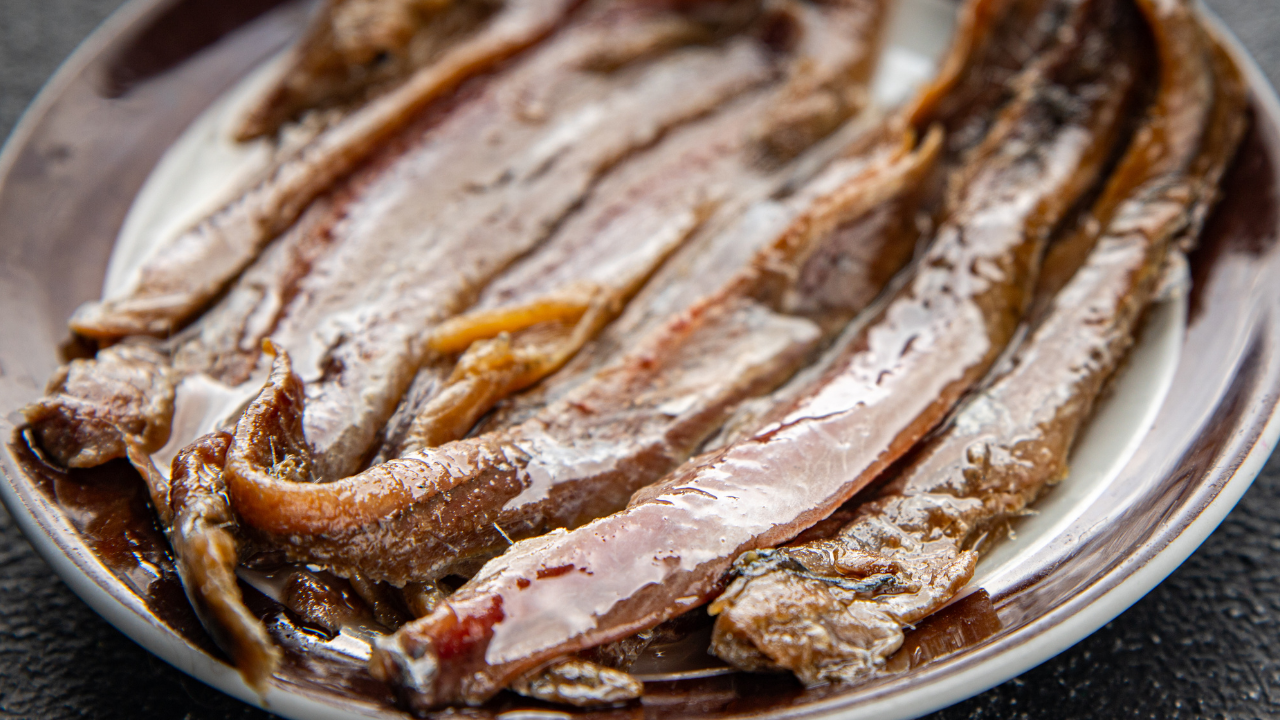
Anchovies are small, salt-cured fish used in small amounts to deepen flavor in savory cooking. Despite their strong reputation, they are not meant to make food taste fishy. Their role is structural. They function as background enhancers that strengthen other ingredients.
Home cooks often encounter anchovies in Caesar dressing, pasta sauces, puttanesca, and Mediterranean-style dishes. Many avoid them because they assume the flavor will dominate. In reality, anchovies are among the most effective ways to add savory complexity without imparting an obvious seafood flavor.
They become especially useful when a dish tastes flat but not under-seasoned. If adding more salt does not solve the problem, the issue may be depth, not seasoning. Anchovies provide that missing layer.
Understanding how anchovies work gives you another decision-making tool. Instead of relying only on salt, you gain a controlled way to build balance and richness.
What Anchovies Really Do in Cooking
Anchovies are small fish preserved by heavy salting and curing. This curing process is not simply for storage. It transforms the fish. Over time, natural enzymes break down proteins into smaller compounds, including glutamates. These compounds are responsible for savory intensity.
This transformation is the key. Fresh fish tastes clean and marine. Cured anchovies have a concentrated, salty, deeply savory flavor. The curing process shifts their role from protein to seasoning.
In cooking, anchovies function as a source of umami. Umami is the savory taste created by glutamates and certain nucleotides. It does not replace salt. It amplifies flavor perception. It makes tomatoes taste more tomato-like. It makes meat taste richer. It makes vegetables taste more grounded.
Anchovies are not:
- Meant to be eaten like fresh fish in most everyday cooking applications
- A dominant seafood flavor in sauces or dressings
- Interchangeable with regular salt
- Added for texture in most cases
Their primary function is to support structural flavor.
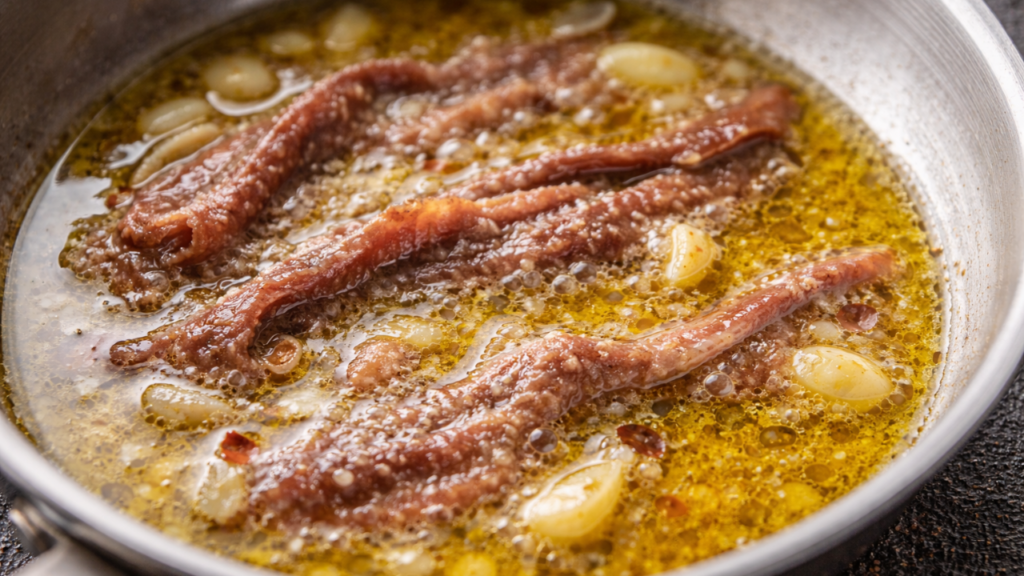
When used properly, anchovies melt into warm fat and fully integrate into a dish. Once integrated, they should not read as fish. They should read with depth.
Understanding this distinction removes hesitation. You are not adding seafood. You are building a savory foundation.
The Science Behind Their Flavor Power
Anchovies are powerful because of their concentration and chemistry.
During curing, moisture is reduced, and flavor compounds intensify. Glutamates become highly concentrated. These compounds interact with taste receptors on the tongue, increasing savory perception.
They also create synergy. When anchovies are combined with ingredients that naturally contain glutamates, such as tomatoes or aged cheese, the savory effect multiplies. The result is a dish that feels fuller and more complete without tasting heavier.
Fat plays a role as well. Anchovies are typically dissolved in oil or butter. Fat carries flavor evenly across the palate. This helps anchovies distribute their savory compounds without leaving isolated pockets of intensity.
For the cook, this matters because it explains predictability:
- Anchovies strengthen savory dishes.
- They work especially well with tomatoes, garlic, olives, capers, and aged cheeses.
- They integrate best when broken down and dispersed.
Once you understand the chemistry, their behavior becomes consistent rather than mysterious.
Why This Matters in Cooking
Anchovies influence flavor in specific and predictable ways. When you understand what they contribute, you gain more control over depth, balance, and overall structure in savory dishes.
Flavor Depth
Anchovies increase savory intensity without making food taste heavier. They create background richness that connects flavors.
They improve depth in specific situations:
• In tomato-based sauces, they reinforce natural glutamates and create a fuller, more developed taste.
• In vegetable sautés, especially greens and brassicas, they soften sharpness and reduce bitterness.
• In meat preparations, they strengthen savory character without changing the identity of the protein.
The dish tastes more complete, not more fishy.
Balance
Salt sharpens flavor. It amplifies what is present without adding complexity. Used aggressively, it can create a harsh or one-dimensional result.
Anchovies provide:
• Salt
• Savory compounds developed during curing
• Flavor depth rather than surface intensity
When a dish tastes seasoned but still lacks satisfaction, the issue is often a lack of structure. Anchovies address that gap more effectively than adding more salt.
Structure of Sauces
When anchovies dissolve into warm fat, they disappear visually and distribute evenly.
This creates:
• A unified flavor base
• Better integration of garlic, herbs, and aromatics
• Cohesion instead of separate flavor notes
You are not simply layering ingredients. You are building a foundation.
Confidence at the Stove
Many cooks hesitate because they associate anchovies with strong fish flavor. That hesitation limits a useful tool.
Understanding their role gives you:
• More precise seasoning decisions
• A solution for flat flavor
• Less risk of over-salting
If a dish tastes flat but not underseasoned, anchovies may be the missing layer.
How It’s Used in Real Recipes
Anchovies are used as a foundational ingredient across many cuisines. They are rarely the star. Instead, they quietly strengthen the structure of savory dishes.
In Italian Cooking
Anchovies are deeply integrated into everyday flavor building. You will see them in:
• Pasta alla puttanesca, where they deepen the tomato base and support olives and capers
• Bagna càuda, where they form the backbone of the sauce with garlic and olive oil
• Tomato sauces and sautéed greens, where they melt into the background and round out acidity or bitterness
In French Cooking
Anchovies often appear in composed dishes and condiments:
• Niçoise-style preparations, where they anchor bright vegetables and tuna with concentrated savory depth
• Tapenade, where they strengthen olive flavor and prevent flatness
In Classic American Applications
Anchovies are frequently present but rarely noticed:
• Caesar dressing, where they provide structure and backbone
• Worcestershire sauce, where they contribute to its layered fermented depth
Across Mediterranean Cooking
Anchovies appear in:
• Vegetable braises
• Olive-based spreads
• Savory pastry fillings
In these dishes, they bridge sharp, acidic, or briny ingredients into a unified flavor profile.
In most cases, the anchovy flavor is not obvious. It supports garlic, tomato, olive, caper, and herb flavors rather than competing with them. The dish tastes balanced and complete.
Recognition is the goal. When anchovies are listed in small quantities, they usually function as a flavor enhancer. Their presence signals depth and structure, not seafood dominance.
How to Apply It at Home
Focus on awareness and judgment rather than technique. Anchovies work best when you evaluate quality, integration, and flavor balance in real time.
| Briny, savory aroma | Proper curing and good quality | Use confidently |
| Sharp, aggressively fishy smell | Possible low quality or poor storage | Consider replacing |
| Soft, pliable texture | Will dissolve easily into fat | Expect smooth integration |
| Tough or dry texture | May not break down properly | Chop finely and allow more time to integrate |
| Dissolves completely in warm fat | Even distribution of flavor | Continue building the dish |
| Visible pieces remain | Incomplete integration | Allow more time in fat and stir thoroughly |
| The dish tastes fishy | Lacks savory depth | Add small amount for structure |
| Too much use or uneven blending | Add a small amount for structure | Balance with more base ingredients |
Anchovies should not stand out. When properly applied, they strengthen the entire dish without drawing attention to themselves.
Common Mistakes & Misconceptions
| Anchovies make food taste fishy | Fear based on smell from the jar | When properly integrated into warm fat, they dissolve and amplify other flavors rather than dominate |
| They are interchangeable with salt | Both are salty | Anchovies provide glutamates and savory complexity, not just sodium |
| You must taste anchovy flavor for them to work | Expectation of a strong identity | Their role is structural and supportive, not dominant |
| More is better for a stronger flavor | Misunderstanding of concentration | Small amounts are sufficient for depth |
| They can be added at the end like a garnish | Confusion about their function | They work best when integrated early into the flavor base |
| Anchovies ruin vegetarian dishes | Assumption that they overpower vegetables | When used correctly, they enhance vegetables without making them taste like fish |
Most problems come from either overuse or poor integration. Anchovies are concentrated. They are meant to disappear into the dish’s structure.
When used with restraint and intention, they increase balance rather than drawing attention.
Forms of Anchovies and When Their Flavor Should Stand Out
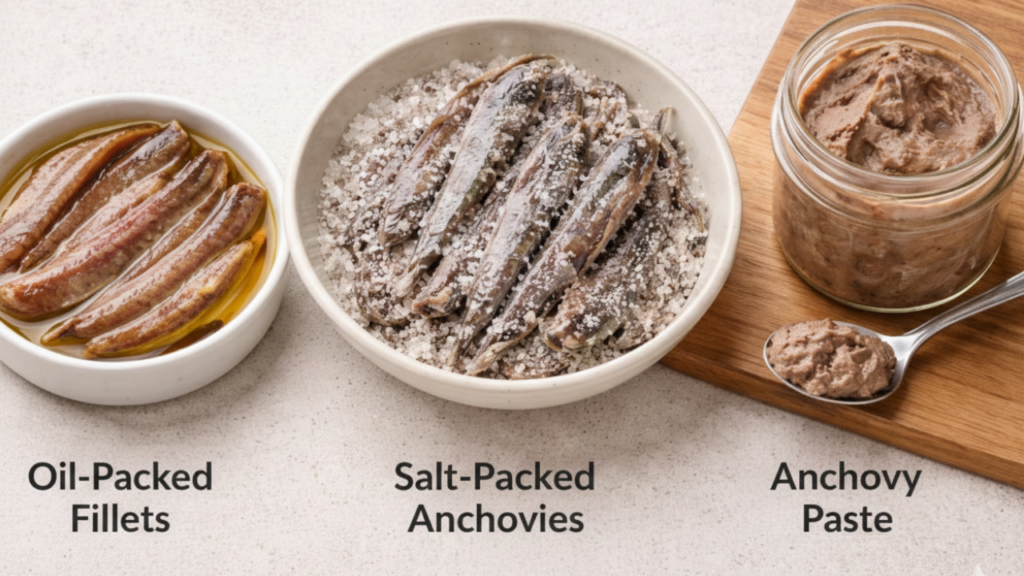
Anchovies are not all identical in strength or application. The form you choose influences both intensity and control.
| Form | Flavor Intensity | Best Use |
|---|---|---|
| Oil-packed fillets | Balanced and easy to control | Everyday cooking and sauce foundations |
| Salt packed whole anchovies | More concentrated and traditional | Rustic or assertive preparations |
| Anchovy paste | Convenient but often sharper | Oil-packed fillets |
- Oil-packed fillets are the most practical for home cooking. They dissolve smoothly and provide predictable depth.
- Salt-packed anchovies are firmer and more intense. They suit dishes where the anchovy character may be slightly more pronounced.
- Anchovy paste is convenient, but its flavor can be more direct and less nuanced. It works well when subtle control is less critical.
When Anchovies Are Meant to Be Noticeable
In most cooking, anchovies function as a background enhancer. However, some dishes intentionally highlight their presence.
Examples include:
- Bagna càuda
- Certain rustic pasta sauces
- Strong olive or caper-based preparations
In these dishes, anchovies shift from quiet support to flavor partner. Their identity is part of the dish rather than hidden within it.
The principle is not that anchovies must always be invisible. The principle is that their role must be deliberate. Whether subtle or assertive, their presence should align with the dish’s intent.
Quick Takeaways
- Anchovies are a concentrated source of savory depth, not fishiness.
- They enhance flavor structure rather than dominate it.
- Small amounts are powerful.
- If food tastes flat but salted, anchovies may add needed complexity.
- Use them with intention, not fear.
FAQs
Do anchovies taste fishy in finished dishes?
When used properly and integrated into warm fat, they dissolve and distribute evenly. In most savory dishes, they do not taste fishy. They enhance depth and roundness. If fishiness is noticeable, either too much was used, or the anchovies were not fully incorporated.
Can I skip anchovies in a recipe?
You can, but the dish may lack savory structure. Anchovies contribute glutamates, which enhance overall flavor perception. Alternatives such as miso, aged cheese, or soy-based seasonings provide similar savory compounds, but each changes the final flavor profile. Substitution alters character, not just intensity.
Are anchovy paste and fillets the same?
They serve similar functions, but they are not identical. Fillets often provide better texture and more nuanced flavor. Paste is convenient and integrates quickly, but it can taste sharper and slightly more direct. Choose based on the level of control and the subtlety you want.
How long do anchovies last once opened?
Oil-packed anchovies keep well when refrigerated and fully covered in oil in an airtight container. Exposure to air causes deterioration. If the aroma becomes harsh or unpleasant, the quality has declined.
Are anchovies necessary in vegetarian cooking?
That depends on intent. Anchovies are sometimes used to deepen the flavor of vegetable dishes without making them taste like fish. However, for strictly vegetarian cooking, plant-based sources of umami, such as mushrooms, miso, or aged cheeses, can provide a similar depth of flavor.
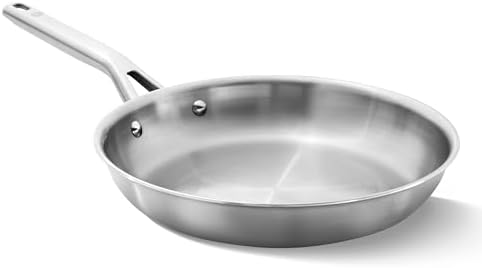
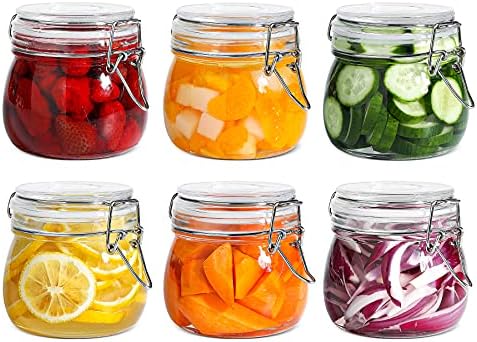
Tools That Support Proper Integration

Final Thoughts
Anchovies are not a gamble. They are a structural ingredient.
When you understand what they contribute, you stop treating them as a specialty item and start using them as part of your flavor foundation. They allow you to deepen sauces, balance vegetables, and correct flat flavor without over-salting.
Cooking improves when your adjustments are intentional. Anchovies offer another controlled way to add depth and cohesion to savory dishes.
Explore more Kitchen Know How articles to continue strengthening how you think about flavor and structure in everyday cooking.
1 thought on “Anchovies in Cooking: How to Use Them for Depth Without Fishy Flavor”
Comments are closed.