
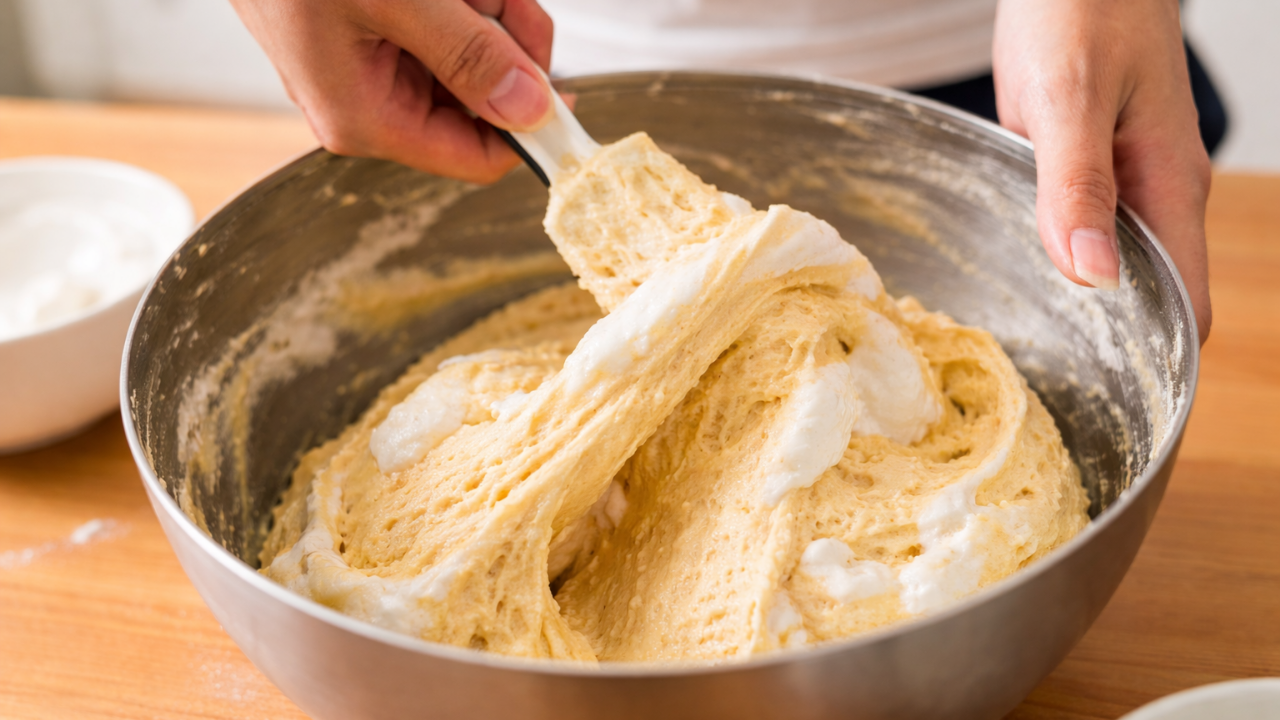
Recipes often use short instructions that describe specific kitchen techniques. One of the most common is the word fold. In baking, this instruction signals a specific way of combining ingredients that helps protect the structure of delicate mixtures.
Home cooks frequently encounter the term when working with sponge cakes, soufflés, mousse, whipped cream mixtures, and other light batters. These preparations rely on trapped air for lift and texture. The way ingredients are combined determines whether that structure remains intact or collapses.
Understanding what “fold” means helps cooks interpret recipes more accurately. When the technique is used correctly, batters stay light and stable. When it is misunderstood, the same mixture can quickly become dense, flat, or uneven. Learning the purpose behind the instruction makes baking more predictable and easier to control.
Folding Defined: The Principle Behind Gentle Incorporation
Folding is a controlled mixing technique used to combine ingredients while preserving the air already incorporated into a mixture. Instead of aggressively blending ingredients together, folding gently brings components together so the structure created by whipped eggs, beaten egg whites, or whipped cream remains intact.
In baking, air is often introduced intentionally during earlier steps. Whisking egg whites forms a foam. Whipping cream traps tiny air bubbles. Beating eggs and sugar can create volume. These air pockets act as natural leavening, helping batters rise and creating a light, tender texture. Folding protects that structure while allowing additional ingredients to be incorporated.
Folding differs from other mixing methods because it minimizes mechanical force.
Stirring moves ingredients around the bowl in a circular motion and quickly blends mixtures together.
Whisking introduces air through rapid agitation.
Beating applies a strong mixing force to fully combine ingredients and build structure.
Folding does the opposite. Instead of building air or aggressively mixing, it preserves what is already present. The movement is slow and deliberate. A spatula typically cuts down through the center of the mixture, sweeps across the bottom of the bowl, and gently turns the mixture over itself. This motion distributes ingredients without collapsing the foam or batter.
The foundational rule behind folding is simple: combine ingredients completely while disturbing the structure as little as possible. The goal is even incorporation, not speed. When done correctly, the mixture becomes uniform while remaining light, airy, and stable.
How Folding Protects Texture and Structure in Delicate Batters
Many baked goods depend on trapped air for their final texture. When egg whites, whipped cream, or aerated egg mixtures are prepared earlier in a recipe, thousands of tiny air bubbles become suspended inside the mixture. These bubbles expand during baking and help create lift. Folding protects those air pockets while additional ingredients are incorporated.
When the technique is applied correctly, the mixture keeps its volume. A sponge cake batter stays light and fluid instead of dense. Soufflé bases remain airy enough to rise in the oven. Mousses hold a stable foam that sets smoothly rather than separating. The final crumb becomes tender and open instead of tight and heavy.
Proper folding also improves consistency throughout the mixture. Dry ingredients, melted chocolate, or flavored bases become evenly distributed without flattening the foam that gives the batter its structure. The result is a batter that looks smooth and cohesive while still appearing light and slightly aerated.
Aggressive mixing changes this structure quickly. Stirring, whisking, or beating after foam has formed breaks the delicate air bubbles intentionally created earlier. As those bubbles collapse, the mixture loses volume. The batter becomes thinner and heavier, and the final baked product often turns dense or flat.
| Situation | Result in the Bowl | Final Texture Outcome |
| Gentle folding | Air pockets remain intact | Light, airy, stable structure |
| Even incorporation | Ingredients are distributed without collapsing | Smooth, consistent texture |
| Aggressive mixing | Air bubbles break down | Dense, heavy, or flat result |
| Overmixing | Volume is lost | Tight crumb, reduced lift |
This is why recipes call for folding at specific moments. By switching from stronger mixing methods to a gentler technique, the cook protects the structure already built in the bowl. The texture of the finished dessert depends on that restraint.
Where Folding Appears Across Baking and Pastry
Folding occurs when a light, aerated mixture is combined with heavier ingredients. Recognizing these situations helps cooks understand when to switch from active mixing to a gentler technique that protects structure.
Common Baking Applications
- Sponge cakes, where whipped eggs provide the primary structure
- Chiffon cakes that combine whipped egg whites with a richer batter base
- Soufflés, where egg whites are folded into a flavored base to create lift
Pastry and Dessert Preparations
- Chocolate and fruit mousses that rely on folded whipped cream or egg whites
- Whipped cream mixtures used for fillings, toppings, and layered desserts
- Custard-based desserts that are lightened with aerated components
What These Applications Have in Common
- A foam or aerated mixture is prepared first
- A heavier ingredient or base is added afterward
- Folding is used to combine them without collapsing the structure
Although these dishes come from different baking and pastry traditions, they follow the same structural principle. Folding connects them by allowing full incorporation while preserving the air that gives each preparation its light texture and proper rise.
Recognizing When and How to Fold in Your Own Kitchen
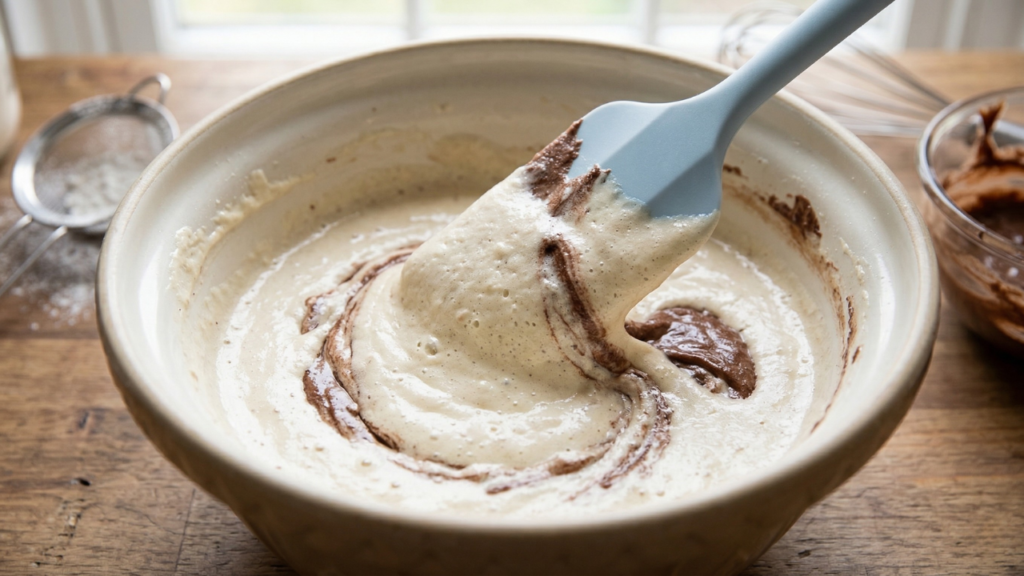
Folding is usually introduced at the point where a light, aerated mixture must be combined with heavier ingredients. This often follows steps in which egg whites, whipped cream, or eggs are whipped to create volume. Recognizing that moment helps you shift from active mixing to a more controlled, gentle approach that protects the structure already built.
Visual Cues to Watch For
- Visible streaks or layers at the start, showing that the ingredients are not yet combined
- Gradual disappearance of streaks as folding continues
- Mixture remains light, slightly airy, and not compacted
Signals That Folding Is Complete
- No visible streaks of flour, foam, or base remain
- Texture looks smooth and evenly combined
- Volume is mostly preserved, and the mixture has not collapsed
Tool and Movement Awareness
- Use a flexible spatula to lift and turn the mixture rather than pressing through it
- Rotate the bowl as you fold to distribute ingredients evenly
- Keep movements slow and controlled to avoid breaking air pockets
Folding is complete when the mixture is uniform but still light and aerated. Stopping at this point helps preserve the structure that gives the final result its proper texture.
When Folding Goes Wrong and How to Correct It
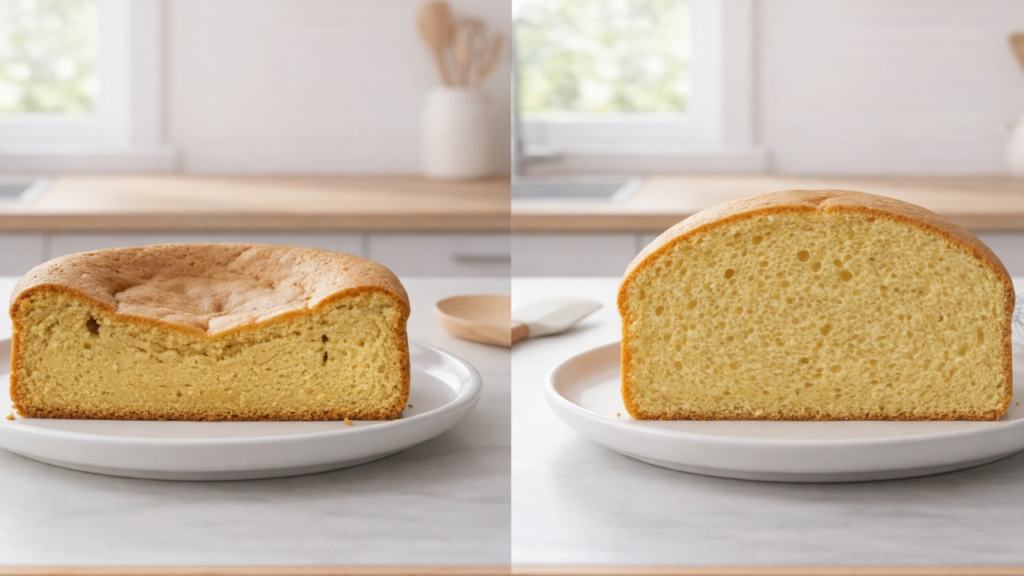
Folding is designed to protect the structure, but small changes in speed or pressure can quickly affect the result. Most issues stem from applying too much force or combining ingredients too quickly.
Overmixing
- Continued folding after ingredients are already combined
- Breaks down air pockets created during whipping
- Results in a dense, heavy batter with reduced rise
Rushing Incorporation
- Adding ingredients too quickly or all at once
- Leads to uneven mixing and visible streaks
- Often causes cooks to switch to stirring or whisking, which collapses the structure
Applying Too Much Force
- Pressing down with the spatula instead of lifting and turning
- Compresses delicate air bubbles in the mixture
- Causes the batter or foam to lose volume quickly
How to Correct These Issues
- Slow down and allow ingredients to incorporate gradually
- Rotate the bowl to distribute movement evenly
- Stop folding as soon as the mixture looks uniform and still airy
Seeing the Technique Clearly: Folding Compared to Other Mixing Methods
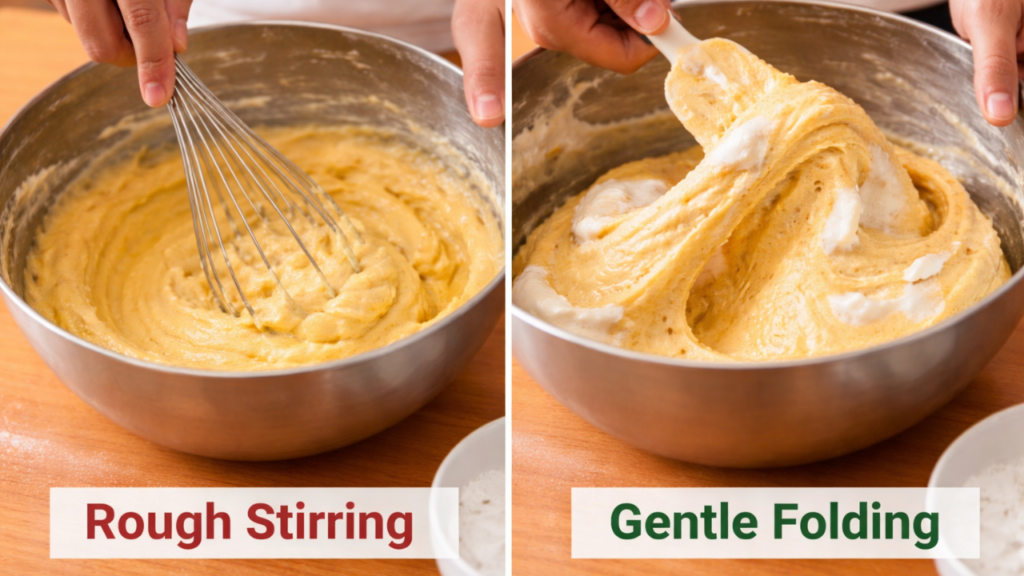
Understanding folding becomes easier when compared with other common kitchen mixing techniques. Each method moves ingredients differently and affects the structure of a mixture in specific ways. Recognizing those differences helps cooks understand why folding is used at particular moments in baking.
Stirring is one of the simplest mixing methods. A spoon or spatula moves ingredients in a circular motion until they combine. The goal is uniform distribution rather than preserving structure. Stirring works well for soups, sauces, and batters where air retention is not critical. Because the motion is continuous and repetitive, it tends to flatten delicate foams if used after whipping.
Whisking is designed to introduce air into a mixture. Rapid whisking traps air bubbles and suspends them in liquid ingredients such as eggs or cream. This technique builds volume and lightness. Whisking is often used early in a recipe to create a foam or aerated base.
Beating applies a stronger mechanical force. Whether done with a whisk, spoon, or electric mixer, beating aggressively combines ingredients while building structure. It is commonly used when creaming butter and sugar or fully blending ingredients into a uniform mixture. The motion is vigorous and intentionally disruptive.
Folding serves a different purpose. Instead of building air, like whisking or aggressively combining ingredients (beating), folding is used after air has already been incorporated. The technique protects the fragile structure created earlier while allowing additional ingredients to be added. The movement is slower and more controlled, so the foam or batter keeps its volume.
| Method | Primary Action | Effect on Air | When to Use |
| Stirring | Circular mixing | Minimal effect | General combining |
| Whisking | Rapid agitation | Adds air | Building foam or volume |
| Beating | Forceful mixing | Can add or remove air | Fully combining or structuring |
| Folding | Gentle lifting | Preserves air | Combining delicate mixtures |
This comparison helps clarify when folding is appropriate. If the goal is to create air, whisking or beating is used. If the goal is to combine ingredients quickly, stirring may be sufficient. But when a mixture already contains delicate air bubbles that must remain intact, folding becomes the correct technique.
Situations Where Gentle Folding Adjustments Are Needed
The core principle of folding remains the same across recipes. Ingredients should be incorporated while preserving as much air and structure as possible. However, certain mixtures require small adjustments to the technique so the ingredients combine evenly without collapsing the foam.
One situation occurs when a light foam must be combined with a thicker base. For example, whipped egg whites may be folded into a dense batter or custard mixture. If the foam is added all at once, the difference in texture can make folding difficult and uneven. In these cases, cooks often mix a small portion of the foam into the base first. This initial blending slightly lightens the heavier mixture, making the remaining folding easier and gentler.
Another adjustment appears when dense ingredients are added to an already aerated batter. Items such as chocolate chips, chopped nuts, dried fruit, or cocoa powder introduce weight and resistance to the mixture. If they are folded too aggressively, they can drag through the batter and break down the air structure. The solution is to incorporate these ingredients gradually and allow the spatula to lift and turn the mixture rather than pressing through it.
Ingredient distribution also affects how folding is approached. When dry ingredients such as flour or cocoa are involved, they should be added in stages rather than all at once. Smaller additions allow the cook to incorporate each portion gently before adding more, reducing the need for excessive mixing.
These adjustments do not change the underlying goal of folding. The technique still prioritizes controlled incorporation with minimal disruption to the mixture’s structure. Adapting the approach simply helps manage differences in density, texture, and ingredient weight so the batter remains light and stable.
Quick Takeaways: The Essential Idea Behind Folding
- Folding gently combines ingredients while preserving trapped air
- The technique protects the light structure created during whipping
- Stirring or beating at this stage can collapse the mixture
- Folding is complete when ingredients are evenly combined, but the mixture still looks airy
- Patience and gentle movement matter more than speed
Frequently Asked Questions About Folding
Why do baking recipes specify folding instead of mixing?
Folding is used when a mixture already contains air that must be preserved. Gentle incorporation keeps the foam or batter light, which helps baked goods rise and maintain a tender texture.
What tool works best for folding batter?
A flexible silicone spatula is most commonly used because it can move smoothly along the bottom and sides of the bowl. This allows ingredients to be lifted and turned without applying excessive pressure that could collapse the mixture.
How do you know when folding is finished?
Folding is complete when the ingredients are evenly distributed, and no visible streaks remain. The mixture should still look light and slightly aerated rather than dense or flattened.
Can you fold with a whisk instead of a spatula?
A whisk can be used to incorporate light ingredients into a loose mixture. However, a spatula usually provides better control and reduces the risk of breaking the foam.
Why are ingredients sometimes folded in stages?
Adding ingredients gradually helps maintain the mixture’s structure and prevents heavy components from sinking. Smaller additions also make it easier to combine ingredients evenly without excessive mixing.
What happens if you fold too much?
Excess folding presses out the air that was created during earlier whipping steps. When those air bubbles collapse, the batter loses volume, and the finished product becomes denser.
Kitchen Tools That Help You Fold Ingredients Gently


Folding relies on controlled, gentle movement, so the tools you choose should support that approach. The right equipment makes it easier to incorporate ingredients evenly while preserving the air and structure already built into the mixture.
Flexible silicone spatula: Allows the cook to sweep along the bottom and sides of the bowl while lifting the mixture over itself. The flexibility helps incorporate ingredients without pressing down on the foam, which can cause it to collapse.
Wide mixing bowl: Provides enough surface area for ingredients to turn and move during folding. A larger bowl reduces crowding, making it easier to rotate the mixture gently while maintaining volume.
Balloon whisk for preparing foams: Often used earlier in the process to create whipped egg whites or whipped cream before folding begins. A stable, well-whipped foam makes folding easier and helps maintain structure during incorporation.
Understanding Folding Helps Protect Light, Airy Baking Results
Folding is a technique that protects the structure created earlier in the mixing process. When air is built into egg whites, cream, or batter, that structure becomes part of how the final dish rises and sets. Folding allows you to combine ingredients without removing what gives the mixture its lightness.
The difference between folding and mixing is not just movement. It is control. Gentle incorporation keeps the batter stable, while aggressive mixing can quickly collapse it. Small changes in how you handle the mixture lead to clear differences in texture and consistency.
When you understand what folding does, recipes become easier to follow. The instruction is no longer vague. It becomes a clear signal to slow down and protect the structure already in the bowl. This awareness helps you avoid dense results and produce more consistent outcomes.
Explore more Kitchen Know How articles to build confidence with essential techniques and improve your results in the kitchen.